What maintenance does a water heater need each year?
A tank water heater needs a yearly flush to clear sediment, more often with hard water, a yearly check of the temperature and pressure relief valve and of the anode rod, and a look for leaks and corrosion. Gas models also need the burner and venting inspected. Keep the thermostat at about 120°F. Your manual sets the schedule, and a licensed plumber can do it all in one visit.
Free to ask. Local shops send quotes, and you pay only when you book one.
By Kasra Taheri, Founder, LoclisPublished
Researched and drafted with AI, then checked claim by claim against the sources listed below before it was published. Prices and rules change; the dates beside each source say when it was last checked.
This is a job for a licensed pro in Virginia
This page explains what the work involves, the permits, what a licensed pro does and what drives the cost. It does not give step-by-step instructions, because this work needs a licence, a permit or both, and doing it wrong can injure someone. Before you hire, check the licence on Virginia's DPOR record.
A tank water heater needs four things each year: a flush to clear sediment, a check of the temperature and pressure (T&P) relief valve, an anode rod inspection, and a look over the tank and connections for leaks and corrosion. Gas heaters add a burner and vent inspection, heat pump models an air filter, and tankless models descaling. A. O. Smith sums up the routine: "Typical maintenance tasks include annual flushing to remove sediment, checking and replacing the anode rod and testing the T&P valve."[2]
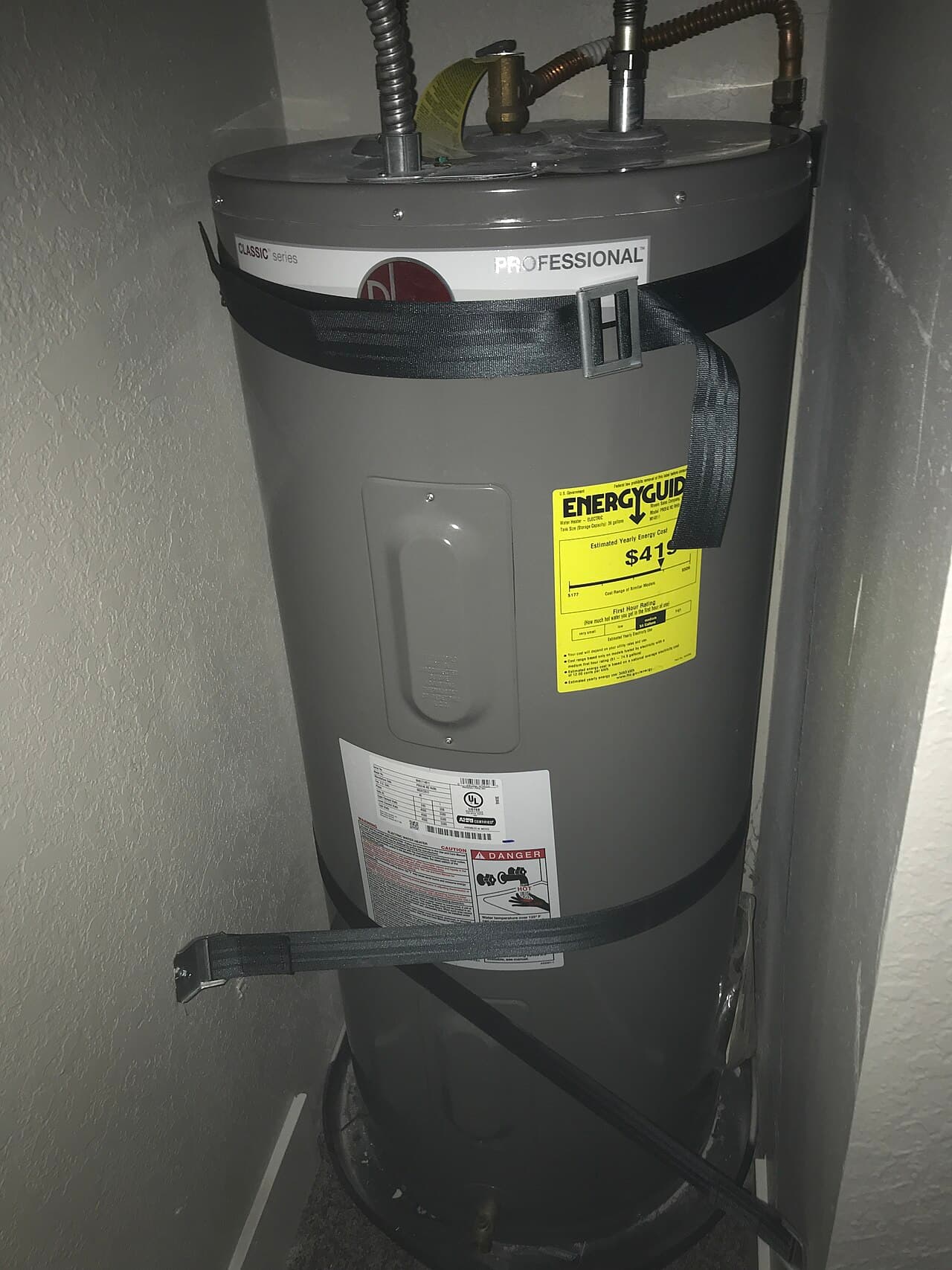
It pays off. "Tune-ups also help keep your energy costs in check, keep your warranty valid and prolong the life of your system."[2] Your owner's manual sets the exact schedule for your model and comes first.
The yearly flush
"Most types of tank water heaters require flushing at least once per year."[1] Hard water can mean flushing more often, because the extra minerals in hard water raise the chance of sediment building up in the tank.[1]
Sediment costs money even before it causes trouble. The Department of Energy's Building America guide explains: "Sediment can collect in your water heater tank over time, potentially causing mineral deposits on the heating element, reducing its effectiveness in transferring heat to the water."[5] On a gas heater the same layer sits between the flame and the water, which is where popping noises come from; see why a water heater pops.
A flush is where most maintenance problems show up. A. O. Smith notes that sediment can block the drain valve so the tank will not empty.[1] On an electric heater, refilling matters as much as draining: "If there is not enough hot water around the heating element, it will burn out".[1] These are good reasons to have a licensed plumber do it, especially the first time. Our flushing answer covers frequency in more detail.
The relief valve check
The T&P valve is the heater's last line of defence. "In the event the tank is over-pressurized, the relief valve opens and releases the pressure. If the valve doesn't operate correctly, the tank can over-pressurize and explode."[1] A. O. Smith says the T&P valve should be inspected once a year by the owner and every 5 years by a professional,[1] following the instructions on the valve's label. A. O. Smith warns that if you touch the valve while the heater is running, scalding water can shoot out,[3] so it is reasonable to leave this to the technician at the yearly visit.
A valve that drips is telling you something about the house's plumbing. "T&P relief valves will drip if the water pressure is too high or due to thermal expansion on a closed plumbing system."[1] Ask the plumber to check pressure and the expansion tank rather than only swapping the valve.
The anode rod
The anode is the metal rod that corrodes in place of the tank's steel. "How long an anode rod will last depends on what chemicals are in the water, how much hot water is used, and whether or not a water softener is installed."[1] A. O. Smith's advice: "To extend the life of your water heater, we recommend inspecting the anode rod once a year."[1]
When a technician pulls it, A. O. Smith's guide says a healthy rod is smooth and about half an inch thick.[1] A rod with several inches of bare core wire showing is due for replacement.[1]
Extra items for gas, heat pump and tankless heaters
- Gas tanks. "The burner should be inspected and cleaned of any debris once a year."[3] A. O. Smith adds that a gas heater needs periodic inspection and servicing, and that this work is best left to professionals.[4] The technician also checks the flame and the vent.
- Heat pump models. ENERGY STAR notes: "HPWHs may also require annual maintenance, including changing air filters."[7]
- Tankless models. "Tankless water heaters don't require flushing because they do not have a tank; however, many tankless water heaters require descaling."[1]
What you can keep an eye on yourself
Some checks need no tools. Look around the base and fittings every month or so for damp, rust or water in the pan, and keep the space around the heater clear. Check the hot water temperature at a tap: "Hold a candy or meat thermometer under the faucet to check water temperature."[6]
The target is 120°F. "The U.S. Consumer Product Safety Commission (CPSC) urges all users to lower their water heaters to 120 degrees Fahrenheit."[6] Hotter water scalds fast: "Burns will also occur with a six-second exposure to 140 degree water or with a thirty second exposure to 130 degree water."[6] Ask the plumber to set it at the yearly visit if yours runs hotter.
If you are on a private well or see heavy scale, test your water. Virginia Cooperative Extension says a qualified laboratory can analyze your water for hardness, and that levels below 7.0 grains per gallon or 120 mg/L generally do not require treatment.[8] Its advice for heaters: "If scale forming in your water heater is an issue, consider softening only water that is to be heated."[8]
When to call a licensed pro
Book a yearly service if you have not had one, and A. O. Smith's broader advice is: "Have a licensed plumber look at your water heater every couple of years to catch small problems before they turn into expensive ones."[3] Call sooner for a dripping relief valve, rusty hot water, new popping noises, water in the pan, or a heater that runs out of hot water faster than it used to. If you smell gas, do not wait for a service visit. Columbia Gas of Virginia tells its customers to "go outside and call 911 and then call us at 1-800-544-5606 (24/7)."[9] If another company supplies your gas, use its emergency number.
Service inside the heater is licensed work in Virginia. Under the Code, no individual may work as a tradesman without a licence, and the Code's definition of a tradesman covers electrical, plumbing and heating, ventilation and air conditioning work done for the public for pay.[10][11] Check any business on DPOR's License Lookup[12] before it starts.
Booking a service in Virginia
Loclis lists DPOR-licensed businesses with their licence number and class. Find plumbers in Blacksburg, browse water heater repair, or read more plumbing repair answers. If something has already gone wrong, see why a water heater leaks.
Ask for a water heater service and licensed local businesses quote the visit.
Common questions
- How often should a water heater be serviced?
- A. O. Smith recommends flushing a tank at least once a year, checking the relief valve and anode rod yearly, and having a licensed plumber look at the heater every couple of years. Gas models also need the burner inspected each year. Your manual's schedule comes first.
- What happens if I never flush my water heater?
- Sediment builds up on the bottom of the tank and on electric elements, which cuts efficiency and can cause popping noises, overheating and, over time, leaks. Heavy sediment can also clog the drain valve, which makes a late first flush harder.
- Do tankless water heaters need yearly maintenance?
- They have no tank to flush, but A. O. Smith says many tankless models need descaling, and how often depends on the model and your water. The manual gives the interval.
- What temperature should my water heater be set to?
- The U.S. Consumer Product Safety Commission urges setting water heaters to 120°F to prevent scalds, and A. O. Smith presets its heaters there. You can check the temperature at a tap with a cooking thermometer.
- Does skipping maintenance void the warranty?
- It can affect it. A. O. Smith says following the manufacturer's maintenance schedule helps keep the warranty valid. Read your warranty and keep receipts for each service visit.
- Should I soften my water to protect the water heater?
- Only if your water is hard enough to cause trouble. Virginia Cooperative Extension says hardness below 7.0 grains per gallon generally needs no treatment, and suggests softening only the heated water if scale in the heater is the problem. A certified lab test tells you where you stand.
Sources
- [1] Water Heater Maintenance, A. O. Smith. Checked October 26, 2026.
- [2] How to Diagnose, Fix, and Prevent Water Heater Leaks, A. O. Smith. Checked October 26, 2026.
- [3] Is Your Hot Water Not Getting Hot? Common Causes & What To Do About Them, A. O. Smith. Checked October 26, 2026.
- [4] How to Adjust Temperature on Gas Water Heater Safely, A. O. Smith. Checked October 26, 2026.
- [5] Flush Water Heater Tank, Building America Solution Center, Pacific Northwest National Laboratory (U.S. Department of Energy). Checked October 26, 2026.
- [6] Avoiding Tap Water Scalds (CPSC document 5098), U.S. Consumer Product Safety Commission. Checked October 26, 2026.
- [7] Heat Pump Water Heaters, ENERGY STAR, U.S. Environmental Protection Agency. Checked October 26, 2026.
- [8] Virginia Household Water Quality Program: Hardness in Household Water (publication 442-664), Virginia Cooperative Extension, Virginia Tech. Checked October 26, 2026.
- [9] Natural Gas Safety, Columbia Gas of Virginia. Checked October 26, 2026.
- [10] Va. Code § 54.1-1129, Necessity for licensure, Code of Virginia, Virginia General Assembly. Checked October 26, 2026.
- [11] Va. Code § 54.1-1128, Definitions, Code of Virginia, Virginia General Assembly. Checked October 26, 2026.
- [12] License Lookup, Virginia Department of Professional and Occupational Regulation. Checked October 26, 2026.
Want a pro to handle it?
Describe the job once. Licensed local businesses send quotes, and you pay only when you book one.
Get a quote for Plumbing Repair