What does a pool inspection check?
A pool inspection checks the safety barrier (height, gaps, self-closing and self-latching gate), the drain covers and circulation piping, the electrical items such as lights and bonding, the pump, filter and heater, and the deck and shell. A Virginia home inspection report is not required to cover a pool, so ask for it separately.
Free to ask. Local shops send quotes, and you pay only when you book one.
By Kasra Taheri, Founder, LoclisPublished
Researched and drafted with AI, then checked claim by claim against the sources listed below before it was published. Prices and rules change; the dates beside each source say when it was last checked.
Step by step
Read when to stop and call a pro, further down this page, before you start.
Step 1: Measure the barrier height
Measure from the ground to the top of the barrier on the side facing away from the pool; Roanoke County requires at least 48 inches.[1]
Step 2: Check the gap at the bottom
Look under the fence: Roanoke County allows no more than 2 inches over grass, mulch or gravel, and 4 inches over concrete.[1]
Step 3: Look for openings and footholds
Check that no opening is big enough for a 4-inch sphere to pass, which is Roanoke County's limit, and that nothing on the fence works as a ladder.[1]
Step 4: Test the gate
Open the gate from outside; it should swing away from the pool, close by itself and latch by itself.[1]
Step 5: Clear the climbing zone
Roanoke County requires a clear zone of 36 inches around the barrier, so move anything a child could climb within it, and note pump, filter or heater equipment that cannot move.[1]
Step 6: Check doors and windows to the pool
If a wall of the house is part of the barrier, look for working alarms on doors and low windows that open to the pool, or a powered cover.[1]
Step 7: Read the drain cover labels
Roanoke County requires drain covers to be listed, labeled and dated, so look at them from the deck for a label and date; do not remove them.[1]
Step 8: Check the rope, float and deck
Roanoke County also requires a rope and float at the first slope break and slip-resistant walking surfaces, so look for both.[1]
Step 9: Note anything electrical or mechanical
List lights, cords, the heater and pump with photos for a licensed pro, without opening or testing them.
The short answer
A pool inspection looks at the safety barrier around the water, the drains and circulation piping, the electrical safety items such as lights and bonding, and the working parts: pump, filter, heater, deck and pool shell. It is a different job from a home inspection. The list of what a Virginia home inspection report must cover names the structure, roof, exterior walkways and patios, interior, plumbing, electrical, heating and air conditioning, but not a swimming pool.[4] If a house has a pool, ask for the pool to be inspected on purpose.
The safety barrier
Most of a safety-focused pool inspection is about keeping children away from the water, and it is the part you can see for yourself. The numbers below are from Roanoke County, which publishes its pool requirements with reference to the International Swimming Pool and Spa Code. Other Virginia localities publish their own, so confirm yours with your building department.
Roanoke County's published pool requirements say all pools, spas and hot tubs must have a code-compliant barrier under the International Swimming Pool and Spa Code.[1] Against those rules, the barrier items to check are:
- Height. The top of the barrier must be at least 48 inches above grade, measured on the side facing away from the pool.[1]
- Gap at the bottom. There can be no more than 2 inches between the ground and the bottom of the barrier over grass, mulch or gravel, and 4 inches over a solid surface such as concrete.[1]
- Openings. Openings in the barrier must not allow a 4-inch sphere to pass.[1] A fence of vertical and horizontal members also has a limit on rail spacing: a spacing of no more than 1¾ inches between vertical members where the horizontal rails are less than 45 inches apart.[1]
- Gates. Pedestrian gates must open outward, away from the pool, and be self-closing with a self-latching device.[1] Where the latch release is less than 54 inches from the ground, it must sit on the pool side of the gate at least 3 inches below the top, with no opening larger than ½ inch within 18 inches of it.[1]
- Climbing aids. There must be a clear zone of at least 36 inches around the outside of the barrier and around permanent structures or equipment, such as pumps, filters and heaters, that could be used to climb it.[1]
- The house as a barrier. When a wall of the house forms part of the barrier, Roanoke County requires a powered safety cover, or alarms on doors and operable windows with a sill height under 48 inches that open to the pool, or an approved equivalent.[1]
- Above-ground pools. An above-ground pool's ladder or steps must be able to be secured, locked or removed, or be surrounded by a code-compliant barrier.[1]
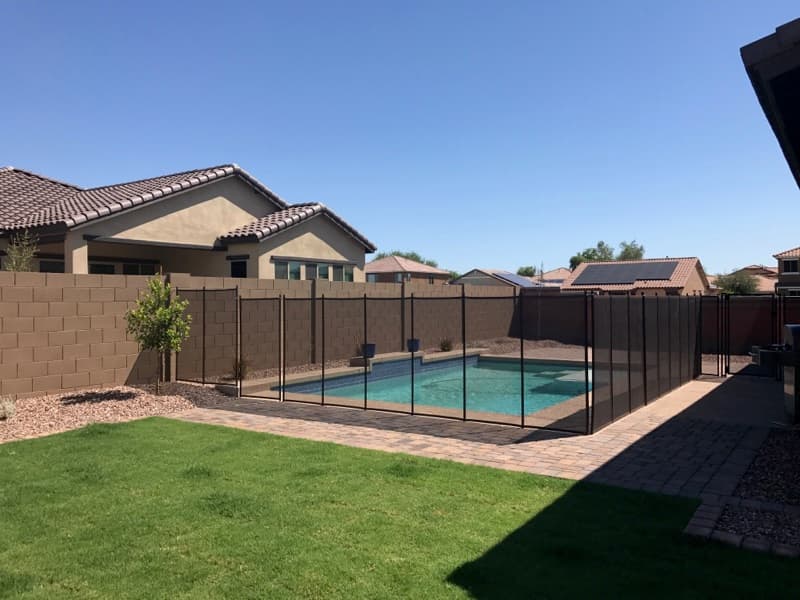
The federal Consumer Product Safety Commission gives the same advice in plainer terms: CPSC's barrier guidelines call for a barrier at least 4 feet high, with door alarms and self-closing, self-latching doors where the house is one side of the barrier.[3]
Drains, rails and surfaces
Beyond the fence, the same Roanoke County document lists items to look for at the water. Drain covers must be listed, labeled and dated under the APSP-7 standard for suction entrapment avoidance, and circulation piping and fittings must be installed to avoid suction entrapment.[1] The pool needs a rope and float at the first slope break, slip-resistant walking surfaces around the pool, and pools deeper than 42 inches must have handholds.[1]
Electrical, heater and permits
Permits are worth checking too. A pool that has lighting, circulation equipment or receptacle outlets needs an electrical permit, a field-installed heater needs a mechanical permit and a fuel-fired heater needs a gas permit.[1] The county also lists a pool bonding inspection and a final electrical inspection among the typical inspections for a pool or hot tub.[2] A missing permit or final inspection is a finding worth raising before you buy, and you can ask the locality's building department for the file.
How to look at a pool yourself
A walk-through will not replace a licensed inspection of the electrical and equipment, but it will show you the obvious barrier problems in ten minutes. Work through the numbered steps on this page, then note what you find.
Write down each problem with a photo. Do not try to fix a drain cover, a light or a heater yourself: those need a pool contractor or a licensed electrician or gas fitter.
Stop and call a pro if
- A drain cover is cracked, missing, loose or has no date or label.
- A pool light, junction box or cord looks damaged, or anyone feels a tingle in the water.
- A gas pool heater smells of gas or shows scorching.
- The gate will not self-latch, or the barrier has an opening you cannot close with a simple, non-structural fix.
- The deck is cracked, lifting or sinking near the pool.
Virginia's contractor regulations define swimming pool construction contracting as the construction, repair, improvement or removal of in-ground swimming pools, and say no trade-related plumbing, electrical, backflow or HVAC work is included in that specialty.[5] So a pool contractor, an electrician and a gas fitter may all be involved.
To see what an inspection costs, read how much a pool inspection costs in Virginia. If you are buying, see whether to get the pool inspected before buying a house. For the house itself, what a home inspection costs is a separate quote. You can also browse inspection answers and inspection services.
Ready for a pool inspection? Describe the pool once and local inspectors can quote it.
Common questions
- Does a standard home inspection include the pool?
- Usually not on its own. The list of what a Virginia home inspection report must cover names the structure, roof, exterior walkways and patios, interior, plumbing, electrical, heating and air conditioning, but not a swimming pool. Ask for the pool to be written into the scope or hire a separate pool inspector.
- What is the most important safety item?
- The barrier. In Roanoke County's published requirements it must be at least 48 inches high, have no opening a 4-inch sphere can pass, and have a gate that opens outward and is self-closing and self-latching. Check your own locality's rules.
- Do pool drains get inspected?
- They can be. Roanoke County's requirements say drain covers must be listed, labeled and dated under the APSP-7 standard for suction entrapment avoidance. Ask the inspector to note the label and date.
- Does a pool need a permit in Virginia?
- In Roanoke County, a pool with lighting, circulation equipment or receptacle outlets needs an electrical permit, in addition to any building permit. Permit rules are set locally, so ask your building department.
- Can I inspect the pool myself before hiring someone?
- You can check the barrier, gate and surfaces yourself and take notes. Leave drains, lights, wiring, gas heaters and the shell to licensed pros.
Sources
- [1] Residential Pools, Spas, & Hot Tubs Barrier & Safety Requirements, Roanoke County Office of Building Safety. Checked October 27, 2026.
- [2] Residential: Installing a Swimming Pool or Hot Tub, Roanoke County, Virginia, Building Safety. Checked October 27, 2026.
- [3] Safety Barrier Guidelines for Residential Pools (Publication 362), U.S. Consumer Product Safety Commission. Checked October 27, 2026.
- [4] 18VAC15-40-130, Home inspection report, Virginia Administrative Code, Virginia General Assembly. Checked October 27, 2026.
- [5] 18VAC50-22-30, Definitions of specialty services (Board for Contractors Regulations), Virginia Administrative Code, Virginia General Assembly. Checked October 27, 2026.
Want a pro to handle it?
Describe the job once. Licensed local businesses send quotes, and you pay only when you book one.
Get a quote from a local pro