What does replacing a furnace blower motor involve?
It starts with a diagnosis, because a bad capacitor, a clogged filter or a control fault can look like a dead motor. If the motor has failed, a licensed HVAC technician cuts the power, takes the blower assembly out, fits a motor matched to the furnace, rewires it and runs a full heating cycle. A straightforward job takes one to two hours.
Free to ask. Local shops send quotes, and you pay only when you book one.
By Kasra Taheri, Founder, LoclisPublished
Researched and drafted with AI, then checked claim by claim against the sources listed below before it was published. Prices and rules change; the dates beside each source say when it was last checked.
This is a job for a licensed pro in Virginia
This page explains what the work involves, the permits, what a licensed pro does and what drives the cost. It does not give step-by-step instructions, because this work needs a licence, a permit or both, and doing it wrong can injure someone. Before you hire, check the licence on Virginia's DPOR record.
Replacing a furnace blower motor is a short job for a licensed HVAC technician once the motor is confirmed as the problem: the power goes off, the blower assembly comes out, a motor matched to the furnace goes in, and a full heating cycle proves it works. Carrier's summary of who should do it: "Repairing or replacing a furnace blower motor is a complex task involving high-voltage electrical wiring and is generally best left to a professional HVAC technician to ensure safety and reliable performance."[1] Here is what to expect, from the diagnosis to the test run.
First, a diagnosis
A blower that will not run, or runs weakly or noisily, does not always need a new motor. Bryant lists the signs that call for an inspection, including weak airflow from your vents, unusual noises such as screeching or banging, higher-than-expected energy use, or a system that frequently overheats and shuts down.[2] Then it adds the caution that matters for your bill: "These symptoms can indicate a blower motor problem, airflow restriction, or another HVAC issue, so a professional diagnosis is important before replacing the motor."[2]
Carrier describes the same visit: "A Carrier dealer will inspect the motor for wear, test electrical connections, and check for airflow obstructions. If necessary, they will clean, lubricate, or replace the motor to restore optimal performance."[1]
The most common lookalike is the capacitor on older motors. "A humming motor that won't start often indicates a failed capacitor."[1] A capacitor is a smaller, cheaper part, so ask what was tested before you approve a motor. See why a blower motor hums but does not spin.
What the technician does
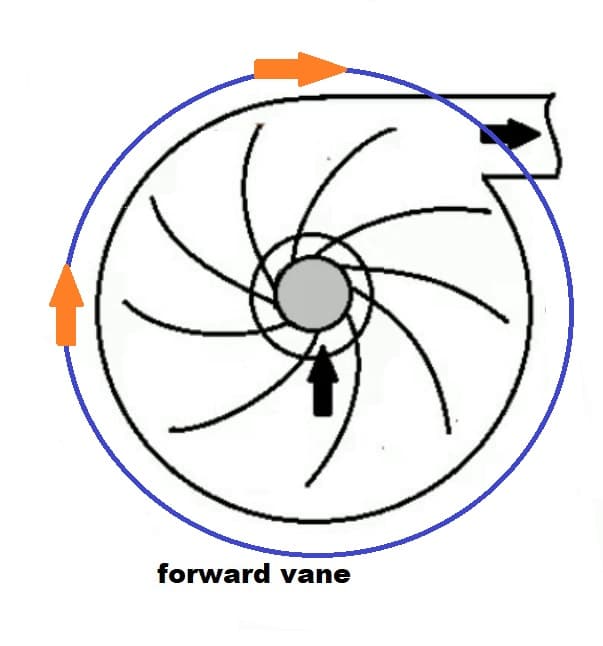
The blower is a fan wheel in a curved housing, like the one drawn below, with the motor mounted inside or beside the wheel. Replacing the motor means getting that assembly out of the furnace.
Carrier describes the replacement as a set sequence: power off at the breaker and the furnace's power switch, the blower compartment panel removed, the wires labelled and disconnected from the motor and capacitor, the blower housing unbolted and slid out, the old motor separated from the housing and blower wheel, the new motor secured, the wires reconnected to the correct terminals and the assembly reinstalled.[1] Then the check that tells you the job is done: "Power is restored, and the technician runs a heating cycle to confirm smooth, quiet operation and optimal airflow."[1]
On time, Bryant says: "Most replacements take 1 to 2 hours for a straightforward job, though more complex systems may take longer."[2] A furnace in a tight closet, an attic or a crawl space takes longer than one in an open basement, and a motor that has to be ordered means a second visit.
While the assembly is out, a good technician also looks at the wheel and the compartment. Dust caked on the wheel makes any motor work harder.
Choosing the replacement motor
It has to match the furnace. Carrier: "Components such as blower motors, igniters, control boards, and heat exchangers are selected for specific furnace models and should be matched to the equipment's requirements."[3] The technician works from the model and serial numbers on the furnace's rating plate.
Original or aftermarket. Carrier's view: "Choosing an OEM (Original Equipment Manufacturer) part ensures compatibility and reliability. While sometimes higher in upfront cost, OEM parts often come with better warranty protection."[1] Ask which you are getting, and what warranty comes with it.
Same type, or an upgrade. Bryant's list of blower designs: "Common designs include fixed-speed PSC motors, multi-speed ECM motors, constant-torque ECM motors and variable-speed, constant-airflow ECM motors."[2] Older furnaces usually have the first kind: "Older furnace designs commonly use permanent split capacitor (PSC) motors."[2] If the replacement is a different type, ask what changes. One thing that surprises people: "Variable-speed blower motors are designed to run continuously at a very low, energy-efficient speed."[2]
Warranty. Look up the furnace's warranty before the visit. In Trane's words: "If your furnace is still under the manufacturer's warranty, certain replacement parts may be covered. Unless you have an upgraded warranty or separate labor warranty with the original furnace installer, you may have to pay for labor costs."[4]
Permits in Virginia
Virginia's Uniform Statewide Building Code requires a permit application before work that involves mechanical systems or any equipment the code regulates,[5] and for urgent replacements it allows the paperwork to follow: "applications for emergency construction, alterations, or equipment replacement shall be submitted by the end of the first working day that follows the day such work commences".[5]
The code's list of ordinary repairs that need no permit does not name blower motors. It covers "Replacement of mechanical appliances provided such equipment is not fueled by gas or oil" in houses,[5] and it ends with "Other repair work deemed by the building official to be minor and ordinary which does not adversely affect public health or general safety."[5] So the answer depends on your local building official. Ask the contractor how your county or city treats a motor swap. Even for exempt work, the code says that when an owner or an owner's agent requests that a permit be issued for any of the following, then a permit shall be issued and any related inspections shall be required.[5]
What it costs
Carrier's guide says "In 2026, furnace blower motor replacement typically costs about $300 to $900, with an average cost of approximately $560".[1] That is a national figure. For what moves a Virginia bill up or down, see how much a furnace blower motor replacement costs in Virginia, and for the bigger question, whether it is worth replacing the motor.
When to call a licensed pro
Call as soon as the blower stops, stalls, smells hot or starts to grind or squeal, and keep the furnace off in the meantime. Everything behind the access panel is the technician's: the motor, the capacitor, the wiring and the controls. The filter is the one part that is yours; see how often to change a furnace filter.
In Virginia, no individual may engage in, or offer to engage in, work as a tradesman unless licensed, unless working under the supervision of a tradesman licensed in that specialty, and the Code defines a tradesman to include heating, ventilation and air conditioning work done for the general public for compensation.[6][7] Check a business on DPOR's License Lookup[8] before it starts. For what a general furnace call looks like, see what happens during a furnace repair visit.
Getting it done
Loclis lists DPOR-licensed HVAC businesses with their licence number and class. Find HVAC businesses in Blacksburg or another town, see blower motor repairs, or browse more HVAC repair answers.
If your furnace blower has stopped or is failing, describe what it is doing once and licensed local HVAC businesses quote the repair.
Common questions
- How long does a furnace blower motor replacement take?
- Bryant puts a straightforward replacement at one to two hours, longer on more complex systems. Add time for the diagnosis, and for a second visit if the exact motor has to be ordered.
- Does the whole blower have to come out?
- Usually the blower assembly is unbolted and slid out of the furnace so the motor can be separated from its housing and wheel, which is how Carrier describes the job. The technician also inspects the wheel while it is out, since a dirty or damaged wheel affects the new motor too.
- Will a new motor make my furnace work differently?
- It can, if the type changes. A variable-speed ECM motor may run at a low speed for long stretches, which Bryant says is by design. Ask before the job whether the replacement is the same type as the original, and what fan settings the technician will leave it on.
- Do I need a permit to replace a blower motor in Virginia?
- The building code does not list a blower motor by name. It requires a permit application for work on mechanical systems and regulated equipment, exempts some ordinary repairs, and leaves other minor repairs to the local building official. Ask the contractor how your county or city treats it, or call the building department.
- Can I replace a furnace blower motor myself?
- Carrier and Bryant both say this is a job for a professional, because it involves high-voltage wiring, the capacitor and moving parts inside the furnace. In Virginia, HVAC work done for pay also needs a licensed tradesman. Changing the air filter is the homeowner's part.
Sources
- [1] Furnace Blower Motor Repair & Replacement Guide, Carrier. Checked October 27, 2026.
- [2] Furnace Blower Motor Guide: What It Is, How It Works, and Types, Bryant Heating & Cooling Systems. Checked October 27, 2026.
- [3] Furnace Parts, Carrier. Checked October 27, 2026.
- [4] Average Furnace Repair Cost, Trane. Checked October 27, 2026.
- [5] 13VAC5-63-80, Section 108 Application for permit (Virginia Uniform Statewide Building Code), Virginia Administrative Code, Virginia General Assembly. Checked October 27, 2026.
- [6] Va. Code § 54.1-1129, Necessity for licensure, Code of Virginia, Virginia General Assembly. Checked October 27, 2026.
- [7] Va. Code § 54.1-1128, Definitions, Code of Virginia, Virginia General Assembly. Checked October 27, 2026.
- [8] License Lookup, Virginia Department of Professional and Occupational Regulation. Checked October 27, 2026.
Want a pro to handle it?
Describe the job once. Licensed local businesses send quotes, and you pay only when you book one.
Get a quote for HVAC Repair