Why is my furnace blower motor humming but not spinning?
A hum with no spin means power is reaching the motor but the shaft cannot start turning. On older furnaces the usual cause is a failed capacitor, the small part that gives the motor its starting push. Worn bearings, a jammed blower wheel or a failing motor can do the same. Switch the furnace off and have a licensed HVAC technician diagnose it.
Free to ask. Local shops send quotes, and you pay only when you book one.
By Kasra Taheri, Founder, LoclisPublished
Researched and drafted with AI, then checked claim by claim against the sources listed below before it was published. Prices and rules change; the dates beside each source say when it was last checked.
This is a job for a licensed pro in Virginia
This page explains what the work involves, the permits, what a licensed pro does and what drives the cost. It does not give step-by-step instructions, because this work needs a licence, a permit or both, and doing it wrong can injure someone. Before you hire, check the licence on Virginia's DPOR record.
A furnace blower motor that hums but will not turn is getting power but cannot get its shaft moving. On older furnaces the usual cause is the capacitor. Carrier puts it plainly: "If the capacitor is bad, the motor receives power (the hum) but can't spin."[1] The other causes are mechanical drag, from worn bearings or a jammed blower wheel, or a motor that is failing. Either way the repair belongs to a licensed HVAC technician, and the furnace should stay off until then.
What the hum is telling you
The blower motor spins the wheel that moves air through the house. Bryant's description of the job: "It takes air from the return ductwork, moves it through the furnace or air handler and sends the conditioned air through the supply ducts and into your living spaces."[2]
A hum is usually the sound of electricity reaching the motor's windings while something keeps the shaft from turning. That is a different fault from a motor that stays completely silent, which more often points to power, controls or wiring. Note which one you hear; it saves the technician time.
The most common cause: a failed capacitor
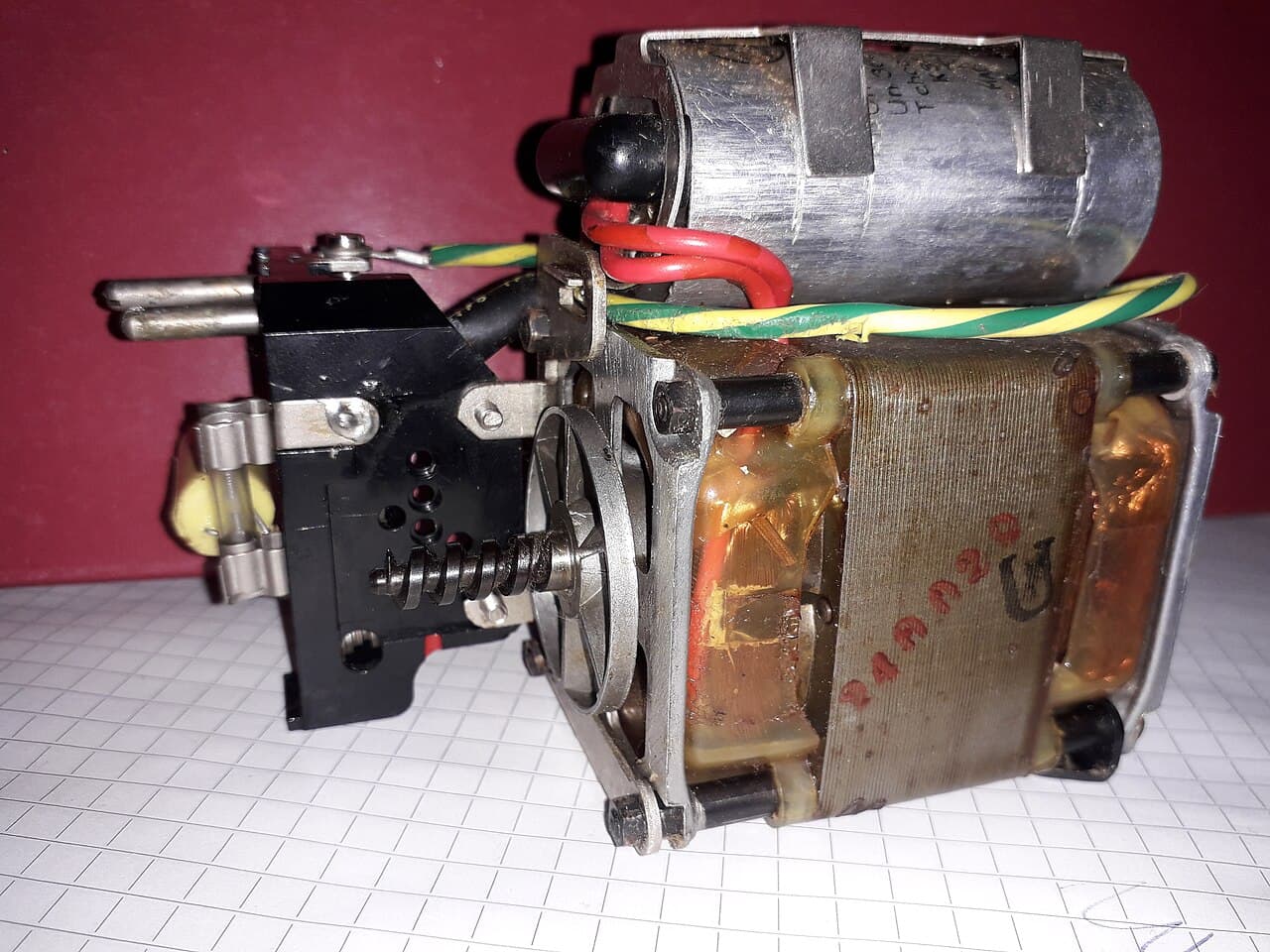
Many furnaces in Virginia homes are old enough to have this kind of motor. In Bryant's words, "Older furnace designs commonly use permanent split capacitor (PSC) motors."[2] The capacitor is a small canister wired to the motor, like the one strapped to the motor in the photo above. Carrier explains its role: "The capacitor provides the electrical torque needed to start the motor."[1]
When it weakens, the motor gets power but not the push it needs to start. Bryant lists the symptoms: "Capacitors store electrical energy to help the blower motor start and run. A failing capacitor may cause a loud humming sound, hard starting, or prevent the blower from turning on altogether."[3]
This is the best version of the problem to have. In a guide Trane published in September 2024 and last updated in February 2026, it put a furnace capacitor or blower motor capacitor at $100-$250, against $300-$900 for a furnace blower motor.[8] Those are national figures, not Virginia quotes, but the gap is why a proper test comes before a new motor.
The capacitor is not a homeowner part. Carrier: "A bulging or leaking capacitor prevents the motor from starting. Do not touch this component; if it looks damaged, call a technician."[1] It also warns that "Attempting DIY fixes on capacitors or wiring can be unsafe and may void warranties or damage other furnace parts."[1] Bryant's line is the same: "Do not remove furnace access panels or attempt to test wiring, capacitors, control boards, or other internal electrical components yourself."[4]
Other reasons a motor hums and stalls
Worn bearings or a damaged wheel. If the hum came after weeks of noise, that is a clue. Bryant: "Grinding, squealing, rattling or other unusual sounds can indicate worn bearings, a damaged blower wheel, or a motor problem."[2] Dust and debris packed into the wheel can add drag too. A Carrier dealer's visit is described as a chance to "inspect the motor for wear, test electrical connections, and check for airflow obstructions".[1]
The motor itself. Carrier notes that blower motors can fail due to overheating or lack of maintenance.[6] A motor that has overheated many times, often behind a clogged filter, can reach the point where a new capacitor will not bring it back.
A newer electronic motor. Not every furnace has a PSC motor. Bryant's list of blower designs: "Common designs include fixed-speed PSC motors, multi-speed ECM motors, constant-torque ECM motors and variable-speed, constant-airflow ECM motors."[2] ECM stands for electronically commutated motor. Bryant describes a dealer working to diagnose the root cause using the furnace's model information, observed symptoms, diagnostic indicators, and appropriate service procedures.[5] A blinking light on the furnace's control board is worth noting for that reason.
What you can safely do while you wait
- Turn the furnace off at the thermostat. Asked whether a furnace can run with a bad blower motor, Bryant answers: "No, you should not run it. Without the blower, heat can't circulate and the system can overheat, potentially causing serious damage or safety issues."[2]
- Look at the filter. Carrier: "A clogged filter restricts airflow, putting immense strain on the motor."[1] Carrier's limit on homeowner work is the filter: "Homeowners can, however, safely change the air filter."[7] A new filter will not restart a stalled motor, but it keeps the next one from working harder than it should. See how often to change a furnace filter.
- Check the breaker once. Bryant's rule: "If the breaker has tripped, you can reset it once. If it trips again, turn the system off and contact a qualified HVAC professional rather than repeatedly resetting the breaker."[4]
- Write down what you noticed: when the hum started, whether it happens on heat, cooling and fan-only, any squealing before it, and any blinking light.
Leave the access panels closed. Everything past the filter slot is the technician's.
When to call a licensed pro
A humming, stalled blower is always a service call. Make it the same day when:
- You smell burning or see smoke. Carrier: "Smoke or a burning smell are urgent warning signs."[1] Turn the furnace off first.
- The breaker keeps tripping. Carrier: "Frequent breaker trips or blown fuses usually point to electrical strain or faults within the motor."[1]
- The weather is cold enough to freeze pipes and the house is losing heat.
Ask the technician to say what they tested, and whether the capacitor, the motor or both need replacing. In Virginia, no individual may engage in, or offer to engage in, work as a tradesman unless licensed, unless working under the supervision of a tradesman licensed in that specialty, and the Code defines a tradesman to include heating, ventilation and air conditioning work done for the general public for compensation.[9][10] Check a business on DPOR's License Lookup[11] before it starts.
If the motor does need replacing, read what replacing a furnace blower motor involves, what it costs in Virginia and whether it is worth it on your furnace. If the blower runs but the air is cold, that is a different problem: see why a furnace runs but does not heat.
Getting it fixed
Loclis lists DPOR-licensed HVAC businesses with their licence number and class. Find HVAC businesses in Blacksburg or another town, see blower motor repairs, or browse more HVAC repair answers.
If your blower hums but will not turn, describe what it is doing once and licensed local HVAC businesses quote the repair.
Common questions
- Is a humming blower motor dangerous?
- It can be. A motor that is powered but stalled is working against itself, and without the blower the furnace can overheat. Turn the furnace off at the thermostat and leave it off until a technician has looked at it. If you smell burning or see smoke, turn the furnace off and call for service right away.
- Is it the capacitor or the motor?
- Only a test tells you. On an older furnace with a PSC motor, a failed capacitor is the most common reason for a hum without a spin, and it is the cheaper repair. If the capacitor tests good, the technician looks at the bearings, the blower wheel and the motor itself. Ask what was tested before you approve a new motor.
- Can I replace the blower capacitor myself?
- Carrier and Bryant both tell homeowners not to. The capacitor sits behind the furnace's access panel with the motor wiring, it stores electrical energy, and Carrier warns that DIY work on capacitors or wiring can be unsafe and can void warranties. In Virginia, HVAC work done for pay also needs a licensed tradesman.
- Can I still run the air conditioning?
- Not while the blower is stalled. The same blower moves air across the indoor cooling coil, so a central air conditioner or heat pump that shares it will not cool the house properly either. Keep the system off until the blower is fixed.
- What should I tell the technician?
- When the hum started, whether it happens on heat, cooling and fan-only, any squealing or grinding in the weeks before, any burning smell, whether a breaker tripped, and the pattern of any blinking light on the furnace's control board. The model number on the furnace's rating plate helps too.
Sources
- [1] Furnace Blower Motor Repair & Replacement Guide, Carrier. Checked October 27, 2026.
- [2] Furnace Blower Motor Guide: What It Is, How It Works, and Types, Bryant Heating & Cooling Systems. Checked October 27, 2026.
- [3] Furnace Repair, Bryant Heating & Cooling Systems. Checked October 27, 2026.
- [4] Furnace Troubleshooting, Bryant Heating & Cooling Systems. Checked October 27, 2026.
- [5] Furnace Not Turning On, Bryant Heating & Cooling Systems. Checked October 27, 2026.
- [6] Troubleshooting a Furnace, Carrier. Checked October 27, 2026.
- [7] Furnace Parts, Carrier. Checked October 27, 2026.
- [8] Average Furnace Repair Cost, Trane. Checked October 27, 2026.
- [9] Va. Code § 54.1-1129, Necessity for licensure, Code of Virginia, Virginia General Assembly. Checked October 27, 2026.
- [10] Va. Code § 54.1-1128, Definitions, Code of Virginia, Virginia General Assembly. Checked October 27, 2026.
- [11] License Lookup, Virginia Department of Professional and Occupational Regulation. Checked October 27, 2026.
Want a pro to handle it?
Describe the job once. Licensed local businesses send quotes, and you pay only when you book one.
Get a quote for HVAC Repair