What happens during a furnace repair visit?
The technician asks what the furnace is doing, checks the thermostat, filter and power, then watches the furnace try to start and reads any error code on its control board. Once the failed part is found, you get the diagnosis and a price before the repair. On a gas furnace, ask whether the visit includes the combustion checks a yearly check-up covers.
Free to ask. Local shops send quotes, and you pay only when you book one.
By Kasra Taheri, Founder, LoclisUpdated
Researched and drafted with AI, then checked claim by claim against the sources listed below before it was published. Prices and rules change; the dates beside each source say when it was last checked.
This is a job for a licensed pro in Virginia
This page explains what the work involves, the permits, what a licensed pro does and what drives the cost. It does not give step-by-step instructions, because this work needs a licence, a permit or both, and doing it wrong can injure someone. Before you hire, check the licence on Virginia's DPOR record.
A furnace repair visit follows a fairly set order. The technician asks what the furnace is doing, rules out the simple causes (thermostat, filter, power), then watches the furnace try to start and reads any fault code on its control board. That usually points to one part. Before the repair, you should get the diagnosis and a price, and on a gas furnace the technician should also look at the burners, gas pressure and heat exchanger before leaving.
Knowing the sequence helps you give the technician what they need and spot a visit that skips steps.
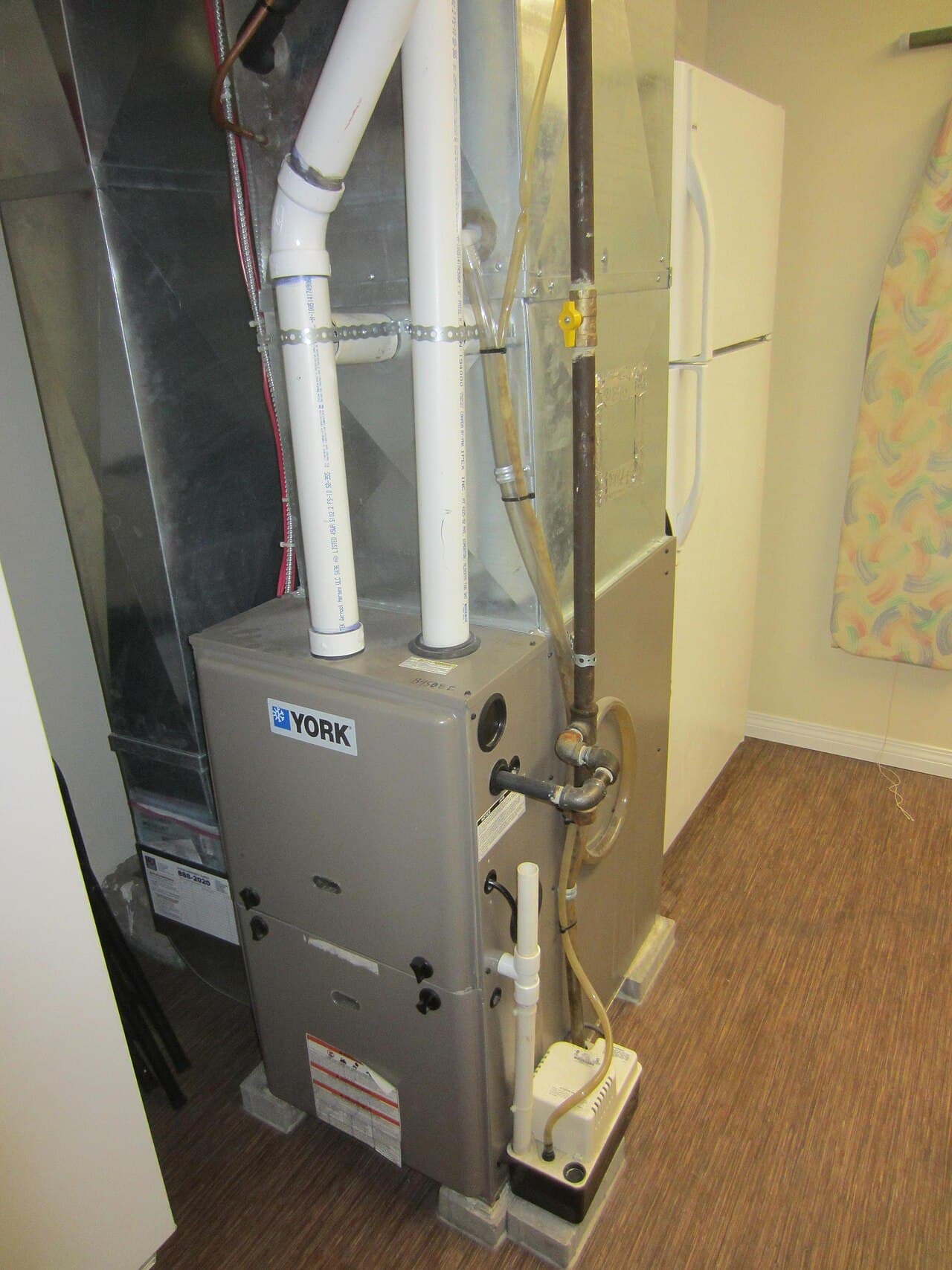
Before the technician arrives
Have a few facts ready. ENERGY STAR's advice before calling a contractor is to know the model of your current system and its maintenance history, and make a note of any uncomfortable rooms.[5] For a repair, add what the furnace is doing: no heat at all, cold air from the vents, short bursts of heat, a noise, a smell, or a light blinking on the furnace. Note when it started and whether other gas appliances in the house still work.
Clear a path to the furnace and the space around it, and know where the filter is.
If you smell gas at any point, do not wait for the appointment. Columbia Gas of Virginia tells customers who smell gas or have carbon monoxide symptoms to "go outside and call 911 and then call us at 1-800-544-5606 (24/7)."[7] If another company supplies your gas, use its emergency number.
The first checks
Most technicians start with the causes that cost nothing to fix, because they are common. Bryant's basic checks are the thermostat, the air filter, the furnace's power switch and circuit breaker, and whether supply registers and return grilles are open.[2] Carrier says the most common cause of a furnace blowing cold air is a thermostat fan set to "On" instead of "Auto".[1] If the visit ends there, it should be short and priced as a service call.
Watching the furnace start
If the basics are fine, the technician calls for heat and watches. Carrier describes a modern furnace's normal startup order as "inducer motor, then ignitor, then gas valve."[1] Where that sequence stops tells the technician which part to test. Carrier also notes that some furnaces hold the blower for about 30 to 60 seconds after the burners light, so the heat exchanger can warm up first,[1] which is why a short wait before warm air is normal.
On many furnaces, blinking LED lights on the control board are diagnostic codes.[1] The code narrows the search; a careful technician still confirms the fault before replacing a part.
The parts that commonly stop a furnace from heating:
- Flame sensor. A dirty flame sensor can fail to detect the flame, so the furnace shuts the burners down as a safety precaution while the blower keeps running.[1][2]
- Limit switch and airflow. If restricted airflow lets the furnace overheat, a high-limit switch shuts off the burners while the blower runs on to cool the equipment.[1] The fix may be the filter, a blocked return or the blower, not the switch.
- Pilot or ignition. On older furnaces, a pilot light that keeps going out can point to a faulty thermocouple.[3] Bryant notes that modern high-efficiency furnaces generally use electronic ignition systems instead.[2]
- Condensate drain. Lennox notes that a blocked condensate drain line on a high-efficiency gas furnace can shut off the burners.[3]
- Control board. Lennox explains that a failing control board can turn on the blower without turning on the burner.[3]
Safety checks on a gas or oil furnace
A repair visit is a good moment for the combustion checks that ENERGY STAR lists for a heating check-up: checking all gas (or oil) connections, gas pressure, burner combustion and the heat exchanger.[4] ENERGY STAR explains why: "A dirty burner or cracked heat exchanger causes improper burner operation."[4] The EPA lists worn or poorly adjusted and maintained combustion devices, including furnaces, among the sources of carbon monoxide indoors.[6]
If the technician finds a safety problem, expect a plain explanation and a clear answer on whether the furnace can keep running. Ask to see what they found, and get it in writing if it changes the job from a repair to a replacement.
The price, the paperwork and the licence
You should hear the diagnosis and the price before the repair starts. If the business charges a service call fee, ask beforehand whether it comes off the repair.
Licence. Under Virginia law, no individual may work as a tradesman without a licence, and the Code defines a tradesman to include anyone doing heating, ventilation and air conditioning work for the public for pay,[8][9] unless they work under the supervision of a tradesman licensed in that specialty.[8] Check the business on DPOR's License Lookup.[12]
Contract. Virginia's Board for Contractors requires those in residential contracting to use a legible written contract, signed by the consumer and the licensee before work starts or payment is accepted, and excludes those who do routine maintenance or service contracts.[10] The rule defines residential contracting as "construction, removal, repair, or improvements to single-family or multiple-family residential buildings," so the rule covers repair work, not only replacements.[10] The contract must include a statement of the total cost and the contractor's name, address, licence number and class of licence.[10]
Permit. If the repair turns into a replacement, Virginia's building code only exempts the replacement of mechanical appliances that are not fueled by gas or oil,[11] so a new gas or oil furnace needs a permit. In a no-heat emergency, an application for emergency equipment replacement must be submitted by the end of the first working day after the day the work starts.[11] For work short of a replacement, the code requires a permit for installations or alterations involving mechanical systems or fuel supply systems,[11] and lets the building official exempt other repair work they deem minor and ordinary that does not adversely affect public health or general safety.[11] Ask the contractor whether they will pull a permit for the work they quote. More on that in do you need a permit to replace an HVAC system in Virginia.
If you are weighing a big repair on an old furnace, read should I repair or replace my furnace before you sign.
When to call a licensed pro
A carbon monoxide alarm is not a reason to book a visit; it is an emergency. If the alarm sounds or anyone has symptoms of carbon monoxide poisoning, Columbia Gas of Virginia's instruction is to "leave the area to get to fresh air and immediately call 911," and not to go back in until emergency responders identify the cause and allow you to go back inside.[7]
Book a visit rather than trying more resets when:
- You smell gas or see soot. Carrier's advice is that if you smell gas or notice soot around the furnace, turn the system off and call a professional.[1] With a gas smell, leave first and call from outside.
- The breaker trips. Bryant says a breaker that trips repeatedly is a reason to stop resetting it and call a professional.[2]
- The furnace starts and quits, the pilot will not stay lit, or warm air never arrives after the thermostat and filter are checked.
For the common symptom, see why a furnace blows cold air, and for what drives the bill, how much furnace repair costs in Virginia.
Getting a licensed technician in Virginia
Loclis lists DPOR-licensed HVAC businesses with their licence number and class. Look up HVAC businesses in Blacksburg or another town, browse heating repair, or read more heating and cooling answers.
When the furnace is not heating, describe the problem once and licensed local HVAC businesses quote it.
Common questions
- How long does a furnace repair visit take?
- It depends on what failed and whether the technician has the part with them. Ask when you book whether they carry parts for your make of furnace, and ask at the visit how long an ordered part would take and whether the furnace is safe to run in the meantime.
- Should I reset the furnace or the breaker before the technician comes?
- Checking that the thermostat is set to heat and that the furnace's power switch is on is fine. Bryant's guidance is that a breaker that trips repeatedly is a reason to stop resetting it and call a professional, and repeated restarts after a lockout hide the symptom the technician needs to see.
- Will I get a price before the repair starts?
- You should. Ask for the diagnosis and the price in writing before you approve the work. Virginia's Board for Contractors requires a signed written contract for residential contracting, which includes repair work, whatever its size. The rule leaves out subcontractors and those who do routine maintenance or service contracts.
- Does a furnace repair need a permit in Virginia?
- Replacing a gas or oil furnace does: the Uniform Statewide Building Code only exempts replacing mechanical appliances that are not fueled by gas or oil. For other work, the code requires a permit for installations or alterations involving mechanical systems or fuel supply systems, and lets the building official exempt repair work they deem minor and ordinary. Ask the contractor whether they will pull a permit for the work they quote.
- Who is allowed to repair my furnace in Virginia?
- HVAC work done for the public for pay must be done by a licensed tradesman or someone working under one's supervision, under Va. Code § 54.1-1129. You can look up the business and the technician on DPOR's License Lookup.
Sources
- [1] Reasons Your Furnace is Blowing Cold Air and How to Fix Them, Carrier. Checked October 26, 2026.
- [2] Why Is My Furnace Blowing Cold Air? Troubleshooting and Solutions, Bryant. Checked October 26, 2026.
- [3] How to Fix a Furnace Blowing Cold Air, Lennox. Checked October 26, 2026.
- [4] Maintenance Checklist, ENERGY STAR, U.S. Environmental Protection Agency. Checked October 26, 2026.
- [5] 10 Tips for Hiring a Heating and Cooling Contractor, ENERGY STAR, U.S. Environmental Protection Agency. Checked October 26, 2026.
- [6] Carbon Monoxide's Impact on Indoor Air Quality, U.S. Environmental Protection Agency. Checked October 26, 2026.
- [7] Carbon Monoxide, Columbia Gas of Virginia. Checked October 27, 2026.
- [8] Va. Code § 54.1-1129, Necessity for licensure, Code of Virginia, Virginia General Assembly. Checked October 26, 2026.
- [9] Va. Code § 54.1-1128, Definitions, Code of Virginia, Virginia General Assembly. Checked October 26, 2026.
- [10] 18VAC50-22-260, Filing of charges; prohibited acts, Virginia Administrative Code, Board for Contractors. Checked October 26, 2026.
- [11] 13VAC5-63-80, Section 108 Application for permit, Virginia Uniform Statewide Building Code, Virginia Administrative Code. Checked October 26, 2026.
- [12] License Lookup, Virginia Department of Professional and Occupational Regulation. Checked October 26, 2026.
Want a pro to handle it?
Describe the job once. Licensed local businesses send quotes, and you pay only when you book one.
Get a quote for HVAC Repair