What does a roof inspection include?
A roof inspection checks the roof covering, the flashing around chimneys, skylights and vents, the gutters and downspouts, the attic ventilation, and the roof framing, sheathing and insulation seen from the attic. In Virginia, a licensed home inspector must describe each of these in writing, say how the roof covering was inspected, and explain anything that could not be inspected.
Free to ask. Local shops send quotes, and you pay only when you book one.
By Kasra Taheri, Founder, LoclisPublished
Researched and drafted with AI, then checked claim by claim against the sources listed below before it was published. Prices and rules change; the dates beside each source say when it was last checked.
This is a job for a licensed pro in Virginia
This page explains what the work involves, the permits, what a licensed pro does and what drives the cost. It does not give step-by-step instructions, because this work needs a licence, a permit or both, and doing it wrong can injure someone. Before you hire, check the licence on Virginia's DPOR record.
A roof inspection is a close look at everything that keeps water out of the house: the roof covering, the flashing around chimneys and vents, the gutters and downspouts, the ventilation, and the attic and roof framing underneath. It should end in a written report that says what was looked at, how it was looked at, and what needs attention. Virginia's home inspection rules give a clear checklist of what that report should cover.
The checklist Virginia sets for inspectors
Under Virginia law, a home inspection is "a written evaluation of the readily accessible components of a residential building," and the roof is one of the components the definition names.[1] The state's home inspector regulations spell out the roof part. Unless the contract limits it, a licensed home inspector must inspect and describe in writing the roof covering, roof ventilation, the roof drainage system including gutters and downspouts, roof flashings if readily visible, skylights, chimneys and roof penetrations, roof framing and sheathing, the attic and the attic insulation.[2]
Two details in that rule are worth knowing. First, the method of inspecting the roof covering must be noted and explained,[2] so the report should say whether the inspector walked the roof, looked from a ladder at the eaves, or worked from the ground with binoculars or a drone. Second, the rule covers skylights, chimneys and penetrations but not antennae or other roof attachments,[2] so a satellite dish or a solar array may need a separate look.
The report also records the date, the start and finish times, and the weather conditions at the time of the inspection.[2] Weather matters on a roof: frost, rain or a dusting of snow can hide damage an inspector would otherwise see.
What gets looked at, part by part
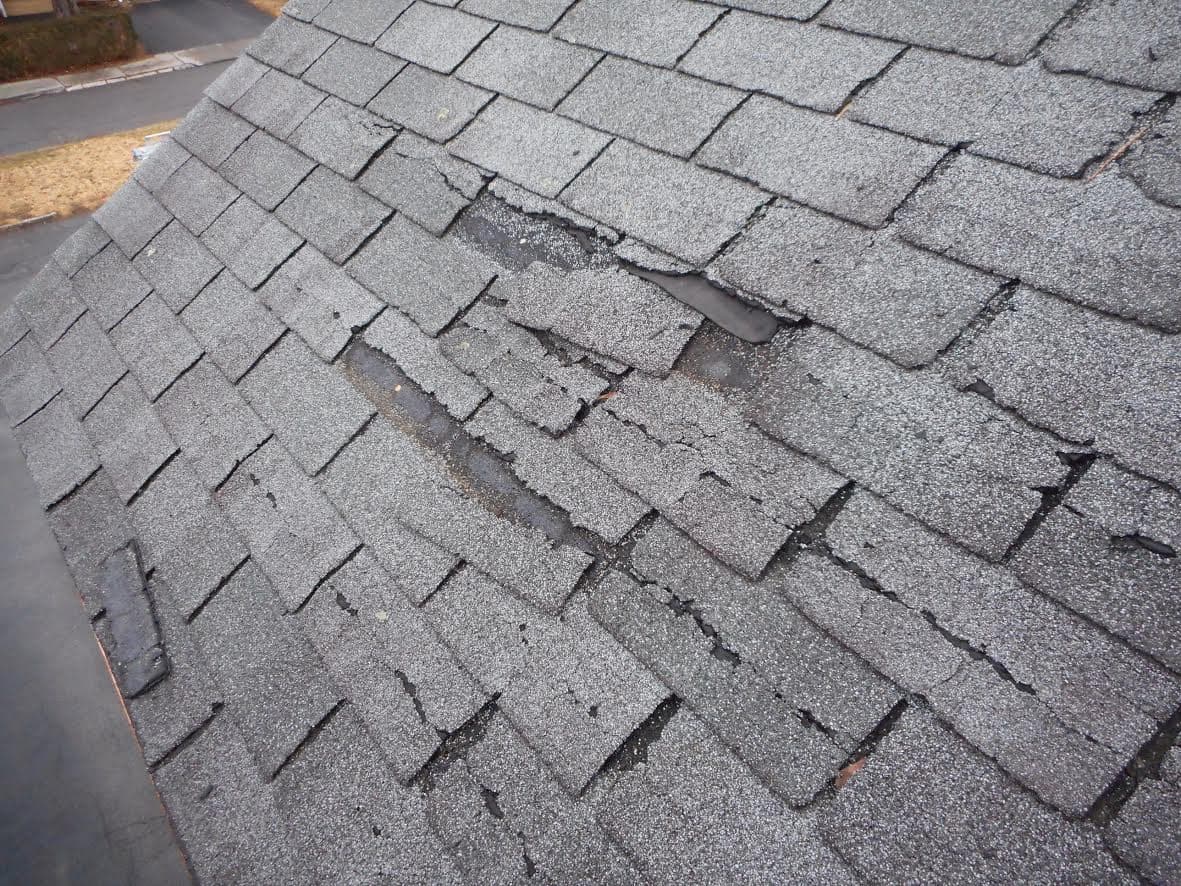
The roof surface. On an asphalt shingle roof, the inspector looks for cracked, curled or missing shingles and for heavy loss of the mineral granules that protect the asphalt. Soft or sagging areas, lifted tabs and patches that do not match the rest of the roof are noted too. The photo above shows the kind of cracking and torn tabs that end up in a report.
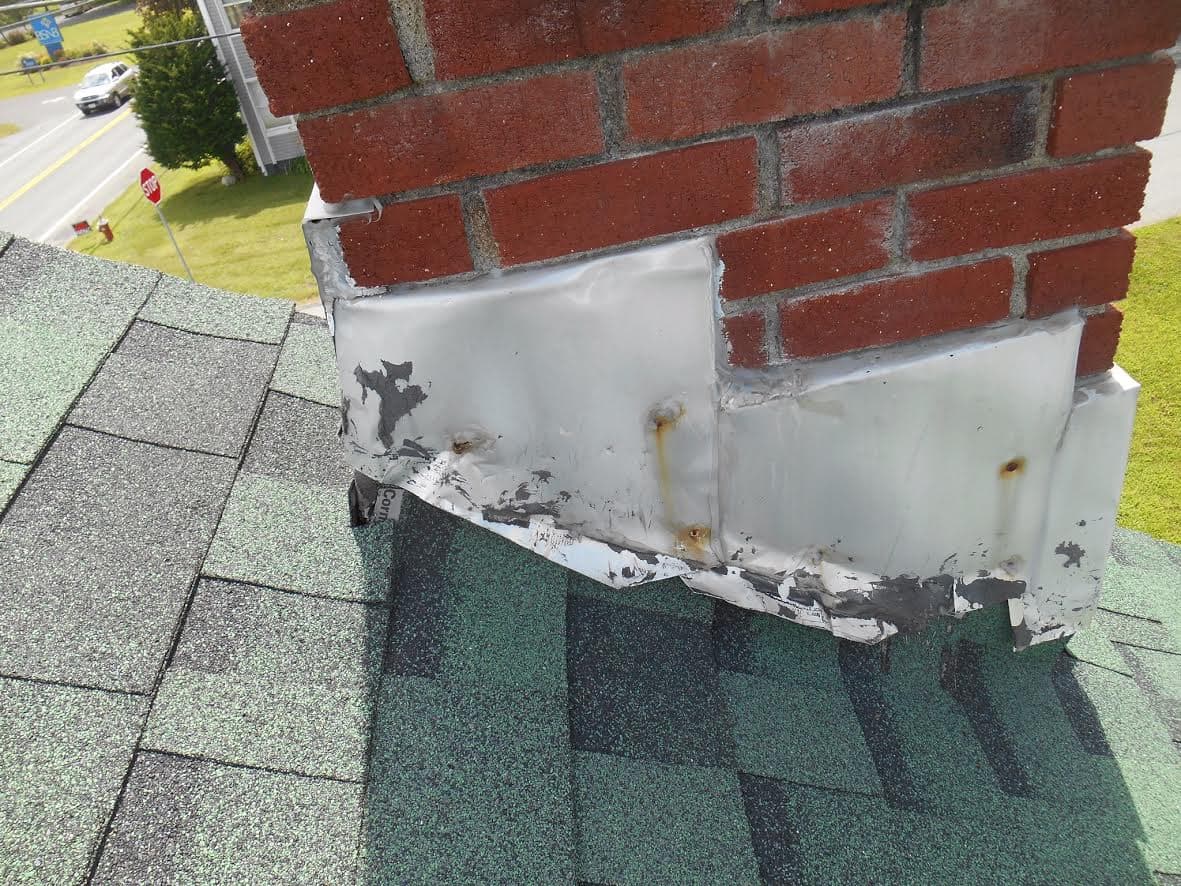
Flashing and penetrations. Metal flashing seals the joints where the roof meets a chimney, a wall, a skylight or a vent pipe. Those joints are common places for leaks to start, so the inspector checks that the metal is tight, sealed and not bent or rusted through.
Gutters and downspouts. Gutters that are clogged, loose or sloped the wrong way can push water back under the roof edge and against the fascia. The inspector checks that they are attached and draining away from the house.
Ventilation. Vents at the eaves and near the ridge let heat and moisture out of the attic. Attic ventilation helps prolong the service life of the roof and moves household water vapor out of the attic, which helps avoid mold, wood rot and wet insulation.
The attic. From inside, with a flashlight, the underside of the roof deck and rafters is checked for stains or wet spots that show water leaks. Daylight through the boards and damp or matted insulation are other common clues.
What an inspection usually leaves out
A visual inspection has limits, and a good report says where they were. Many inspectors work from a ladder at the eaves or from the ground rather than walking the roof, which is why the report must say how the roof covering was inspected. Where a component cannot be inspected, the report must identify it and explain why it was not inspected.[2] The written contract, which both sides must sign before work begins, must list all areas and systems to be inspected and may exclude things such as the remaining life of a component or the causes of a condition.[3] A home inspection is not a promise about how many years the roof has left. It must also state that the inspection is not a review for compliance with the building code.[3]
A home inspector's check versus a roofer's inspection
There are two kinds of roof inspection, and they answer different questions.
- A home inspection usually comes with buying or selling a house. The roof is one section of a whole-house report, written by a home inspector licensed by Virginia's Board for Asbestos, Lead, and Home Inspectors.[1][2] It is not required to tell you what the fix costs: the methods, materials or costs of corrections can be excluded in the contract.[3]
- A roofing contractor's inspection is aimed at a repair or a replacement. A roofer is more likely to walk the roof where it is safe, check how shingles are sealed and fastened, and price the work. Virginia defines roofing contracting as installing, repairing, removing or improving the materials that form a watertight, weather resistant surface for roofs and decks.[4]
If you are buying, the home inspection comes first; if it flags the roof, a roofer's inspection and written quote is the usual next step.
When to call a licensed pro
Leave the roof itself to a professional. Walking on a roof is dangerous and can damage it, so do not climb up to check. Look from the ground with binoculars and from the attic with a flashlight instead.
Book an inspection when you are buying a house, after hail or high winds, when a ceiling stain appears, or when the roof is getting old; when to get a roof inspection covers the timing. For any repairs that follow, work valued at $1,000 or more needs a valid Virginia contractor's licence,[5] and for roofing-only work you may want a contractor licensed in that specialty.[5] Check a home inspector or a roofer with DPOR's License Lookup or by calling (804) 367-8511,[6] or follow how to check a contractor's licence.
Before you book, ask which method they will use on the roof, whether the attic is included, whether you get dated photos, and whether the report is separate from any repair quote. For prices, see what a roof inspection costs in Virginia; if the report points to the end of the roof's life, read how to know if you need a new roof. Browse roof inspection services, exterior contractors in Blacksburg or all exterior answers.
Describe your roof and what you want checked, and licensed local roofers quote or offer to come and look.
Common questions
- Does a roof inspection include the attic?
- It should. Virginia's home inspection rules list the attic, attic insulation, roof ventilation, and roof framing and sheathing alongside the roof covering. From the attic an inspector can see stains or wet spots on the underside of the roof deck that the outside of the roof does not show.
- Will the inspector walk on my roof?
- Not always. A home inspector may inspect from the ground or the eaves. Virginia's rules require the report to say how the roof covering was inspected, so read that line. A roofer bidding on repairs is more likely to walk a roof that is safe to walk.
- Does a roof inspection tell me how many years my roof has left?
- Usually not in writing. Virginia home inspection contracts may exclude the remaining life of a component. An inspector or roofer may give an opinion, but treat it as an estimate.
- Is a roof inspection the same as a roof certification?
- No. A standard inspection reports what was visible on the day, and it is not a warranty. If a lender, buyer or insurer asks for a certification letter, ask a licensed roofer what theirs covers and for how long, in writing.
- Who can do a roof inspection in Virginia?
- A home inspection, including its roof section, is done by a home inspector licensed by Virginia's Board for Asbestos, Lead, and Home Inspectors. Roof repairs are done by a licensed contractor, and work valued at $1,000 or more needs a valid Virginia contractor's licence. Check either one with DPOR's License Lookup.
Sources
- [1] Code of Virginia § 54.1-500. Definitions (asbestos, lead and home inspection), Virginia General Assembly, Legislative Information System. Checked October 26, 2026.
- [2] 18VAC15-40-130. Home inspection report, Virginia Administrative Code, Virginia Board for Asbestos, Lead, and Home Inspectors. Checked October 26, 2026.
- [3] 18VAC15-40-120. Home inspection contract, Virginia Administrative Code, Virginia Board for Asbestos, Lead, and Home Inspectors. Checked October 26, 2026.
- [4] 18VAC50-22-30. Definitions of specialty services, Virginia Administrative Code, Virginia Board for Contractors. Checked October 26, 2026.
- [5] What You Should Know Before You Hire a Contractor, Virginia Board for Contractors, DPOR. Checked October 26, 2026.
- [6] Disaster Recovery: Avoiding Fraud, Virginia Department of Professional and Occupational Regulation. Checked October 26, 2026.
Want a pro to handle it?
Describe the job once. Licensed local businesses send quotes, and you pay only when you book one.
Get a quote for Roofing