Why is my furnace blowing cold air?
Most often the thermostat fan is set to On instead of Auto, so the blower runs between heating cycles. Other causes are a clogged filter that trips the furnace's high-limit switch, a dirty flame sensor, an ignition or pilot problem, a blocked condensate drain or a failing control board. A short burst of cool air at startup is normal.
Free to ask. Local shops send quotes, and you pay only when you book one.
By Kasra Taheri, Founder, LoclisUpdated
Researched and drafted with AI, then checked claim by claim against the sources listed below before it was published. Prices and rules change; the dates beside each source say when it was last checked.
This is a job for a licensed pro in Virginia
This page explains what the work involves, the permits, what a licensed pro does and what drives the cost. It does not give step-by-step instructions, because this work needs a licence, a permit or both, and doing it wrong can injure someone. Before you hire, check the licence on Virginia's DPOR record.
The most common reason is simple: the thermostat fan is set to "On", so the blower runs between heating cycles and pushes room-temperature air. If the fan is on "Auto" and the air stays cold, the furnace has probably shut its burners off for a reason. Common causes are a clogged filter that let it overheat, a dirty flame sensor, an ignition or pilot problem, a blocked condensate drain on a high-efficiency furnace, or a failing control board. A short burst of cool air at startup is normal.
Check the thermostat first
Carrier says the most common cause of a furnace blowing cold air is a thermostat fan set to "On" instead of "Auto".[1] With the fan on, the system circulates cool air between heating cycles.[1] Setting it to "Auto" lets the blower run only while the furnace is heating.
While you are there, Carrier suggests confirming the mode is "Heat", that the set temperature is higher than the room temperature, and that a programmable thermostat's schedule has not shifted after daylight saving time or a power outage.[1] On a battery-powered thermostat, Lennox notes that batteries do not have to be completely dead for the thermostat to malfunction.[3]
Cold air for the first minute is normal
Carrier notes that some furnaces delay the blower for about 30 to 60 seconds after the burners light so the heat exchanger can warm first,[1] and Lennox explains that cold air is normal at first because the air in the ductwork is cold.[3] If the air is still cold after a few minutes, keep reading.
The furnace shut its burners off
A furnace that blows cold air with the fan on "Auto" is often running its blower after a safety control has stopped the burners. These are the usual reasons.
A clogged filter and the limit switch. Carrier puts it this way: "A clogged filter can cause the heat exchanger to overheat, triggering the limit switch to shut down the burners while the fan keeps running to cool it off."[1] Carrier recommends replacing 1-inch furnace filters every 1–3 months.[1] Closed vents cause the same problem: closing too many supply vents or blocking return grilles can restrict airflow and lead to furnace overheating.[1] If a clean filter and open vents do not fix it, the blower or another part may be at fault. See how often to change a furnace filter.
A dirty flame sensor. "If the sensor becomes dirty, it may fail to detect the flame, causing the furnace to shut down the burners as a safety precaution."[1] Bryant lists a dirty flame sensor as one possible cause when a furnace starts and then shuts down shortly afterward.[2] The sensor sits inside the burner compartment, so this is a service call.
Pilot or ignition. "A failed pilot light or electronic ignition prevents the burners from igniting".[2] On older furnaces with a standing pilot, Lennox says a faulty thermocouple could be the culprit if the pilot light keeps going out.[3] "If a pilot light repeatedly goes out or an electronic ignition system fails to establish a flame, Bryant recommends professional service rather than repeated attempts to restart the furnace."[2]
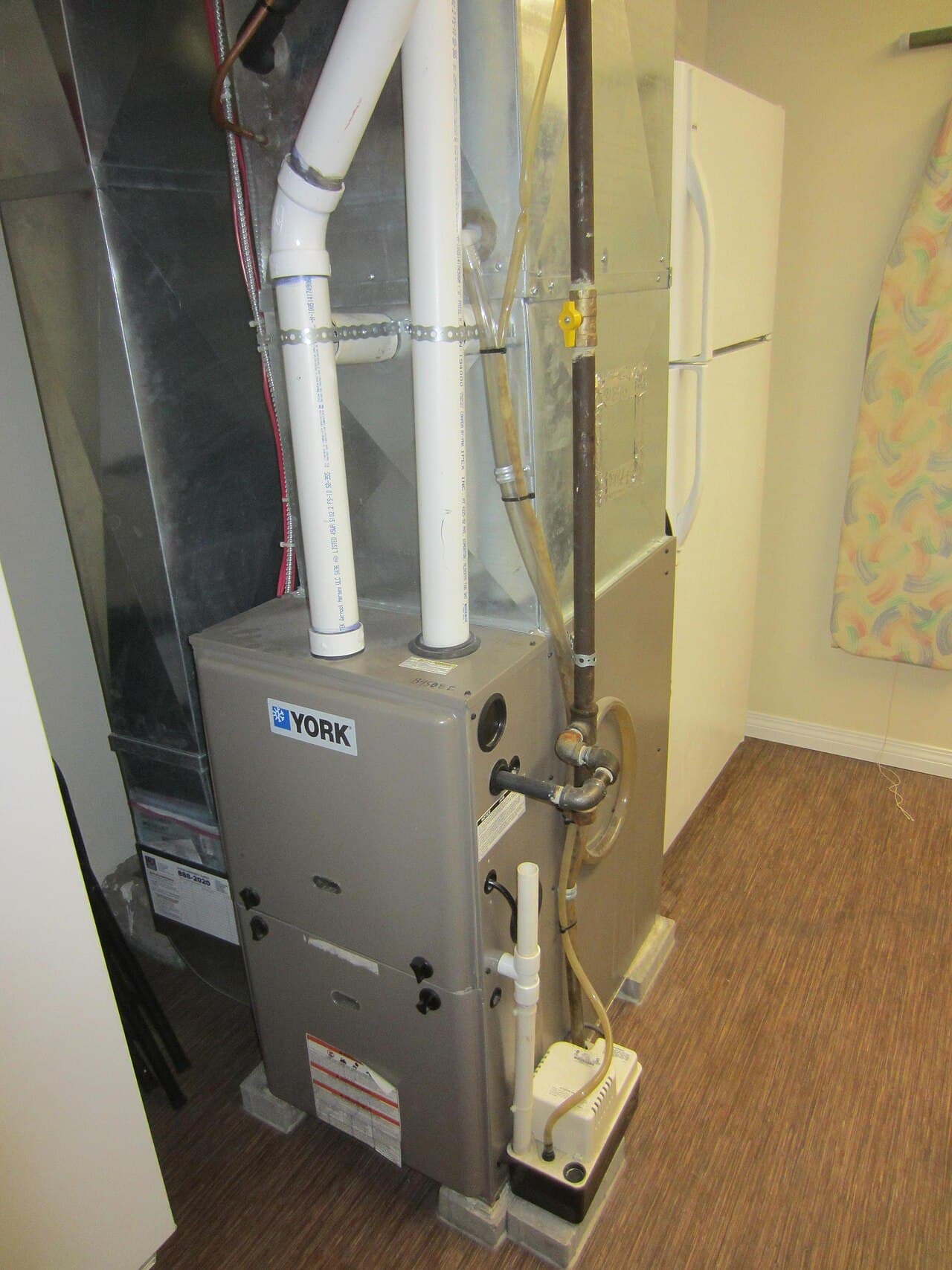
A blocked condensate drain. "Some gas furnaces have condensate drain lines to help remove moisture."[3] Lennox says a blockage in those lines could deactivate the burners and cause the furnace to blow cold air.[3] These are high-efficiency furnaces, usually vented with white plastic pipe like the one pictured.
Fuel supply. Carrier suggests you check whether other gas appliances in the home are working, and if they are not, contact the gas utility.[1] It adds that for oil or propane furnaces, an empty tank can be the whole problem.[1]
The control board. Lennox describes a board that turns on the blower but not the burner: the furnace blows cold air because the circuit control board didn't turn on the burner to heat the air.[3] A blinking light on the board is a fault code the technician reads.
Lukewarm air in some rooms
If the air is warm at the furnace but cool by the time it reaches a far room, the ducts may be the problem. Carrier explains that leaky ductwork lets warm air escape into an attic or crawlspace and draws cold air in from those spaces.[1] Bryant adds that duct leaks generally do not explain a furnace producing genuinely cold air at the supply register,[2] so truly cold air still points back to the furnace.
If you have a heat pump
A heat pump behaves differently from a furnace in winter. Carrier lists the system entering its normal defrost cycle as one cause of cool air in heat mode,[4] and says "A typical defrost cycle lasts about 5–10 minutes".[4] Persistent cold air, or ice more than 1/4 inch thick, or ice that does not clear during a normal defrost cycle,[4] needs a technician.
When to call a licensed pro
Once the thermostat, filter and vents are ruled out, the remaining causes are inside the furnace: burners, sensors, ignition, gas valve and control board. That is licensed work. Under Virginia law no individual may work as a tradesman without a licence, and the Code's definition of a tradesman covers heating, ventilation and air conditioning work done for the public for pay.[6][7] Check a business on DPOR's License Lookup.[8]
Two signs are emergencies, not service calls. If you smell gas, Columbia Gas of Virginia tells customers to "go outside and call 911 and then call us at 1-800-544-5606 (24/7)."[5] If another company supplies your gas, use its emergency number. If a carbon monoxide alarm sounds or anyone has symptoms of carbon monoxide poisoning, Columbia Gas says to "leave the area to get to fresh air and immediately call 911."[5]
Call promptly when:
- You see soot around the furnace. Carrier's advice for soot around the furnace is to turn off the system immediately and contact a professional.[1] A gas smell is different: leave the house first and call from outside, as above.
- The burners light and quit, the pilot keeps going out, or the furnace locks out after a restart.
- The breaker trips when the furnace runs.
For what the technician will do, see what happens during a furnace repair visit; for the bill, how much furnace repair costs in Virginia.
Getting it fixed in Virginia
Loclis lists DPOR-licensed HVAC businesses with their licence number and class. Look up HVAC businesses in Blacksburg or another town, browse heating repair, or read more heating and cooling answers.
Describe what the furnace is doing and licensed local HVAC businesses quote the repair.
Common questions
- Is it normal for a furnace to blow cold air when it first turns on?
- For a short time, yes. Air sitting in the ducts is cold, and Carrier notes some furnaces delay the blower about 30 to 60 seconds after the burners light. If the air is still cold after a few minutes, something is wrong.
- Why does my furnace blow cold air between cycles?
- Usually because the thermostat fan is set to On. The blower then runs all the time and moves room-temperature air when the burners are off. Setting the fan to Auto lets it run only while the furnace is heating.
- Can a dirty filter make a furnace blow cold air?
- Yes. A clogged filter restricts airflow, the furnace overheats, and its high-limit switch shuts the burners off while the blower keeps running to cool it down. Carrier suggests replacing 1-inch filters every 1 to 3 months. If a clean filter does not fix it, call a technician.
- Is a furnace blowing cold air dangerous?
- Usually it is a safety control doing its job, not an emergency. It becomes urgent if you smell gas, see soot around the furnace, or a carbon monoxide alarm sounds: leave the house and call 911 and your gas company from outside.
- My heat pump blows cool air in winter. Is it broken?
- Not necessarily. Heat pumps run a defrost cycle that Carrier says typically lasts about 5 to 10 minutes, and the air can feel cooler while it runs. Cold air that persists, or ice on the outdoor unit that does not clear, needs a technician.
Sources
- [1] Reasons Your Furnace is Blowing Cold Air and How to Fix Them, Carrier. Checked October 26, 2026.
- [2] Why Is My Furnace Blowing Cold Air? Troubleshooting and Solutions, Bryant. Checked October 26, 2026.
- [3] How to Fix a Furnace Blowing Cold Air, Lennox. Checked October 26, 2026.
- [4] Heat Pump Troubleshooting Guide, Carrier. Checked October 26, 2026.
- [5] Carbon Monoxide, Columbia Gas of Virginia. Checked October 27, 2026.
- [6] Va. Code § 54.1-1129, Necessity for licensure, Code of Virginia, Virginia General Assembly. Checked October 26, 2026.
- [7] Va. Code § 54.1-1128, Definitions, Code of Virginia, Virginia General Assembly. Checked October 26, 2026.
- [8] License Lookup, Virginia Department of Professional and Occupational Regulation. Checked October 26, 2026.
Want a pro to handle it?
Describe the job once. Licensed local businesses send quotes, and you pay only when you book one.
Get a quote for HVAC Repair