What is the best way to clear a driveway after a big snow?
Clear it in layers rather than all at once, push the snow instead of lifting it, and open a path to the door first. Pile snow on your own property, never in the street. Leave the end of the driveway until the street plow has passed, then clear it and an open area about 10 feet to the right of the driveway as you face the road.
Free to ask. Local shops send quotes, and you pay only when you book one.
By Kasra Taheri, Founder, LoclisPublished
Researched and drafted with AI, then checked claim by claim against the sources listed below before it was published. Prices and rules change; the dates beside each source say when it was last checked.
Step by step
Read when to stop and call a pro, further down this page, before you start.
Step 1: Check yourself first
If you have a medical condition or do not exercise regularly, talk with your doctor before shoveling, or hire someone to do it.[4]
Step 2: Dress for the job
Wear boots with slip-resistant soles and sunglasses, and keep your hat or scarf out of your eyes.[2]
Step 3: Warm up
Spend about 10 minutes on light exercise to warm your muscles before you pick up the shovel.[4]
Step 4: Open a path to the door
Clear a walkway from the door to the driveway first so you can get out in an emergency.[2]
Step 5: Work in layers
Take deep or heavy snow off a few inches at a time instead of trying to move the full depth in one pass.[4]
Step 6: Push, do not lift
Push snow to the edges with the shovel close to your body; when you must lift, squat, bend your knees and lift with your legs.[4]
Step 8: Pile it on your own property
Stack snow beside the driveway, away from shrubs and the path meltwater will take, and not in the street or on the sidewalk.[2]
Step 9: Wait for the plow at the end
Clear the apron after the street plow passes, and shovel an open area about 10 feet to the right of the driveway as you face the road.[1]
Step 11: Treat what is left
Spread a little sand for traction on the thin layer that remains; the City of Richmond notes that salt and chemicals only speed up melting when temperatures are above 20 degrees.[3]
Step 12: Pace yourself
Take frequent breaks and drink fluids, and stop and seek emergency care if you feel chest pain or shortness of breath.[4]
The easiest way to clear a driveway after a big snow is in stages. Open a path to the door first, then take the snow off in layers, pushing it to the sides rather than lifting it. Pile it on your own property, never in the street. Leave the end of the driveway until the street plow has been by, so you only clear it once.
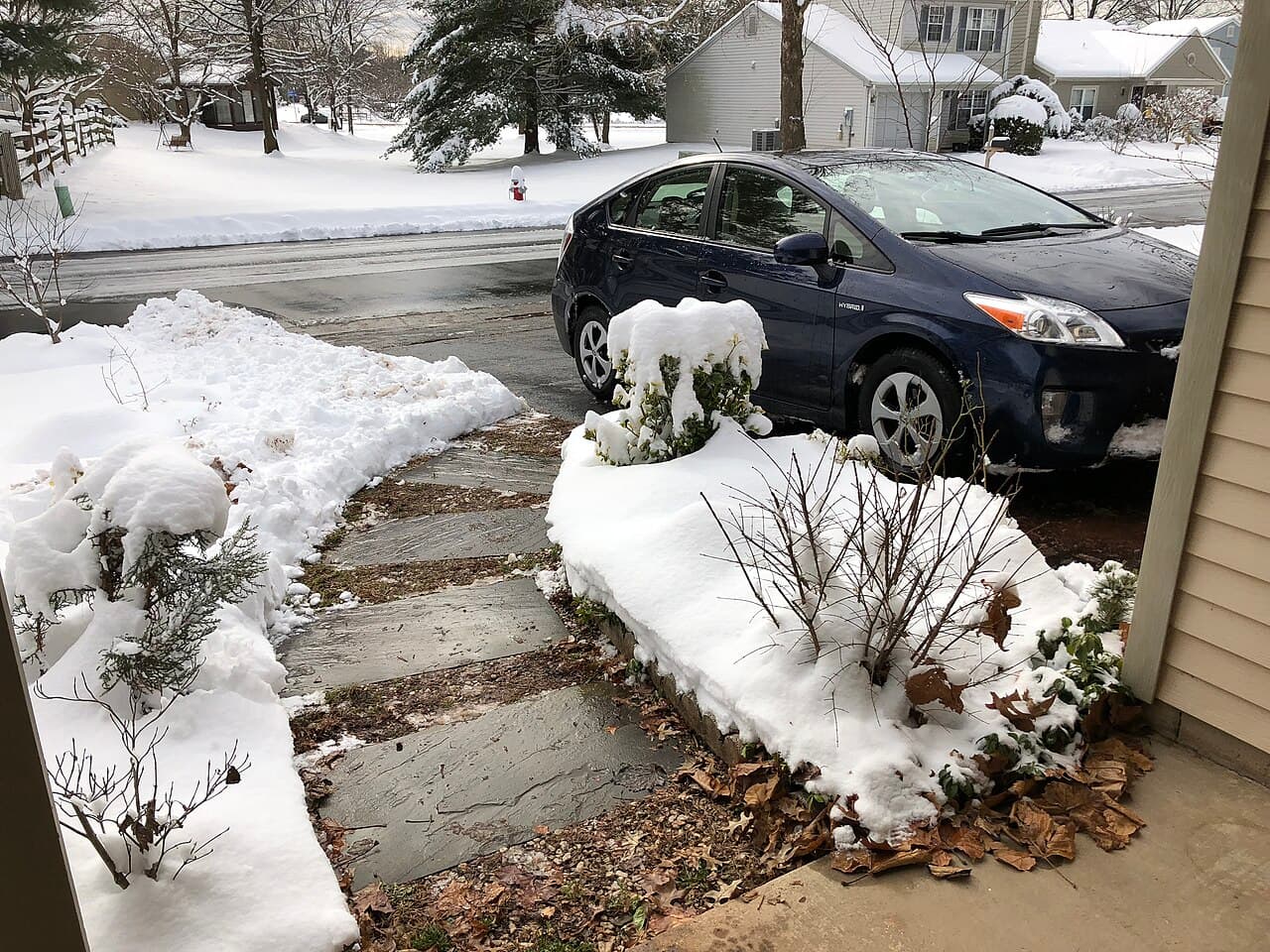
Before you pick up the shovel
Heavy snow is hard on the heart as well as the back. The National Weather Service warns that "the strain from the cold and the hard labor may cause a heart attack,"[5] and federal preparedness advice is to reduce that risk by avoiding overexertion when shoveling snow.[6] Orthopaedic surgeons and the City of Alexandria give the same advice: if you have a medical condition or do not exercise regularly, talk with your doctor before shoveling, and consider hiring someone to remove the snow.[4][2]
If you are clearing it yourself, start by warming up your muscles for 10 minutes with light exercise.[4] Wear boots with slip-resistant soles, keep your hat and scarf out of your eyes, and on a bright day wear sunglasses to prevent "snow blindness".[2] A lighter shovel that suits your height is easier on you than a big heavy one.
Start early and work in layers
Newly fallen snow is lighter than heavily packed or partially melted snow,[2] so in a long storm it usually pays to go out once while it is still coming down rather than face the whole depth at the end. Whenever you start, open a path from the door first, so you keep a path to your door in case you need to leave in an emergency.[2]
Never remove deep snow all at once.[4] After a big storm, skim off the top few inches across a section, then come back for the bottom layer. Working down the driveway in strips, from the house toward the street, means each scoop has a short trip to the edge.
Push the snow, and lift only when you must
Push the snow instead of lifting it.[4][2] Keep the shovel close to your body and space your hands apart on the handle for leverage. When you do have to lift, squat with your legs apart, knees bent and back straight, and lift with your legs, not by bending at the waist.[4][2] Take small scoops and walk them to the pile. Holding a shovelful at arm's length puts too much weight on your spine.[4] Throwing snow over your shoulder or to the side twists and stresses your back.[4][2]
Take frequent breaks and drink water. If you feel chest pain, shortness of breath or other signs of a heart attack, stop and seek emergency care.[4]
Where the snow goes
Pile it on your own property. Alexandria's guidance is direct, "do not shovel snow into streets or onto sidewalks," and it gives the practical reason too: "Do not shovel snow into the street, or it will just be plowed back again."[2] Richmond likewise asks residents not to move snow from driveways into city streets.[3]
Choose the piles with spring in mind. Keep them off shrubs and young trees, especially if the snow has been salted: Virginia Cooperative Extension notes that snow and ice laden with salt is often heaped in parking lot islands and sidewalk tree lawns where melting carries salt into the soil.[7] Avoid piling snow where its meltwater will run back across the driveway, or you will be chipping ice tomorrow (see why a plowed driveway refreezes). If there is a fire hydrant or storm drain at your curb, clear ice, snow and leaves from around fire hydrants and storm drains so firefighters can reach the hydrant and meltwater can drain.[2]
The end of the driveway and the street plow
Crews push snow off the road, to the right,[1] and that snow often lands across the end of the driveway as a heavy, packed ridge. VDOT's advice is to shovel the end of your driveway once the plow has passed, and shovel that snow to the right of your driveway as you face the road. By creating an open area of about 10 feet there keeps a plow from pushing snow back across your driveway apron.[1] Even so, be prepared to clear driveways and sidewalks more than one time in a big storm.[2]
Expect to wait. On roads it maintains, VDOT generally plows neighborhood streets once 2 or more inches have accumulated, and only after interstates, primary roads and high-volume secondary roads.[1] Cities and counties that maintain their own streets set their own order.
If you use a snow blower
A snow blower saves your back, but it is a machine with a spinning auger. Never stick your hands in the snowblower.[4] If it jams, stop the engine, wait more than 5 seconds, and clear the chute with a solid object.[4] Add fuel before you start it, never while the engine is running or hot, and fuel it outside rather than in a garage or shed.[4] Never run it in an enclosed area, never leave it running unattended, and keep children 15 and younger away while it is in use.[4] Read the owner's manual for your model before the first storm. In heavy, wet snow, slow down and take narrower passes.
The last thin layer
Shoveling and plowing rarely get every bit of snow off. Salt and chemicals can speed up melting when temperatures are above 20 degrees, and sand helps with traction on ice.[3] To go easier on plants and lawn, Virginia Cooperative Extension suggests you use a 50/50 mix of sand and granular de-icer, or calcium, potassium or magnesium products instead of sodium-based ones.[7] Spread it thinly on the paths you actually walk.
Sidewalks, vents and cars
Many Virginia localities make the sidewalk in front of your home your job, and VDOT does not clear sidewalks.[1] In Alexandria, property owners and tenants must clear adjacent city sidewalks within 24 to 72 hours of the end of the snowfall, depending on the storm level, or may be fined $50 plus the cost of the city having it done.[2] In Richmond, City Code requires sidewalks to be cleared within 6 hours of snow stopping or by 11 a.m. the next day if snow falls through the night.[3] Check your own town or county before the next storm.
Before you go inside, check the house. The National Weather Service says to make sure a gas furnace vent is not blocked by a snowdrift.[5] If you are digging out a car to warm it up, clear snow from the exhaust pipe first,[5] so exhaust does not back up into the car.
Stop and call a pro if
- You have a heart condition, a bad back or another medical reason to avoid heavy exertion. That is reason enough to hire the job out; see what snow removal costs in Virginia.
- You feel chest pain or shortness of breath while shoveling. Stop and seek emergency care.[4]
- The driveway is long, steep or gravel and the snow is deeper than your tools can handle. A plow or a crew will do in an hour what could take you a day.
- Snow is loading the roof or icicles are hanging over the walk. Roof snow and ice dams are not a ladder job for a homeowner; look at roof snow and ice dam services.
- A furnace or water heater vent is buried somewhere you cannot reach safely, such as on the roof, or you smell gas. Leave the house and call the gas company or a licensed HVAC technician.
- Your snow blower jams repeatedly, will not start or makes new noises. Have it looked at through snow blower repair.
For more on snow and seasonal work, browse snow and seasonal answers, see snow removal services, find seasonal services around Blacksburg, or describe the job once and local businesses quote it.
Common questions
- Should I shovel during the storm or wait until it stops?
- In a big storm, going out once or twice while it is still snowing usually makes the job easier. Alexandria's shoveling advice is to shovel early and often, because newly fallen snow is lighter than packed or partially melted snow. Leave the end of the driveway until the street plow has passed.
- Why does the plow keep filling in the end of my driveway?
- VDOT crews push snow off the road to the right, and there is nowhere else for it to go, so it lands across driveway ends. VDOT's advice is to clear the end after the plow has passed and to clear an area about 10 feet to the right of the driveway as you face the road, so the next pass drops its snow there instead.
- Can I push my driveway snow into the street?
- No. Richmond and Alexandria both ask residents not to move driveway snow into the street, and Alexandria notes it will simply be plowed back. Pile it on your own property instead.
- Is a snow blower safer than a shovel?
- It takes much of the lifting out of the job, but it brings its own risks. Never put your hands in the chute. Stop the engine and wait more than 5 seconds before clearing a jam with a solid object, and never run it in a garage or other enclosed space.
- Do I have to clear the sidewalk in front of my house?
- Often, yes, depending on where you live. VDOT does not clear sidewalks. Alexandria gives owners and tenants 24 to 72 hours depending on the storm level, and Richmond requires sidewalks to be cleared within 6 hours of snow stopping, or by 11 a.m. the next day after overnight snow. Check your own town or county code.
Sources
- [1] Winter weather: snow removal and treatment, and frequently asked questions, Virginia Department of Transportation. Checked October 26, 2026.
- [2] Snow and Ice Control, City of Alexandria, Virginia. Checked October 26, 2026.
- [3] Snow Removal, City of Richmond, Department of Public Works. Checked October 26, 2026.
- [4] Prevent Snow Shoveling and Snowblowing Injuries, American Academy of Orthopaedic Surgeons, OrthoInfo. Checked October 26, 2026.
- [5] What To Do If You're Caught in a Winter Storm, National Weather Service. Checked October 26, 2026.
- [6] Winter Weather, Ready.gov, U.S. Department of Homeland Security. Checked October 26, 2026.
- [7] Trees and Shrubs that Tolerate Saline Soils and Salt Spray Drift (430-031), Virginia Cooperative Extension, Virginia Tech. Checked October 26, 2026.
Want a pro to handle it?
Describe the job once. Licensed local businesses send quotes, and you pay only when you book one.
Get a quote from a local pro