Why does my driveway refreeze after it is plowed?
Plowing rarely leaves bare pavement. A thin layer of packed snow or slush stays behind, and meltwater from snow piles, the street plow's ridge, downspouts and daytime sun runs across the driveway and freezes again when the temperature drops at night. Shade, low spots and cold too deep for salt to work make it worse.
Free to ask. Local shops send quotes, and you pay only when you book one.
By Kasra Taheri, Founder, LoclisPublished
Researched and drafted with AI, then checked claim by claim against the sources listed below before it was published. Prices and rules change; the dates beside each source say when it was last checked.
Step by step
Read when to stop and call a pro, further down this page, before you start.
Step 1: Scrape to pavement early
Shovel or scrape off the packed layer the plow left while it is still soft, before tires and cold harden it.
Step 2: Find where the water comes from
On a sunny afternoon, watch where meltwater runs: from a pile, a downspout, the plow ridge or the yard.
Step 3: Move the piles
Shift snow piles onto the lawn, away from beds and from salted pavement, so melt drains away from the driveway.[5]
Step 4: Point downspouts away
Turn or extend downspout outlets so roof meltwater lands on the lawn instead of running across the driveway.
Step 5: Clear the plow ridge
Break down the ridge at the end of the driveway so it does not melt back onto the apron.[2]
Step 6: Push off slush before dark
Late in the afternoon, shovel or squeegee standing slush and water off the pavement before it freezes overnight.[1]
Step 7: Treat before the temperature falls
Spread ice melt in the afternoon, while it is still warm enough to work, so it can act before the night freeze; Richmond says salt and chemicals help above 20 degrees.[3]
Step 8: Use sand when it is too cold
When it is very cold, spread sand on walking and driving paths for traction; Richmond says sand helps with traction on icy surfaces.[3]
Step 9: Pre-treat before the next storm
Treat dry pavement before snow starts to keep it from bonding to the surface.[2]
A plowed driveway refreezes because a plow almost never leaves bare pavement. A thin skin of packed snow or slush stays behind, and on top of it comes meltwater: from snow piles, from the ridge the street plow left at the end of the drive, from downspouts and from snow the sun softens during the day. When the temperature drops after sunset, all of that water freezes again, often as clear ice you cannot see. Fixing it means getting to bare pavement early, keeping meltwater off the surface, and treating before the night freeze.
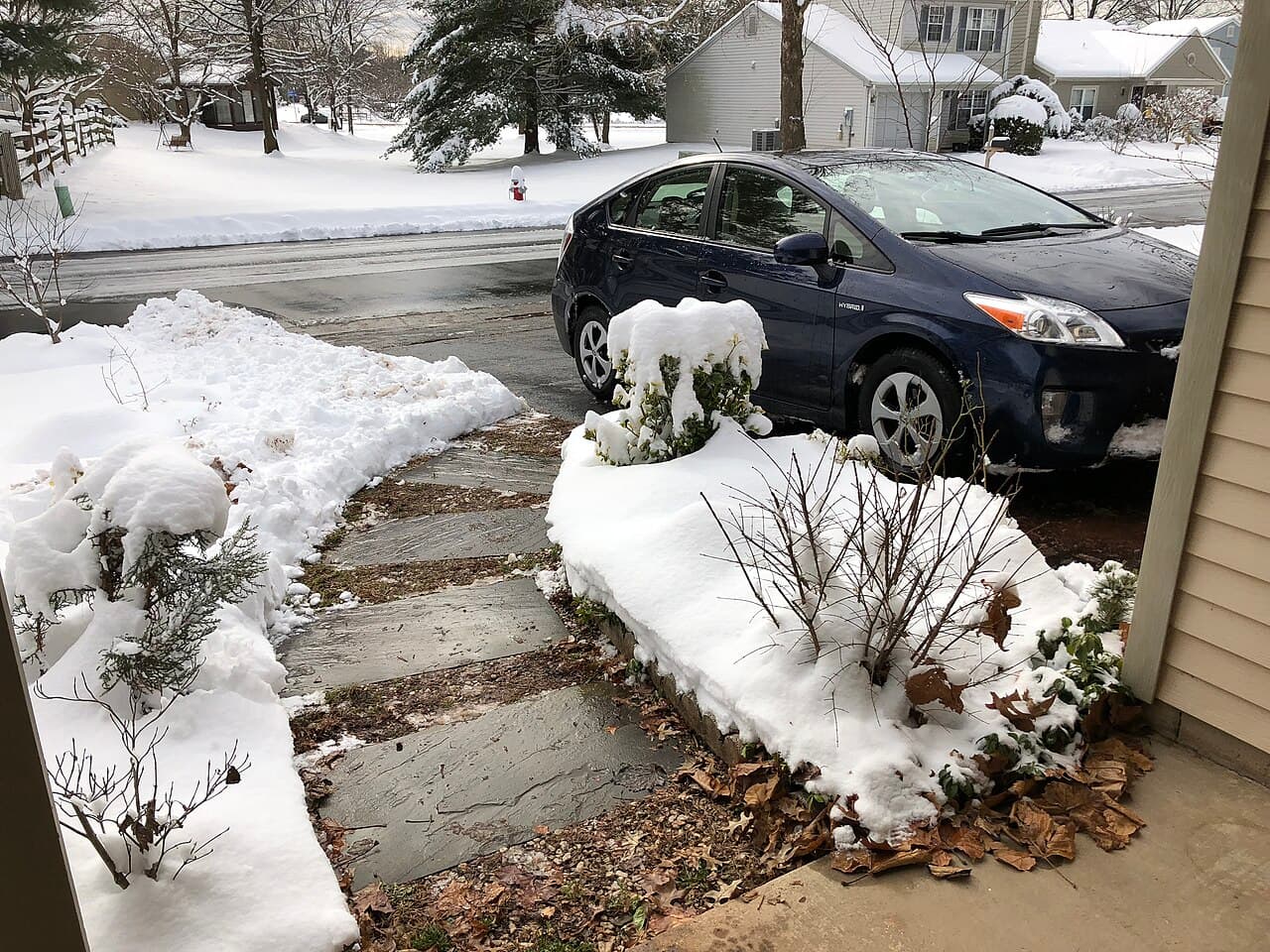
What the plow leaves behind
Plows move the bulk of the snow, not the last layer. On public roads, VDOT says its neighborhood plowing leaves roads drivable but possibly "snow-packed or even icy" rather than bare pavement.[2] Alexandria describes a "cleared" street as one with snow pushed to the sides, "leaving one or two inches of snow, or cleared down to blacktop".[4] Driveways work the same way. A blade usually rides a little above the surface, and on gravel it has to, so some snow remains. Richmond's public works department adds that when the snowfall is less than 2 inches, or the accumulation is primarily ice, plow blades are not as effective.[3]
That leftover layer is the start of the problem. Tires pack it into a hard, smooth sheet, and every melt-and-freeze cycle adds a little more ice.
The melt-and-freeze cycle
The National Weather Service defines black ice as patchy ice on roadways or other transportation surfaces that cannot easily be seen.[1] It is most common in the early morning, especially after snow melt has a chance to refreeze overnight when the temperature drops below freezing.[1] It also forms when surfaces are wet from rain and the temperature drops below freezing overnight.[1] A driveway that looked merely wet at 4 p.m. can be a sheet of ice at 7 a.m.
Dark pavement warms in the sun even on a cold day, so the surface melts at midday while the air stays near freezing. The water sits or runs downhill, then freezes as soon as the sun goes down.
Where the water comes from
Look for the source, because it is usually something you can change:
- Snow piles on the high side. A pile beside the top of the driveway melts all week and sends a thin sheet of water across the pavement every afternoon.
- The street plow's ridge. On public streets, crews push snow off the road, to the right, and it can block driveways.[2] If that ridge is left at the end of the drive, it melts back across the apron.
- Downspouts. A downspout that empties onto or toward the driveway carries roof melt across it, day after day, long after the storm.
- Low spots. A sunken slab, a dip in the asphalt or a settled edge holds water that freezes into a patch in the same place every night.
- Shade. A section shaded by the house, a fence or evergreens never gets the sun's help. Even Richmond's public works crews adjust their treatment when one side of a street is shadier or carrying more ice than forecast.[3]
Cold that is too deep for salt
Ice melt is not magic in every weather. Richmond notes, about its road treatment, that salt and chemicals can speed up melting when temperatures are above 20 degrees, and sand helps with traction on icy roads.[3] VDOT does not apply salt brine when temperatures are below 20 degrees or when winter weather starts as rain.[2] So salt spread at dusk before a very cold night may do little. Spread it in the afternoon while there is still some warmth, and switch to sand when the cold sets in.
Snow that bonds to the pavement
Snow that falls on bare, untreated pavement can freeze to it, which is why the bottom layer is so hard to scrape. Road crews pre-treat for this reason: VDOT says applying chemicals to dry pavement before a storm helps prevent a bond from forming between the pavement and the snow and ice after the storm starts.[2] Alexandria's crews sometimes salt a street first "so that the snow will be soft enough to plow on the next pass".[4] At home, a light treatment before the snow starts, or between passes in a long storm, keeps the last layer loose enough to shovel. See how to get your driveway ready before a snowstorm.
Going easy on the yard
Salting the same spot all winter has a cost. Virginia Cooperative Extension explains that as the ice and snow melt, runoff carries the salt to low-lying areas and into the soil,[5] where it harms roots. Extension suggests you use a 50/50 mix of sand and granular de-icer, or calcium, potassium or magnesium products instead of sodium-based ones.[5] Fixing the water source means you need less of any of them.
Stop and call a pro if
- The same low spot or sunken slab ices over after every storm. Settled concrete or a dip in the asphalt needs a driveway contractor to repair or regrade; see driveway services.
- A downspout can only be moved by burying a drain line under the driveway or yard. Digging and drainage work is a job for a downspout and drainage pro.
- Ice or icicles are building along the roof edge over the driveway. That points to ice dams, which are roof work; see roof snow and ice dam services.
- Someone in the household has already slipped, or you cannot keep up with treatment. A company that does salting and de-icing can treat on a schedule.
More snow help is under snow and seasonal answers, including the best way to clear a driveway after a big snow. Find seasonal services around Blacksburg, or describe the job once and local businesses quote it.
Common questions
- Why is my driveway icy in the morning when it was wet the afternoon before?
- That is the classic black ice pattern. The National Weather Service says black ice is most common in the early morning, especially after snow melt has had a chance to refreeze overnight once the temperature drops below freezing. Push water and slush off the pavement before dark.
- Why did the salt stop working?
- Salt needs some warmth to work. Richmond's public works department notes that, on its roads, salt and chemicals can speed up melting when temperatures are above 20 degrees. On a colder night, ordinary rock salt does little, so sand for traction is the practical fallback.
- Should my plow operator scrape down to bare pavement?
- A plow blade usually rides slightly above the surface, and on gravel it has to, so a thin layer is normal. Ask whether shoveling or treatment of what is left is part of the service, or plan to handle that layer yourself the same day.
- Why does ice always form in the same spot?
- Usually because water collects or runs there: a low spot or sunken slab that holds a puddle, a downspout that empties onto the pavement, the foot of a snow pile, or a patch that stays in shade all day. Watch the driveway on a sunny afternoon to see where the water goes.
- Will salt from the driveway hurt my lawn and shrubs?
- It can. Virginia Cooperative Extension explains that as ice and snow melt, runoff carries the salt into low-lying soil, where it can damage plants. Use less, keep salty snow off beds, and consider a sand mix or calcium, potassium or magnesium products.
Sources
- [1] Ice Storms (black ice and frost), National Weather Service. Checked October 26, 2026.
- [2] Winter weather: snow removal and treatment, and frequently asked questions, Virginia Department of Transportation. Checked October 26, 2026.
- [3] Snow Removal, City of Richmond, Department of Public Works. Checked October 26, 2026.
- [4] Snow and Ice Control, City of Alexandria, Virginia. Checked October 26, 2026.
- [5] Trees and Shrubs that Tolerate Saline Soils and Salt Spray Drift (430-031), Virginia Cooperative Extension, Virginia Tech. Checked October 26, 2026.
Want a pro to handle it?
Describe the job once. Licensed local businesses send quotes, and you pay only when you book one.
Get a quote from a local pro