What yard work should I do in the fall in Virginia?
Mulch or remove the leaves, test the soil, and feed a cool-season lawn between September and November. Aerate compacted cool-season turf in fall, but not warm-season grass. Clean gutters at least once a year, and keep leaves off storm drains. Cut down on bagging by mowing moist leaves back into the lawn.
Free to ask. Local shops send quotes, and you pay only when you book one.
By Kasra Taheri, Founder, LoclisPublished
Researched and drafted with AI, then checked claim by claim against the sources listed below before it was published. Prices and rules change; the dates beside each source say when it was last checked.
Step by step
Read when to stop and call a pro, further down this page, before you start.
Step 1: Check your grass type
Find out whether you have cool-season grass (tall fescue, Kentucky bluegrass) or warm-season grass (bermudagrass, zoysia), because the fall jobs differ.[2]
Step 2: Pick up sticks and limbs
Walk the lawn and remove sticks and branches so they do not turn into flying debris under the mower.[1]
Step 3: Mulch the leaves into the lawn
Mow over moist leaves, up to about 6 inches deep, making more than one pass if needed. Wear goggles and a mask.[1]
Step 4: Rake pine needles and thick drifts
Rake pine needles into shrub beds, and clear any leaves piled over storm drains.[1]
Step 5: Take a soil sample
Test the soil for pH and nutrients, then apply lime in fall or winter only if the test says so.[2]
Step 6: Feed a cool-season lawn
Apply nitrogen between September and November at the rate on the bag, and never on frozen soil.[2]
Step 7: Aerate or dethatch if needed
On cool-season grass, aerate compacted soil and dethatch a layer of 1 inch in the fall.[2]
Step 8: Check the gutters from the ground
Look for streaks, watermarks or erosion along the drip line, which mean the gutters overflow and need cleaning.[5]
In Virginia, fall yard work comes down to five jobs: deal with the leaves, test the soil, feed and lime a cool-season lawn, aerate if the ground is compacted, and keep gutters and drains clear. Most of it is a weekend of work with a mower and a rake.
Start with the leaves
Leaves left in a thick layer do real harm. A thick layer of leaves blocks sunlight, reducing turf growth because of the shading effect, and the leaves also trap and hold moisture in the turf canopy, increasing the potential for turf disease.[1]
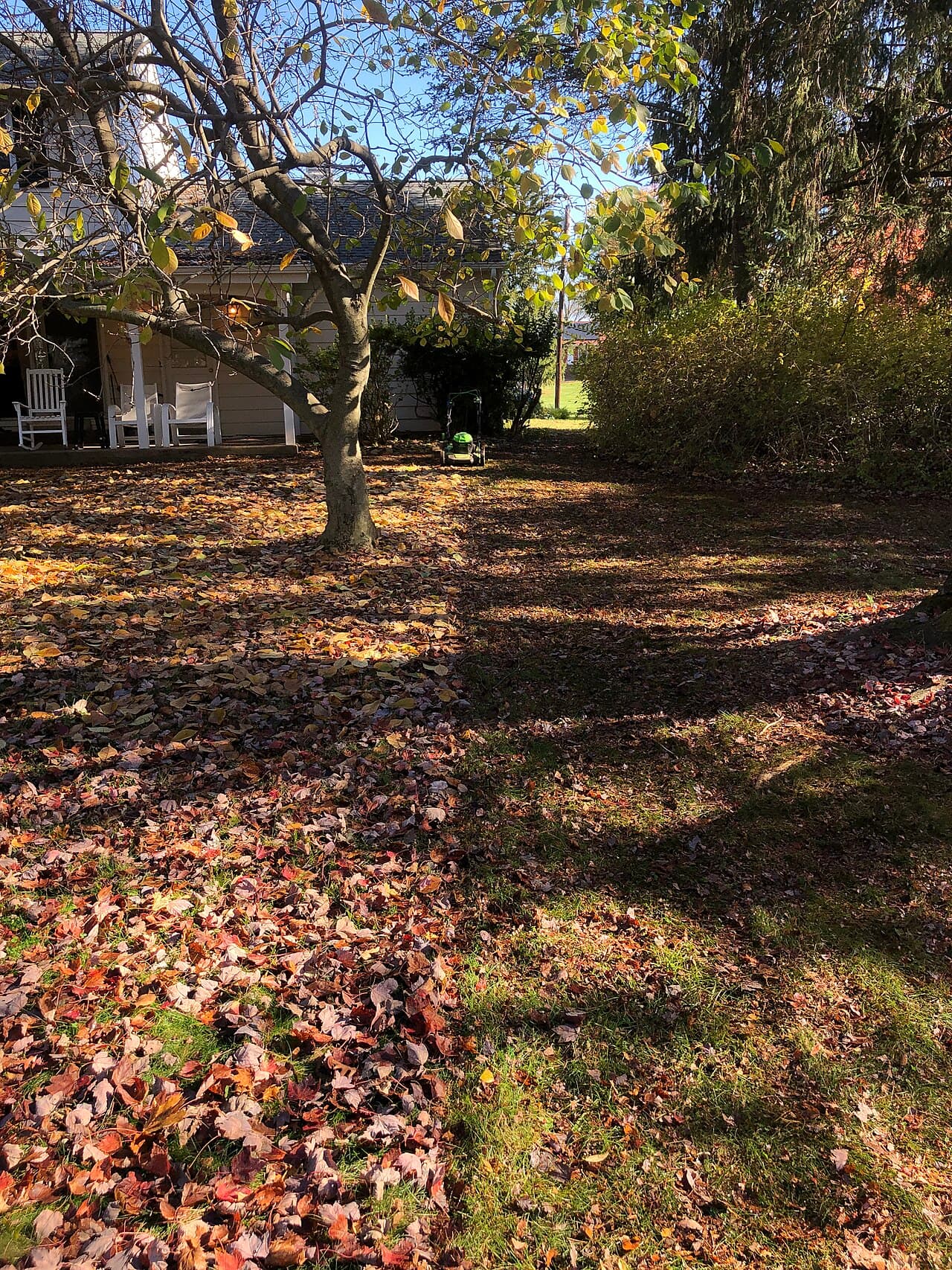
You do not have to bag them. Virginia Cooperative Extension says chopping up deciduous leaves as part of a regular mowing schedule is an effective means of managing these leaves without harming the turf.[1] Extension reports that a depth of up to 6 inches of leaves can be successfully mulched at a time, though it varies with your mower, and it may take several passes.[1] Mulch moist leaves: if they are too wet, they strain the engine and do not chop finely.[1]
Two cautions. First, clear sticks and limbs before you mow, and wear safety goggles and a mask over your mouth and nose.[1] Second, pine needles are the exception, because they are highly resistant to microbial breakdown and stay physically intact for months even when chopped.[1] Rake those into shrub beds as mulch instead.
If you would rather haul leaves away, check your locality first. Fairfax County, for example, runs vacuum leaf collection in designated areas from November through January, and its rules say to keep piles no more than 4 feet from the edge of the street and never block storm drains.[3] Other localities set their own rules, so look up yours.
Look after the lawn
What you do depends on the grass. Late summer to mid-fall is the best time to establish cool-season turfgrass, such as tall fescue and Kentucky bluegrass.[2] Warm-season grasses such as bermudagrass and zoysia go dormant after the first killing frost.[2]
Test the soil before you buy anything. Extension advises testing at least once every three years, and notes that the fall and winter months are ideal times to make lime applications because it takes weeks to months to fully realize the benefit.[2] Apply lime only if the test calls for it.
For fertiliser on a cool-season lawn, Extension uses the memory aid "SON," for September, October and November, and says one fall application is often enough on a well-established lawn.[2] Its guidance is to use up to 0.7 pound of water-soluble nitrogen per 1,000 square feet at four-week intervals, and never apply fertilizer to frozen soil.[2] Read the bag for its nitrogen content so you can work out how much to spread.
Compacted lawns benefit from core aeration, and a lawn with a thatch layer of 1 inch needs dethatching.[2] On cool-season grass, do both in the fall.[2] Warm-season grass is the opposite: fall is too late to safely aerate or dethatch it, so wait for late spring or early summer.[2]
Do not forget the gutters
Gutters should be cleaned free of debris at least once a year, and more often if you have trees close to your house.[5] Streaks or watermarks on the outside of a gutter, or erosion along the drip line, are signs that it is overflowing when it rains.[5] Fall, after the leaves come down, is the natural time.
Stop and call a pro if
- The leaf pile hides storm drains or a drainage ditch. Fairfax County, for one, lists leaves blocking a storm drain as an unacceptable set-out, which is a good rule anywhere.[3] Clear the opening and ask your locality what it expects.
- Gutters are above the first story, or you would be standing on the roof. Hire a gutter pro rather than risk a fall.
- Gutters overflow even when clean. If you see spillover in normal rain, the gutter system may be undersized.[5]
- The job includes limbs, stumps or tree removal. Fairfax County does not count material from tree removal as ordinary yard waste.[4] Large limbs and dead trees are work for a tree service.
- You want weed or pest chemicals applied for you. In Virginia, a business that applies pesticides for pay needs a pesticide business license.[6]
Getting help in Virginia
If a whole fall of yard work is too much, read what a fall yard cleanup costs in Virginia and whether a spring and fall cleanup service is worth it. Browse more snow and seasonal answers or the seasonal services on Loclis.
When you are ready, describe your yard once and local pros quote it.
Common questions
- Do I have to rake all my leaves in the fall?
- No. Virginia Cooperative Extension says chopping deciduous leaves with a regular mowing schedule manages them without harming the lawn.[^vce-leaves] Mow moist leaves up to about 6 inches deep, and rake or bag only what the mower cannot handle, such as pine needles.
- When should I fertilize my lawn in the fall in Virginia?
- For cool-season grass, Extension points to September, October and November, and says a single fall application is often enough on a well-established lawn.[^vce-fall] Soil-test first and never apply fertilizer to frozen soil.
- Should I aerate in the fall?
- On cool-season grass such as tall fescue, yes, if the soil is compacted. Extension recommends waiting until fall to aerate or dethatch it.[^vce-fall] On warm-season grass such as bermudagrass or zoysia, fall is too late, so wait until late spring or early summer.[^vce-fall]
- How often should I clean my gutters?
- At least once a year, and more often if trees are close to the house.[^nvswcd] After the leaves have come down is a sensible time. If the gutter is above the first story, hire a pro.
- Can I put leaves out for the town to collect?
- It depends on your locality. Fairfax County collects leaves in designated areas from November through January with set-out rules, while Extension notes that in some areas it is illegal to place bagged leaves at curbside.[^vce-leaves][^ffx-leaf] Check your own county or city website before you set anything out.
Sources
- [1] "Leave" Them Alone: Lawn Leaf Management (430-521), Virginia Cooperative Extension, Virginia Tech. Checked October 27, 2026.
- [2] Fall Lawn Care (430-520), Virginia Cooperative Extension, Virginia Tech. Checked October 27, 2026.
- [3] Vacuum Leaf Collection, Fairfax County Department of Public Works and Environmental Services. Checked October 27, 2026.
- [4] Yard Waste, Fairfax County Department of Public Works and Environmental Services. Checked October 27, 2026.
- [5] Gutters and Downspouts: Wetness or Erosion Problems, Northern Virginia Soil and Water Conservation District, Fairfax County. Checked October 27, 2026.
- [6] Pesticide Business License, Virginia Department of Agriculture and Consumer Services. Checked October 27, 2026.
Want a pro to handle it?
Describe the job once. Licensed local businesses send quotes, and you pay only when you book one.
Get a quote from a local pro