What should be on a spring yard cleanup checklist?
Pick up sticks and leftover leaves, clear gutters and downspouts, rake off matted grass, refresh beds, test the soil, and mow once the grass is growing. Time weed prevention for crabgrass, hold off on heavy fertilizer, and cut back leaf litter and tall grass near the house to reduce ticks. In Fairfax County, bag yard waste in paper or reusable containers, not plastic.
Free to ask. Local shops send quotes, and you pay only when you book one.
By Kasra Taheri, Founder, LoclisPublished
Researched and drafted with AI, then checked claim by claim against the sources listed below before it was published. Prices and rules change; the dates beside each source say when it was last checked.
Step by step
Read when to stop and call a pro, further down this page, before you start.
Step 1: Walk the yard and pick up debris
Collect fallen sticks, branches and winter litter so they do not become flying debris under the mower.
Step 3: Clean gutters from the ground
Check that gutters and downspouts are free of debris; Fairfax County's soil and water conservation district says gutters should be cleaned at least once a year.[6] If it needs a ladder, hire it out.
Step 4: Rake matted grass gently
Lift flattened, matted turf with a leaf rake so new growth can come through.
Step 5: Test the soil
Take a soil sample before adding lime or fertilizer.[4]
Step 6: Time weed prevention
If you use a spring preemergent for crabgrass, check that you are not planning to seed the same area.[2]
Step 7: Refresh the beds
Pull weeds, edge the beds, and top up mulch if it has thinned, without piling it against trunks.[9]
Step 8: Cut back tall grass and brush
Clear tall grass and brush around the house and at lawn edges to reduce ticks.[8]
Step 9: Bag the waste properly
In Fairfax County, put yard waste in reusable containers or paper lawn bags, not plastic.[7] Check your own locality's rules.
Step 10: Start mowing when the grass grows
Cut no more than one-third of the height at a time.[3]
The short checklist
A spring cleanup in Virginia is a short list: clear the winter debris, get water moving away from the house, wake up the lawn gently, refresh the beds, and bag it all the right way. Do it in that order and most of it takes a weekend with a rake, a mower and a pair of loppers.
Start with the walk-around. Pick up sticks, limbs and anything the wind or the snow moved. Then work through the sections below.
Debris and leaves
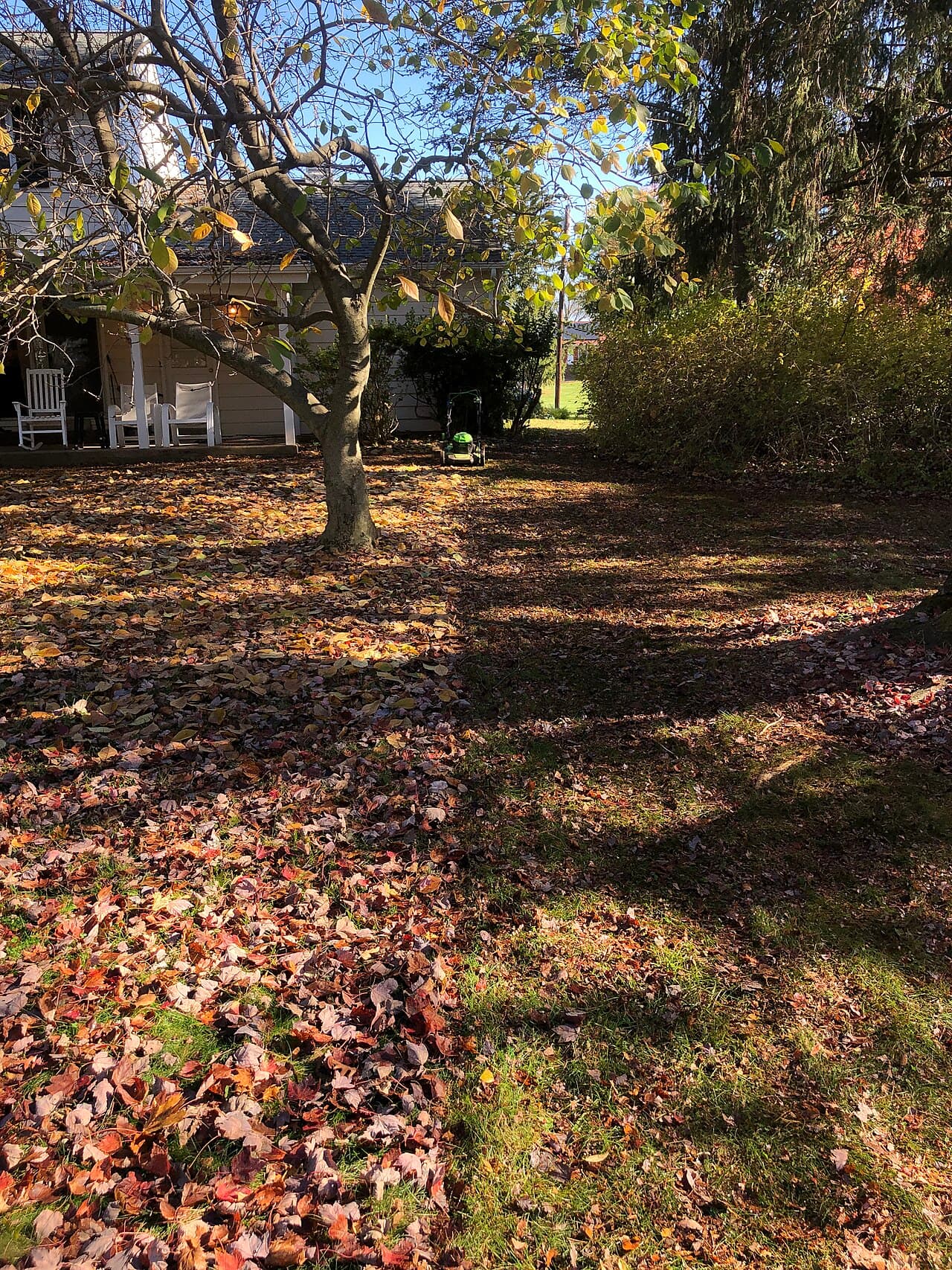
Rake or mow off the leaves still on the lawn. A thick layer of leaves blocks sunlight, reducing turf growth because of the shading effect,[1] and a wet mat left from winter is where thin, pale patches begin. If the lawn looks worse than that after winter, read why a lawn looks worse after winter.
Leaf litter and tall grass near the house are worth the extra minutes. Increasing exposure to sun and air by removing leaf litter, mowing the lawn and clearing tall grass and brush around houses and at the edges of lawns will reduce the numbers of ticks that transmit Lyme disease.[8]
Gutters and downspouts
Gutters should be cleaned free of debris at least once a year.[6] This should be done more frequently if you have trees close to your house.[6] If you did them last fall, spring is the time to check that nothing washed in over winter, that downspouts run clear and that water leaves the gutter at the downspout instead of spilling over the edge. A ladder is the riskiest item on this list; if you are not comfortable, hire it out.
The lawn
Go easy. Rake gently, and wait for the grass to grow before you mow. When mowing starts, only cut one-third of the height of the lawn at a time.[3] Leave the clippings: Fairfax County's advice is to leave grass clippings on your lawn by grasscycling.[7]
Weed prevention is the one spring job with a deadline. Spring preemergent (PRE) herbicide applications are primarily targeting summer annual weeds such as crabgrass, goosegrass, or foxtails.[2] Before applying any PRE herbicide consider possible effects it will have on seeding desirable turfgrasses in the future,[2] so skip it on any patch you plan to seed. Read and follow the product label.
On fertilizer, wait. For warm-season grass, initiate N fertilization for warm-season grasses AFTER spring greening is complete.[5] Base anything beyond nitrogen on a soil test: it is recommended to test homelawn soils every 3-4 years.[2]
Thatch matters only when it is deep. Dethatch in spring or early fall if thatch (the brown layer between the grass blades and the soil surface) is greater than ½ inch deep.[3] For the bigger renovation jobs, see how to aerate and overseed a lawn.
Beds and mulch
Pull early weeds, cut back last year's dead stems, edge the bed and top up mulch if it has thinned. Avoid overly deep mulch or piling the mulch up against the trunk of the shrub; this promotes shallow roots, disease, and pest injury.[9] Keep it thin and pulled back from trunks.
Bagging and hauling
Know what counts as yard waste where you live. In Fairfax County, yard waste includes grass clippings, leaves, straw, flowers, small prunings, and brush (i.e., branches and twigs smaller than 4-feet in length) generated during general yard maintenance.[7] Fairfax County prohibits the use of plastic bags for yard waste,[7] so use reusable containers or paper lawn bags. Other localities and private haulers have their own rules, so check yours before setting anything out.
Stop and call a pro if
- A limb is hanging or split. Leave it alone and call a tree service, especially near wires.
- Gutters are out of reach. A two-storey ladder job is better hired out.
- You are told to spray for ticks. Pesticide application to residential properties should be supervised by a licensed professional pest control expert, according to the Fairfax County Health Department.[8]
- Water stands in the yard after spring rain. That is a drainage problem, not a cleanup problem.
- There is a lot to do. A full spring cleanup is also the job a seasonal service takes on; see whether a spring and fall cleanup service is worth it.
Getting help in Virginia
For the fall version of this list, read what yard work to do in the fall in Virginia, and for what hiring it out costs, how much fall yard cleanup costs in Virginia. Browse more snow and seasonal answers or the seasonal services on Loclis.
When you are ready, describe your yard once and local pros quote it.
Common questions
- When should I start spring yard cleanup in Virginia?
- Once the ground is no longer frozen or soggy, since walking and raking on wet turf compacts it. Debris, gutters and beds can be done early. Mowing, feeding and weed prevention follow the grass, not the calendar, and depend on whether you have cool-season or warm-season turf.
- When should I put down crabgrass preventer?
- Spring preemergent herbicides are aimed at summer annual weeds such as crabgrass, goosegrass and foxtails.[^vce-cal] Follow the product label for timing and rate, and remember that before applying any PRE herbicide you should consider its effect on seeding desirable turfgrasses in the future,[^vce-cal] so skip it where you plan to seed.
- Should I fertilize the lawn in early spring?
- Not early. For warm-season grass, Extension says to initiate N fertilization for warm-season grasses AFTER spring greening is complete.[^vce-warm] A soil test tells you whether you need anything beyond nitrogen; Extension recommends testing home lawn soils every 3-4 years.[^vce-cal]
- Can I put spring yard waste in plastic bags?
- Not in Fairfax County: Fairfax County prohibits the use of plastic bags for yard waste.[^ffx-yard] Use reusable containers or paper lawn bags, or tie branches up with string. Other localities and private haulers have their own rules, so check yours.
- Does spring cleanup help with ticks?
- Yes. Fairfax County's health department says increasing exposure to sun and air by removing leaf litter, mowing the lawn and clearing tall grass and brush around houses and at the edges of lawns will reduce the numbers of ticks that transmit Lyme disease.[^ffx-tick]
Sources
- [1] "Leave" Them Alone: Lawn Leaf Management (430-521), Virginia Cooperative Extension, Virginia Tech. Checked October 27, 2026.
- [2] Maintenance Calendar for Cool-Season Turfgrasses in Virginia (430-523), Virginia Cooperative Extension, Virginia Tech. Checked October 27, 2026.
- [3] 2026 Pest Management Guide: Home Grounds and Animals, Chapter 5: Lawn (456-018, ENTO-634-E), Virginia Cooperative Extension, Virginia Tech. Checked October 27, 2026.
- [4] Fall Lawn Care (430-520), Virginia Cooperative Extension, Virginia Tech. Checked October 27, 2026.
- [5] Maintenance Calendar for Warm-Season Turfgrasses in Virginia (430-522), Virginia Cooperative Extension, Virginia Tech. Checked October 27, 2026.
- [6] Gutters and Downspouts: Wetness or Erosion Problems, Northern Virginia Soil and Water Conservation District, Fairfax County. Checked October 27, 2026.
- [7] Yard Waste, Fairfax County Department of Public Works and Environmental Services. Checked October 27, 2026.
- [8] Tick-Free Yard, Fairfax County Health Department. Checked October 27, 2026.
- [9] Shrubs: Functions, Planting, and Maintenance (426-701), Virginia Cooperative Extension, Virginia Tech. Checked October 27, 2026.
Want a pro to handle it?
Describe the job once. Licensed local businesses send quotes, and you pay only when you book one.
Get a quote from a local pro