When should I call a plumber for a clogged drain?
Call a licensed plumber when a plunger and a hand snake have not cleared a single drain, when water backs up as you use the toilet, tub, washer or sinks, when you smell sewage, or when the same drain keeps clogging. If neighbors are backing up too, or sewage comes up with nothing running, call your city or county sewer utility first.
Free to ask. Local shops send quotes, and you pay only when you book one.
By Kasra Taheri, Founder, LoclisPublished
Researched and drafted with AI, then checked claim by claim against the sources listed below before it was published. Prices and rules change; the dates beside each source say when it was last checked.
Step by step
Read when to stop and call a pro, further down this page, before you start.
Step 2: Try the plunger on one drain
Plunge a single sink or tub with the overflow or second bowl plugged, and repeat once if the first round does not clear it.[4] Skip this if a chemical opener is already in the drain.
Step 3: Check which fixtures are affected
Note whether only one drain is slow, or whether water backs up only when you use a toilet, tub, washer or sink.[1]
Step 4: Ask the neighbors
Ask neighbors whether they are backing up too, and call the sewer utility first if several buildings are affected.[3]
Step 5: Check the plumber's licence
Look the business up on DPOR's licence lookup or call the Board for Contractors to confirm the licence is valid.[6]
Step 6: Get the price in writing
Get a written quote, and for a repair a written contract that says who obtains any permit.[6]
Call when the easy fixes have failed, or the clog is not just one drain
A single slow sink or tub is worth one honest try yourself. Call a licensed plumber when that try fails, when more than one drain is involved, or when you see the warning signs of a sewer line problem below. Call the sewer utility first when neighbors are backing up too.
What to try on one drain first
Plunge it properly. In a single-bowl sink, plug the overflow opening with a washcloth or rag; in a double-bowl sink, plug the other drain.[4] Then press the plunger down smoothly, jerk it up sharply, and repeat 20 to 30 times.[4] A hand snake is the next tool. For a tub, see how to unclog a bathtub drain.
Under a sink, the U-shaped trap is where the trouble usually sits. Most clogs are in the trap.[4] Some traps have a cleanout plug that can be opened with a bucket underneath, but never open one while a chemical opener is in the drain. If this effort does not remove the clog or the trap does not have a clean out plug, notify your landlord or call a plumber.[4]
Stop and call a pro if
Water backs up when other fixtures are used. Fairfax County's wastewater division says: "If the backup occurs only when facilities (such as toilet, tub, washer or sinks) are used, it is possible that you need a plumber."[1] Water rising in the tub when the washer drains, or in a floor drain when the toilet flushes, usually means the blockage is further down a shared line than a plunger reaches.
The same drain keeps clogging, or you smell sewage. Fairfax County's code compliance office lists the signs: "Signs that laterals may require repair include: Frequently clogged drains, odor of sewage, and basement backups during rain."[2] The lateral is the pipe that carries waste out to the public sewer, and a camera inspection is how a plumber sees inside it.
A chemical opener is already in the drain. Do not plunge it, snake it or open the trap. A splash of drain opener in the eyes can cause burns that may result in permanent vision loss.[5] Tell the plumber which product it was before they open anything.
You have been leaning on chemical cleaners. For a backup, Salem's water department says: "Chemical drain cleaners are not likely to help and can cause additional damage."[3] A drain that keeps needing them has a cause a plumber should find.
Several drains are slow at once, or the lowest drain in the house is the one backing up. That usually points to the main line, not a single fixture.
The plumber or a camera finds roots or a broken pipe. In Fairfax County: "If a repair or replacement is to be made on private property, a plumbing permit from the county is required."[2] Fairfax County's Department of Code Compliance also says: "A plumber must be certified, licensed and bonded to make any repairs."[2] Ask your own county or city building office what it requires.
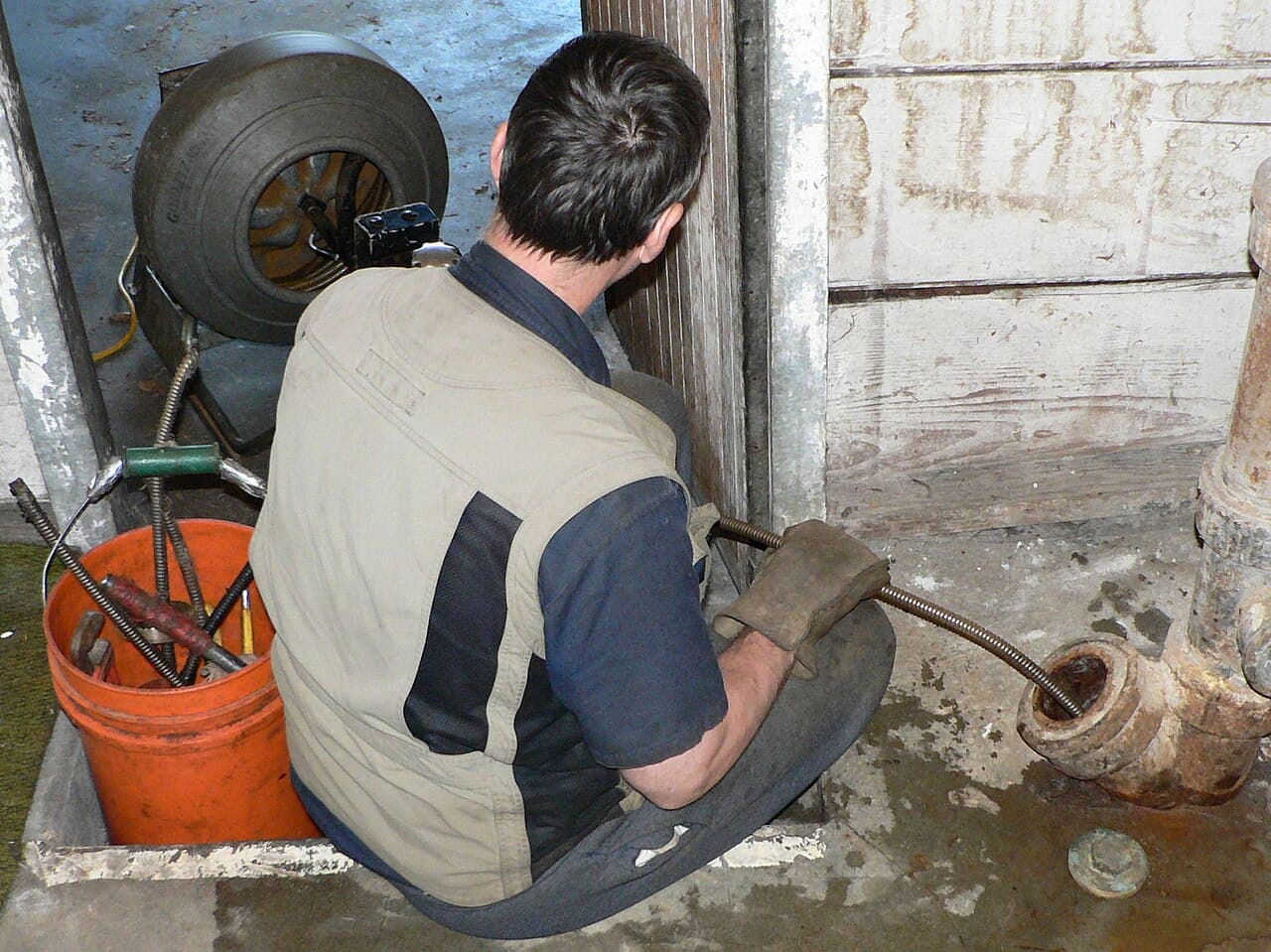
When to call the utility instead
Not every backup is yours to pay for. In Fairfax County, sewage that backs up when nothing in the house is in use may mean a problem in the county main line, and the county sends a Wastewater Collection Division representative to check it.[1] If the county line is operating normally, the private building sewer lateral is the likely cause and the owner is told to contact a plumber.[1] Fairfax County's 24-hour Customer Communications Center is 703-323-1211 (TTY 711).[1]
The City of Salem's test is simple: "Contact neighbors to help determine if the blockage is inside the building or on the sewer main."[3] If the problem is affecting multiple buildings, Salem residents are told to call the Salem Water Department at 540-375-3029 right away; if it appears to be one building, contacting a licensed plumber is recommended.[3] Elsewhere in Virginia, find your own utility's emergency number on your water and sewer bill, and save it before you need it.
If sewage is coming up right now
Salem's guidance is to shut off any running water, seal sink, tub and floor drains, and keep yourself, other people and pets away from the wastewater, which can contain harmful bacteria and chemicals.[3] If your basement has a sump pump, Salem says to turn it off, since sump pumps are meant to pump clear water to a greenspace or storm drain.[3] "Do not pour anything down the drain until the backup has receded."[3] Fairfax County likewise advises owners to close all drain openings with stoppers or plugs and not to run any water down the drains until the blockage has been cleared.[1] Then call the utility or a plumber.
Hiring a licensed plumber in Virginia
Virginia's plumbing contractor licence (PLB) covers piping, fixtures and appurtenances for sanitary or storm drainage facilities, and these contractors also install, maintain, extend or alter sewerage systems.[8] Under the Code of Virginia, the Board for Contractors requires a master tradesman licence as a condition of licensing plumbing contractors.[7] The same law sets the licence classes by the size of the work. Class C covers a single contract or project worth "over $1,000 but less than $30,000," Class B covers $30,000 or more but less than $150,000, and Class A covers $150,000 or more.[7] A contractor's total work over any 12-month period also counts toward the class.[7]
Check before you hire. The Board for Contractors warns: "A license number in an advertisement or on a business card does not necessarily mean the contractor's license is valid."[6] So check it on DPOR's website or with the Board for Contractors at (804) 367-8511.[6] "Unlicensed contracting is against the law."[6] And if you contract with someone who does not hold a license, the Board may not be able to help you resolve a complaint.[6]
For anything past a simple cleaning, get it in writing. Virginia law requires all licensed contractors to provide a written contract for residential work,[6] and the Board's advice is that licensed contractors should apply for and obtain all building permits, not the consumer.[6] For a line repair, make sure the quote names who pulls the permit. There is more on this in how to check if a contractor is licensed in Virginia.
Finding one through Loclis
On Loclis, plumbing is licensed work at any job size, so an unlicensed quote is refused, and the directory shows each business's DPOR licence number and class. Find plumbers in Blacksburg, browse drain cleaning, read what drain cleaning costs in Virginia or why a drain keeps clogging, and see more plumbing answers.
When it is time, describe the clog once and licensed local plumbers quote it.
Common questions
- Should I call the city or a plumber for a sewer backup?
- Ask the neighbors first. Salem tells residents to call the city water department if a backup is affecting several buildings, and Fairfax County says sewage backing up with nothing in use may mean a problem in the county main. If it appears to be only your house, Salem recommends a licensed plumber.
- Is it an emergency if sewage is coming into the house?
- Treat it as one. Shut off running water, plug the drains, keep people and pets away from the wastewater, and call your utility or a plumber. Salem's water department warns that wastewater can contain harmful bacteria and chemicals.
- How do I check that a plumber is licensed?
- Look the business up on DPOR's licence lookup or call the Board for Contractors. A licence number printed on an ad or a card is not proof that the licence is current, and the record should show a plumbing (PLB) classification.
- How long should I try to clear a drain myself?
- For one sink or tub, a couple of rounds of proper plunging and a hand snake is a fair try. If that has not cleared it, or the trap has no cleanout plug and the clog is past it, call a plumber rather than escalating to chemicals.
- Can I keep using chemical drain cleaner instead?
- Not for a real clog. In a backup, Salem's water department says chemical drain cleaners are not likely to help and can cause additional damage. A drain that keeps needing them has a cause a plumber should find, and if one is in the drain now, do not plunge it or open the trap.
Sources
- [1] Wastewater Management: Sanitary Sewer Emergencies, Fairfax County Department of Public Works and Environmental Services. Checked October 26, 2026.
- [2] Sanitary Sewer House Lateral (published November 2024), Fairfax County Department of Code Compliance. Checked October 26, 2026.
- [3] Water & Sewer: Backup vs. Overflow, frequently asked questions, City of Salem, Virginia. Checked October 26, 2026.
- [4] Making Simple Repairs: Clogged Drains (FCS5234-05, archived fact sheet), UF/IFAS Extension, University of Florida. Checked October 26, 2026.
- [5] Drain opener poisoning, MedlinePlus, U.S. National Library of Medicine. Checked October 26, 2026.
- [6] What You Should Know Before You Hire a Contractor, Virginia Board for Contractors, DPOR. Checked October 26, 2026.
- [7] Code of Virginia § 54.1-1100. Definitions (contractors), Virginia General Assembly, Legislative Information System. Checked October 26, 2026.
- [8] 18VAC50-22-20. Definitions of license classifications, Virginia Board for Contractors, Virginia Administrative Code. Checked October 26, 2026.
Want a pro to handle it?
Describe the job once. Licensed local businesses send quotes, and you pay only when you book one.
Get a quote for Plumbing Repair