Which direction should a ceiling fan spin in summer and winter?
In summer, counterclockwise, looking up at the fan, so it pushes air straight down and you feel a breeze. In winter, clockwise on low speed, which draws air up and lets warm air near the ceiling drift back down without a draft. ENERGY STAR and Hunter give the same rule. The direction is set by a reversing switch, or by the remote on some models.
Free to ask. Local shops send quotes, and you pay only when you book one.
By Kasra Taheri, Founder, LoclisPublished
Researched and drafted with AI, then checked claim by claim against the sources listed below before it was published. Prices and rules change; the dates beside each source say when it was last checked.
This is a job for a licensed pro in Virginia
This page explains what the work involves, the permits, what a licensed pro does and what drives the cost. It does not give step-by-step instructions, because this work needs a licence, a permit or both, and doing it wrong can injure someone. Before you hire, check the licence on Virginia's DPOR record.
Counterclockwise in summer, clockwise in winter, as you look up at the fan. That is the rule from ENERGY STAR and from the fan makers, and it comes down to which way the blades push the air.
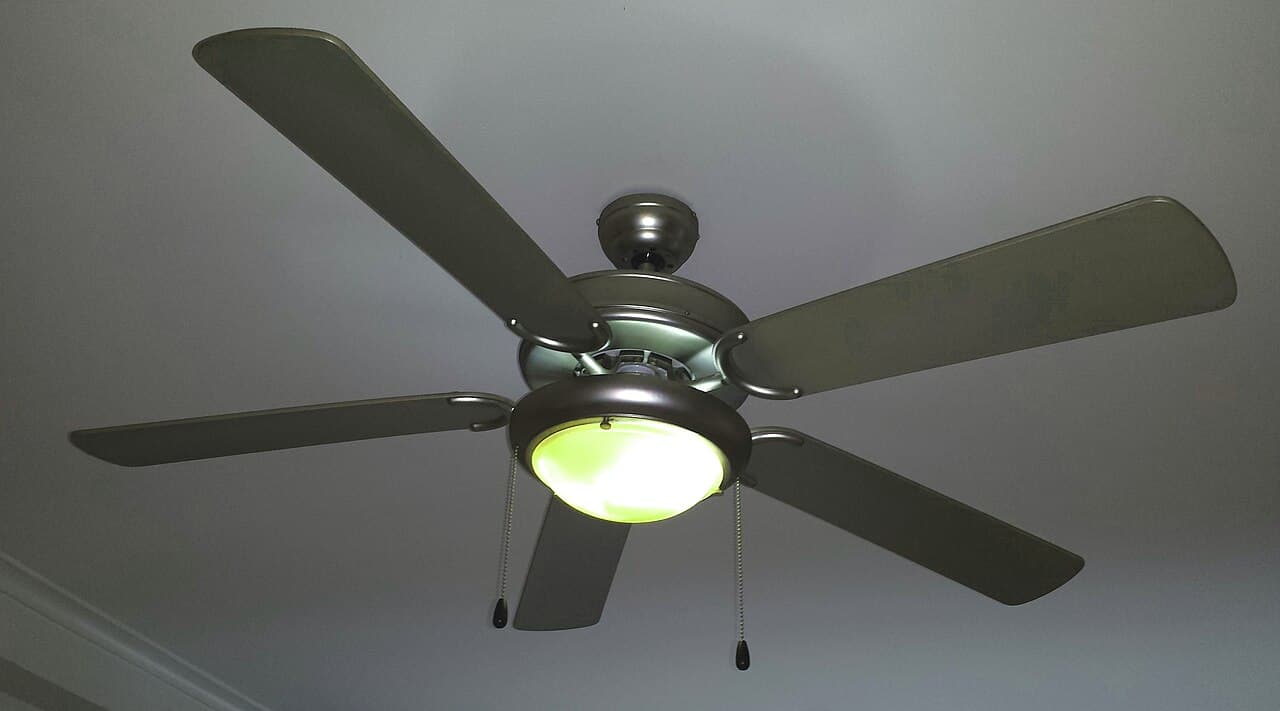
Summer: counterclockwise
ENERGY STAR's advice is short: "In the summer, use the ceiling fan in the counterclockwise direction."[1] Standing under it, you should feel a cool breeze, in its words: While standing directly under the ceiling fan you should feel a cool breeze.[1] Hunter calls this direction a downdraft, and says it creates a direct breeze and maximum cooling effect.[2]
The cooling comes from moving air across your skin, not from changing the temperature. As ENERGY STAR puts it, ceiling fans cool people, not rooms,[1] so leave the fan off in an empty room. Hunter says a ceiling fan can help make a room feel six to eight degrees cooler in the summer,[3] which is why a fan and a higher thermostat setting work well together. ENERGY STAR advises the same: Remember to adjust your thermostat when using your ceiling fan.[1]
Winter: clockwise, on low
For winter ENERGY STAR advises: "In the winter, reverse the motor and operate the ceiling fan at low speed in the clockwise direction."[1] This produces a gentle updraft, which forces warm air near the ceiling down into the occupied space.[1] Hunter's description is the same: by running your fan in a clockwise position on low speed, warm air will be pushed down and recirculated without creating a cooling effect.[3]
The low speed matters. Fast, the fan moves enough air to feel like a draft, which defeats the purpose. Slow, the air circulates without anyone feeling it. It also does the most good in rooms with high ceilings, where warm air collects out of reach.
Two names for the same two settings
Manuals describe the directions two ways, and mixing them up causes most of the confusion. Hunter's manual says ceiling fans work in two directions: downdraft (counterclockwise rotation) and updraft (clockwise rotation).[2] Downdraft is the summer setting and updraft is the winter one. Updraft creates a more indirect airflow, which suits the cold season.
Check from below. If you are not sure which way it is turning, run it on low and look up at the leading edge of a blade. Do it from the floor, not from a ladder.
How the direction is changed
Fans differ. On some, direction is set by a reversing switch on the fan itself; Hunter's Ristrello manual says the reversing switch is located inside the light fixture.[2] On others, a remote or wall control does it: Hunter says its remote lets you adjust the fan's direction and speed.[3] Which type you have depends on the model.
Work on the fan itself is a job for a licensed electrician. Hunter's warning for any servicing is to turn off the breaker: "To avoid possible electrical shock, before installing or servicing your fan, disconnect the power by turning off the circuit breakers to the outlet box and associated wall switch location."[2] Virginia also treats paid work on a fan as trade work. A tradesman is any individual who engages in, or offers to engage in, electrical, plumbing or HVAC work for the general public for compensation,[4] and no individual may engage in, or offer to engage in, work as a tradesman unless licensed.[5]
An electrician who is already there for another reason, such as a clicking or wobbling fan, can set the direction in a minute and show you where the switch is.
When to call a licensed pro
Book an electrician if:
- The fan does not change direction after the switch or remote has been set.
- You cannot find a reversing switch and cannot tell whether the model has one.
- The fan changes direction by itself, runs hot or smells of burning.
- The switch is behind a light kit you cannot remove safely.
- You are replacing the fan, and want one with a remote or wall control that handles direction.
If you are choosing a new fan, what size ceiling fan you need comes first, because a fan that is too small will not circulate enough air in either direction.
Getting help in Virginia
Loclis lists licensed businesses with their licence number and class. Browse ceiling fan installers, the wider electrical pros, or more electrical answers.
When you are ready, describe your ceiling fan job and licensed local electricians quote it.
Common questions
- How can I tell which way my fan is spinning?
- Look up at it from beneath, on low speed. Blades moving counterclockwise as you look up are in the summer setting. Many fans also push a clear breeze straight down in that setting, which is the quick test: stand under it and see whether you feel moving air.
- Should I run the fan in winter at all?
- It is optional. ENERGY STAR advises running it clockwise at low speed, which draws air up and lets warm air near the ceiling drift down into the room. Whether it is worth doing is up to you.
- Will a ceiling fan cool an empty room?
- No. ENERGY STAR puts it plainly: ceiling fans cool people, not rooms. Turn the fan off when nobody is in the room, because the breeze is what makes you feel cooler, not any change in the air temperature.
- My fan has no reversing switch. What now?
- Some models are controlled by a wall control or a handheld remote that can change direction, according to Hunter. If yours has neither a switch nor a remote setting, the electrician can tell from the model number whether it can reverse at all.
Sources
- [1] Ceiling Fan Installation and Usage Tips, ENERGY STAR, U.S. Environmental Protection Agency. Checked October 27, 2026.
- [2] Ristrello Ceiling Fan Installation Manual (PG3865, 2021), Hunter Fan Company. Checked October 27, 2026.
- [3] How to Choose a Ceiling Fan Size & Style, Hunter Fan Company. Checked October 27, 2026.
- [4] Code of Virginia § 54.1-1128, Definitions, Code of Virginia, Legislative Information System. Checked October 27, 2026.
- [5] Code of Virginia § 54.1-1129, Necessity for licensure, Code of Virginia, Legislative Information System. Checked October 27, 2026.
Want a pro to handle it?
Describe the job once. Licensed local businesses send quotes, and you pay only when you book one.
Get a quote for Electrical Repair