What size ceiling fan do I need for my room?
Match the blade span to the floor area. ENERGY STAR's chart suggests 29 to 36 inches up to 75 square feet, 36 to 42 inches up to 144, 44 inches up to 225, and 50 to 54 inches up to 400. Allow at least 7 feet from the blades to the floor. A bigger fan is heavier, so have the ceiling box checked.
Free to ask. Local shops send quotes, and you pay only when you book one.
By Kasra Taheri, Founder, LoclisPublished
Researched and drafted with AI, then checked claim by claim against the sources listed below before it was published. Prices and rules change; the dates beside each source say when it was last checked.
This is a job for a licensed pro in Virginia
This page explains what the work involves, the permits, what a licensed pro does and what drives the cost. It does not give step-by-step instructions, because this work needs a licence, a permit or both, and doing it wrong can injure someone. Before you hire, check the licence on Virginia's DPOR record.
Match the fan's blade span to the floor area of the room. ENERGY STAR's chart suggests 29 to 36 inches for rooms up to 75 square feet, 36 to 42 inches up to 144, 44 inches up to 225, and 50 to 54 inches up to 400.[1] Then check the ceiling height and the clearances, because a fan that is the right size on paper still has to hang safely.
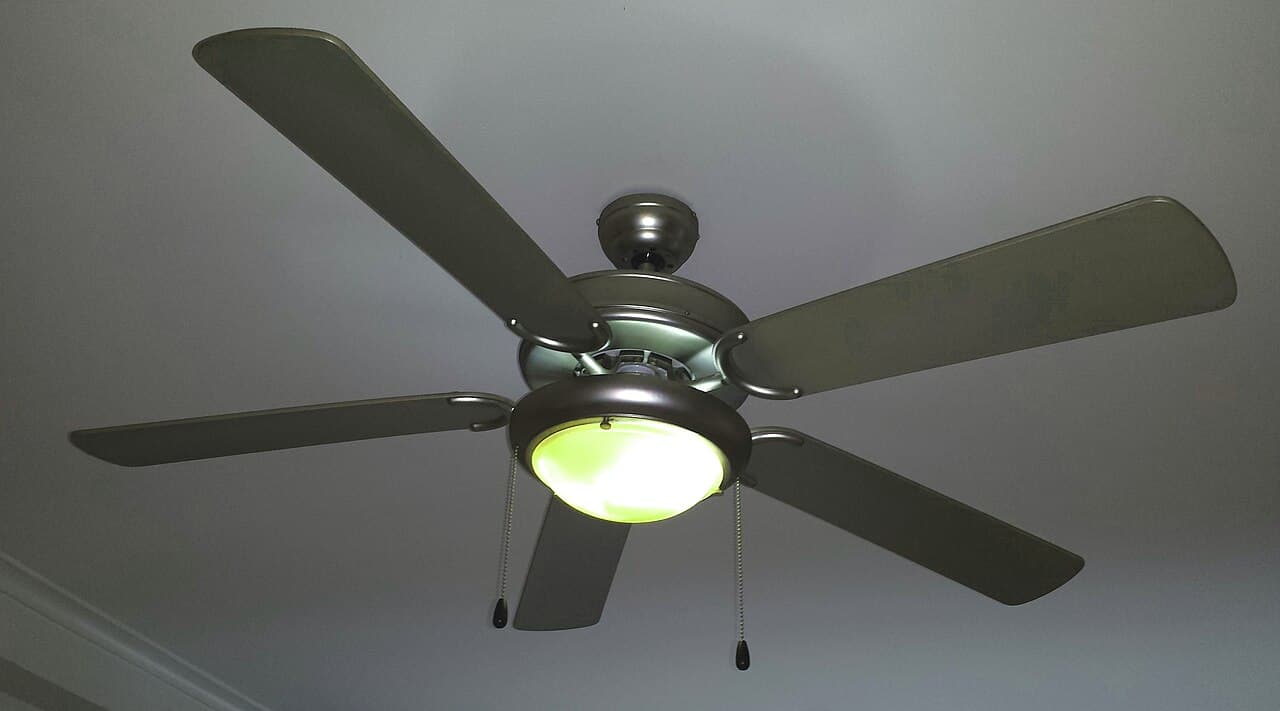
Start with the room's area
Multiply the room's length by its width in feet. A 12 by 14 foot bedroom is 168 square feet. ENERGY STAR notes that ceiling fan blade spans range from 29 to 54 inches, the most popular being the 52-inch model,[1] and publishes this chart:
- Up to 75 square feet: 29 to 36 inches.
- 76 to 144 square feet: 36 to 42 inches.
- 144 to 225 square feet: 44 inches.
- 225 to 400 square feet: 50 to 54 inches.[1]
Manufacturers draw the lines a little differently. Hunter groups rooms of 100 square feet or less with fans from 30 to 48 inches, rooms of 400 square feet or less with fans from 48 to 54 inches, and rooms over 400 square feet with fans of 56 inches or larger.[2] Treat the numbers as a range: when your room sits near a boundary, check the clearances below and pick the size that fits comfortably.
Check the clearances
Size is limited by the room as much as by the airflow you want. ENERGY STAR says a fan should be installed in the middle of the room, at least 7 feet above the floor and 18 inches from the walls.[1] One Hunter installation manual asks for more: 30 inches from the blade tip to the nearest wall or obstruction, and 7 feet from the bottom edge of the blade to the floor.[3] Your fan's own manual is the rule for that fan.
If the ceiling allows it, hang the fan lower. ENERGY STAR advises that if ceiling height allows, install the fan 8 to 9 feet above the floor for optimal airflow.[1]
Ceiling height decides the mount
A standard fan comes with a short downrod. On a low ceiling, a hugger or low-profile fan mounts against the ceiling. Hugger fans are ideal for rooms that have ceilings under 8 feet in height, but they will not move as much air as a regular fan because the blades are closer to the ceiling.[1]
On a taller ceiling, a longer downrod brings the fan down into the 8 to 9 foot zone. Downrods can be purchased from 6 inches for a 9 foot ceiling to 120 inches for a 20 foot ceiling.[1] Hunter adds that sloped or vaulted ceilings exceeding 34 degrees need a sloped ceiling adapter kit.[2]
Cooling people, not the room
Ceiling fans cool people, not rooms.[4] A fan sized to the area where people sit, such as the seating area of a large living room, helps more than an oversized fan in a small bedroom. If a room is much larger than the chart's top band, a single large fan or two fans may serve it, and an electrician can advise on the wiring for either.
What a bigger fan means for the ceiling
The size you choose affects what the fan hangs from. ENERGY STAR says to use the appropriate UL-listed metal box, marked "For Use With Ceiling Fans," and notes that if you are replacing a ceiling fixture, most likely you will need to replace the electrical box.[4] It also says to keep in mind that ceiling fans can weigh as much as 50 pounds.[4]
That is the reason this question belongs with electricians even though measuring is easy. Swapping a light for a fan, or a small fan for a large one, can mean a new box, bracing between joists and sometimes a new switch. Our answer on putting a fan where there is only a light fixture covers that job.
When to call a licensed pro
In Virginia, electrical work is tradesman work: no individual may engage in, or offer to engage in, work as a tradesman unless licensed.[5] Our answer on whether you need an electrician to install a ceiling fan in Virginia explains the owner exemptions and permits. Bring in an electrician when:
- The fan is going where there is no fixture, switch or wiring today.
- You are not sure the existing box is rated for a fan, or you are moving up to a heavier fan.
- The ceiling is high, sloped or vaulted, or the box is under finished space with no attic access.
- You want separate wall controls for the fan and the light.
When you ask for a quote, give the room's dimensions and ceiling height, the fan size you are considering, and ask the written quote to say whether the box and brace are included. For what that costs, see how much it costs to install a ceiling fan in Virginia.
Find an electrician
Browse ceiling fan help on Loclis, read more electrical answers, or describe your ceiling fan job and licensed local electricians quote it.
Common questions
- What is the most common ceiling fan size?
- ENERGY STAR says blade spans range from 29 to 54 inches and that the 52-inch model is the most popular. It suits many bedrooms and living rooms, but check it against your room's floor area, because a 52-inch fan is larger than the chart suggests for a small room.
- How do I work out my room's square footage?
- Multiply the room's length by its width in feet. A 12 by 14 foot bedroom is 168 square feet, which falls in ENERGY STAR's 144 to 225 square foot band. For an L-shaped room, measure the area the fan should serve and size for that.
- Can I put a bigger fan in a small room?
- Usually it will not fit. The fan needs clearance from the walls, 18 inches by ENERGY STAR's guidance and 30 inches in one Hunter manual, so the blades have to clear the nearest wall or obstruction. A fan too large for the room also breaks those clearances.
- What if my ceiling is low?
- Use a hugger or low-profile fan, which ENERGY STAR describes as ideal for ceilings under 8 feet. It moves less air than a regular fan because the blades sit closer to the ceiling, so you may want to size up within what the room allows.
- Does a ceiling fan cool the room?
- It cools people, not the room. ENERGY STAR's advice is to turn the fan off when no one is in the room.
- Does a bigger fan need a different ceiling box?
- The box must be marked for use with ceiling fans, and fans can weigh as much as 50 pounds. Check the weight in the fan's manual and have an electrician confirm the box and its support before you buy.
Sources
- [1] Ceiling Fan Basics, ENERGY STAR, U.S. Environmental Protection Agency. Checked October 27, 2026.
- [2] How to Choose a Ceiling Fan Size & Style, Hunter Fan Company. Checked October 27, 2026.
- [3] Ristrello Ceiling Fan Installation Manual (PG3865, 2021), Hunter Fan Company. Checked October 27, 2026.
- [4] Ceiling Fan Installation and Usage Tips, ENERGY STAR, U.S. Environmental Protection Agency. Checked October 27, 2026.
- [5] Code of Virginia § 54.1-1129, Necessity for licensure, Code of Virginia, Legislative Information System. Checked October 27, 2026.
Want a pro to handle it?
Describe the job once. Licensed local businesses send quotes, and you pay only when you book one.
Get a quote for Electrical Repair