Why is my ceiling fan making a clicking noise?
A click that repeats once per blade turn almost always means something is loose or cracked: a blade, a blade bracket, the glass on the light kit, the switch housing or the canopy. A wobble usually travels with it. Turn the fan off if it shakes, and have a licensed electrician check the mounting, because the box is what holds the fan up.
Free to ask. Local shops send quotes, and you pay only when you book one.
By Kasra Taheri, Founder, LoclisPublished
Researched and drafted with AI, then checked claim by claim against the sources listed below before it was published. Prices and rules change; the dates beside each source say when it was last checked.
This is a job for a licensed pro in Virginia
This page explains what the work involves, the permits, what a licensed pro does and what drives the cost. It does not give step-by-step instructions, because this work needs a licence, a permit or both, and doing it wrong can injure someone. Before you hire, check the licence on Virginia's DPOR record.
A regular click from a ceiling fan, one tick for each turn of the blades, almost always means something is loose, cracked or out of line. Most of the likely causes sit at the fan itself, but one sits above the ceiling, and that one matters most: the part that holds the fan up.
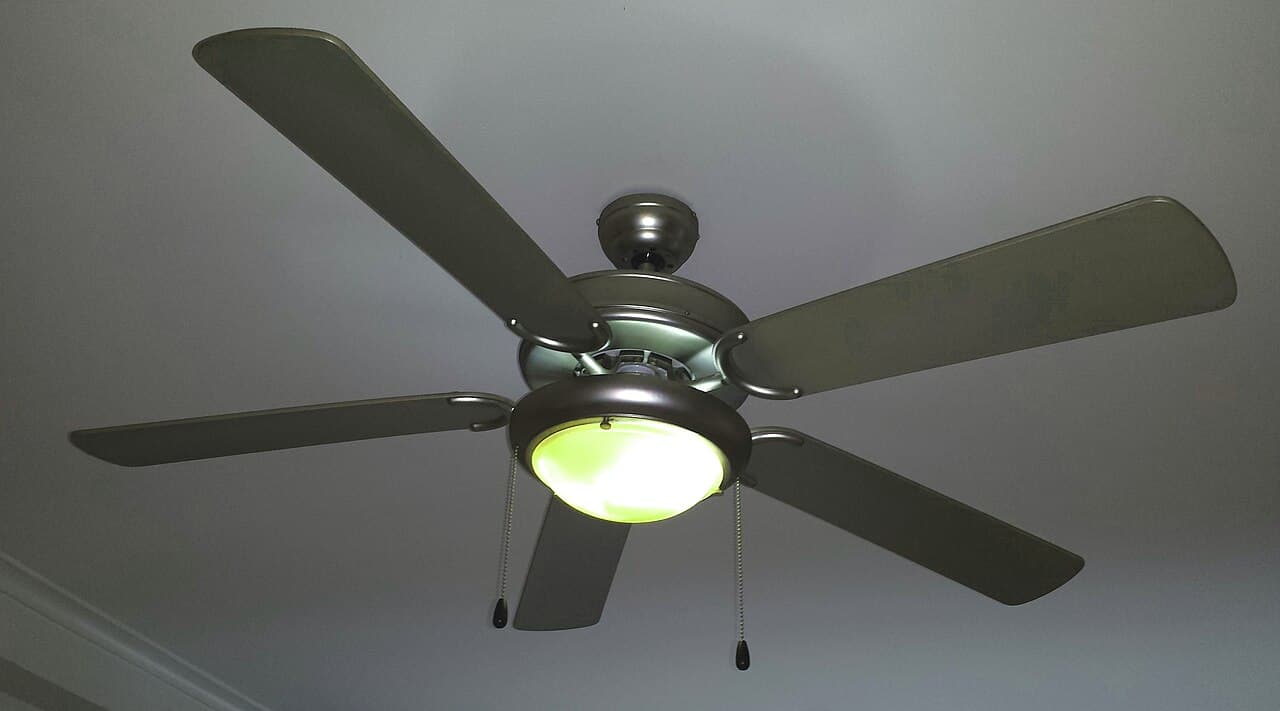
What usually causes the click
Hunter's manual lists the probable causes of noisy operation as blade brackets screwed loosely to the motor, a blade screwed loosely to its blade iron, a cracked blade, a non-approved speed control, glass attached loosely to the fixture, and a loose switch housing.[1] Those are the same things a trained ear picks out in a house call, and they give you a way to describe the noise.
A click that follows the blades, getting faster as the fan speeds up, points at the blades and their brackets. A rattle that comes and goes, often with the light on, points at the glass or the light kit. A buzz or hum that changes when you change the speed points at the control, not the fan.
A cracked blade deserves special attention. Hunter's newer manual says: "Check to see if any of the blades are cracked. If so, replace all of the blades."[2] Replacing the full set keeps the blades matched.
Clicking and wobbling go together
All fan blades should be balanced prior to shipment, ENERGY STAR notes,[3] so a fan that shakes after years of use has usually shifted, loosened or been bumped, for example while cleaning. ENERGY STAR's advice for a fan that wobbles after installation starts with its connections: make sure that all connections are properly aligned and tightly fastened.[3] That check, and any balancing afterwards, is part of what the electrician does on the visit.
The wobble can also start higher up. Hunter's troubleshooting list for a wobbling fan includes the instruction to check that the hanger ball is properly seated.[2] The hanger ball is what hangs the fan from its mounting bracket, so a poorly seated one is more than a nuisance.
Some noise is just the house. Hunter's manual says its fan comes with two neoprene noise isolators that sit between the ceiling plate and the ceiling,[1] so an electrician checking a ticking canopy will look at those too.
Why the mounting is the real question
A ceiling fan hangs from the box, not from the drywall. ENERGY STAR says the ceiling fan should be anchored to a ceiling joist where possible, and that ceiling fans can weigh as much as 50 pounds.[3] It also says to use the appropriate UL-listed metal box, marked for use with ceiling fans.[3] ENERGY STAR adds that if you are replacing a ceiling fixture, most likely you will need to replace the electrical box,[3] so a fan hung on an old light-fixture box is worth questioning.
So a click that comes with a visible sway of the canopy, a gap at the ceiling or a fan that has been shaking for weeks is a different problem from a loose glass shade. The first is a mounting problem. It needs someone who can open the canopy and look at what the fan hangs from.
Why this is a job for a licensed electrician
The risk is not the click. It is the work behind it. Taking a fan apart to check the brackets, the wiring and the switch housing means opening a fixture connected to house wiring. Hunter's warning is blunt: "To avoid possible electrical shock, before installing or servicing your fan, disconnect the power by turning off the circuit breakers to the outlet box and associated wall switch location."[2] Its manual also says do not insert foreign objects in between rotating fan blades,[2] which rules out trying to find the noisy blade while it spins.
Virginia law also treats this as trade work. A tradesman is any individual who engages in, or offers to engage in, electrical, plumbing or HVAC work for the general public for compensation,[4] and no individual may engage in, or offer to engage in, work as a tradesman unless licensed.[5] If you are paying someone to take the fan down and check it, that someone needs an electrical licence or a licensed electrician supervising. Look the person up before the visit: the Board for Contractors warns, "A license number in an advertisement or on a business card does not necessarily mean the contractor's license is valid."[6]
Before you call, you can do the part that costs nothing: note which speed makes the noise, whether the light kit or a wall control is involved, whether the fan also wobbles, and when it started. That shortens the visit.
When to call a licensed pro
Book an electrician soon if:
- The click comes with a visible wobble, or the canopy at the ceiling moves.
- The fan was hung on an existing light fixture box and nobody can say what the box is rated for.
- A burning smell, flickering light, humming or a warm switch housing comes with the noise.
- A blade is cracked or bent.
- The fan has lost a screw, a cap or any part of the light kit.
Switch the fan off in the meantime and leave it off if it shakes.
Getting help in Virginia
Read what size ceiling fan you need for a room if a replacement is on the table, and whether you need an electrician to install a ceiling fan for the licensing rules. Loclis lists licensed businesses with their licence number and class: browse ceiling fan installers, the wider electrical pros, or more electrical answers.
When you are ready, describe your ceiling fan problem and licensed local electricians quote it.
Common questions
- Is a clicking ceiling fan dangerous?
- It can be. The click is often a loose part, and a loose part on a spinning fan can get worse. ENERGY STAR notes that ceiling fans can weigh as much as 50 pounds, so a fan that also shakes should be switched off until it has been checked.
- Why does the click only start on certain speeds?
- Loose parts often rattle only at certain speeds. Hunter's manual also lists a non-approved speed control as a cause of noisy operation, so a fan that is noisy only when slowed down with a wall dimmer is worth mentioning to the electrician.
- Does a clicking fan need all its blades replaced?
- Only if one is cracked. Hunter's installation manual says that if any blade is cracked, all of the blades should be replaced, rather than just the one.
- Can a handyman fix a clicking ceiling fan?
- If you are paying, the work on the fan's wiring or mounting is electrical work, and Virginia requires a tradesman licence or supervision by a licensed tradesman for it. Ask for the licence number and look it up on DPOR before they start.
- Will balancing the fan stop the click?
- Sometimes. Balancing only helps if the wobble is the cause. It does nothing for a loose bracket, a cracked blade or a loose canopy, which is why the electrician should find the cause first.
Sources
- [1] Installation and Operation Manual for Hunter Ceiling Fans (41459-01), Hunter Fan Company. Checked October 27, 2026.
- [2] Ristrello Ceiling Fan Installation Manual (PG3865, 2021), Hunter Fan Company. Checked October 27, 2026.
- [3] Ceiling Fan Installation and Usage Tips, ENERGY STAR, U.S. Environmental Protection Agency. Checked October 27, 2026.
- [4] Code of Virginia § 54.1-1128, Definitions, Code of Virginia, Legislative Information System. Checked October 27, 2026.
- [5] Code of Virginia § 54.1-1129, Necessity for licensure, Code of Virginia, Legislative Information System. Checked October 27, 2026.
- [6] What You Should Know Before You Hire a Contractor, Virginia Board for Contractors, DPOR. Checked October 27, 2026.
Want a pro to handle it?
Describe the job once. Licensed local businesses send quotes, and you pay only when you book one.
Get a quote for Electrical Repair