Why are my gutters sagging?
Gutters sag when they are carrying more weight than their hangers can hold. The usual causes are hangers spaced too far apart, spikes or screws working loose, debris and standing water, ice and snow, a run that has lost its slope, bent hangers from ladders or branches, and soft fascia behind them. Find which one it is before you refasten anything.
Free to ask. Local shops send quotes, and you pay only when you book one.
By Kasra Taheri, Founder, LoclisPublished
Researched and drafted with AI, then checked claim by claim against the sources listed below before it was published. Prices and rules change; the dates beside each source say when it was last checked.
Step by step
Read when to stop and call a pro, further down this page, before you start.
Step 1: Sight along the run
From the ground or an upstairs window, look along the gutter to see whether the dip is between two hangers, at one end, or along the whole run.
Step 2: Watch where water stands
After rain, or with a hose, note where water pools instead of flowing to the downspout; the low spot is where the sag starts.
Step 3: Set the ladder safely
Put the base out one-fourth of the height to the point of support, let the top extend at least 3 feet above the eave, and keep it off the gutter.[5]
Step 4: Empty the sagging section
Scoop out wet leaves and grit and sponge out standing water, since that weight is part of the problem.
Step 5: Check each hanger
Wiggle every hanger and spike in the sag and note which are loose, bent, missing or pulling out of the wood.
Step 6: Measure the spacing
Measure between hangers and compare it with one every 24 inches, or every 18 inches where ice and snow loads are heavy.[1]
Step 7: Probe the fascia
Press a screwdriver into the fascia beside the loose hangers; if it sinks in easily, the wood is rotten and the repair belongs to a pro.
Step 8: Clear the downspout
Run a hose into the downspout outlet; if water backs up, clear the clog so the gutter stops holding water.
Step 9: Refasten into sound wood
Where the fascia is firm, set a screw-in hidden hanger beside each loose spike, driving its 1/4-inch hex-head screw into the fascia board.[1]
Step 10: Recheck the slope and test
Make sure the run falls at least 1/16 inch per foot toward the downspout, then run a hose and watch for pooling.[2]
Cause 1: too few hangers
A gutter needs support along its whole length. Amerimax's installation sheet calls for one hanger every 24 inches, or every 18 inches in areas with heavy ice and snow loads.[1] Older gutters, and some quick installations, have hangers much farther apart, and the gutter droops in a gentle curve between them. Measure the spacing in the sag; if it is well over 2 feet, the fix is adding hangers, not tightening the ones that are there.
Cause 2: fasteners working loose
Many older gutters are hung with spike and ferrule, where a ferrule is slipped inside the gutter and a spike or screw is driven through the gutter, the ferrule and the fascia board.[1] Smooth spikes tend to back out over years of the wood swelling and drying and the gutter's weight tugging on them. You see a spike head standing proud of the front lip, or a gap opening behind the gutter.
Newer gutters often use hidden hangers fastened with a 1/4-inch hex-head screw driven into the fascia board.[1] Screws usually hold better, but they can strip out of wood that has softened. If the sag comes with a gap behind the gutter, see why gutters pull away from the house.
Cause 3: weight from water, debris and ice
Gutters handle a surprising volume. Just a few inches of rain on a roof can produce several thousand gallons of runoff,[3] and a gutter packed with wet leaves holds some of it instead of passing it on. The Northern Virginia Soil and Water Conservation District says gutters should be cleaned of debris at least once a year, and more often with trees close to the house.[4]
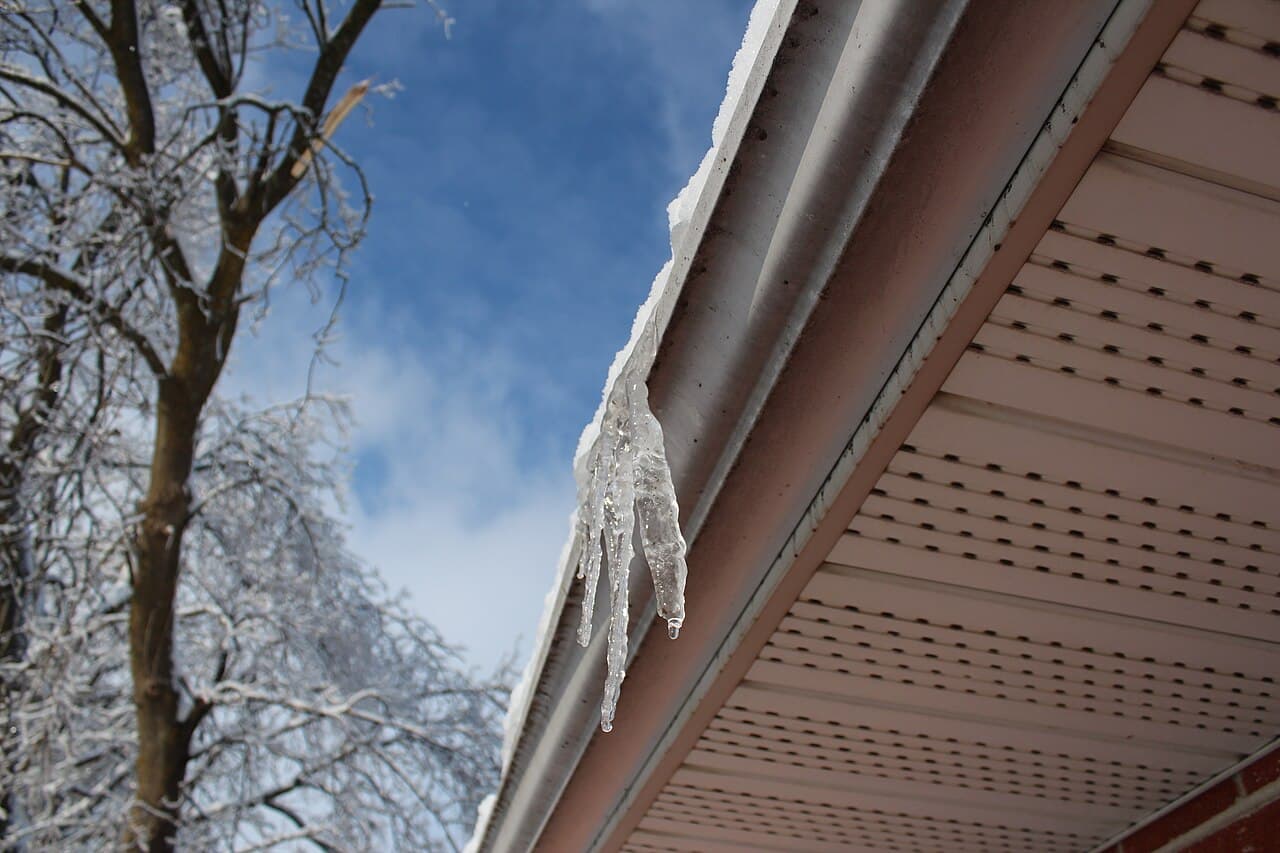
Winter adds the heaviest load. The Building America Solution Center, a U.S. Department of Energy guide, notes that gutters can fill with snow, which may freeze and become part of an ice dam already forming on the roof,[2] and it recommends making sure gutters are clean as winter approaches, so they drain instead of filling with water that could freeze.[2] A sag that appears after a cold snap is often ice that has bent hangers or pulled fasteners.
A clogged downspout has the same effect, because the water has nowhere to go. Downspouts move a lot of water when they are clear: Amerimax rates that a 2-by-3-inch downspout drains 186 gallons per minute and a 3-by-4-inch one drains 434.[1] A partly blocked one backs water up into the run above it.
Cause 4: the run has lost its slope
Gutters are hung on a slight fall toward the downspout. The Building America guide says they should slope at least 1/16 inch per foot of run toward the downspouts,[2] and Amerimax's sheet tacks a level string to the fascia, then lowers the string about 1/4 inch for every 10 feet of gutter, sloping toward the downspout.[1] When one hanger slips, that stretch goes flat or dips the wrong way, water stands in it, and the sag grows. For resetting the fall, see how to adjust gutters so they drain properly.
Cause 5: bent hangers and impact damage
The same guide notes that vinyl and aluminum gutters can crack or dent from impacts from ladders and tree branches.[2] A ladder leaned on the gutter, a falling limb or a slab of sliding snow can bend hangers down or kink the trough, leaving a dip that no amount of cleaning will straighten.
Cause 6: soft fascia
If the hangers are tight in the gutter but loose in the wood, the fascia is the problem. It rots where water has been getting behind or over the gutter for years. Amerimax's replacement procedure starts by removing the old gutters and inspecting the fascia board, replacing it if needed,[1] and that is a carpentry repair before the gutter can go back up.
Staying safe while you look
Checking a sag on a single-storey eave is ladder work. Virginia Commonwealth University's ladder program says to pull the base out so its distance from the wall is one-fourth the height to the point of support,[5] and the top should extend at least 3 feet above the eave, gutter or roofline.[5] Lean on the wall, not the sagging gutter. Virginia's Overhead High Voltage Line Safety Act forbids work that puts a person or a ladder within 10 feet of any overhead high voltage line.[6]
Stop and call a pro if
- The fascia is soft, split or crumbling, or the rafter ends behind it look dark.
- The gutter is above the first storey or can only be reached from the roof.
- A section is kinked, split or hanging, or has come down.
- The sag returns after you refasten it, or it sags and leaks in many places, which is when repairing or replacing is the real question. In Virginia, a Class C licence covers construction, removal, repair or improvement jobs with a single contract over $1,000 and under $30,000,[7] so check the licence of anyone quoting a job that size.
To keep it from coming back, see how to keep gutters from sagging. Browse the roofing answers, gutter repair on Loclis or exterior pros around Blacksburg, and when it is time for a fix, describe the sagging gutter once and licensed local businesses quote it.
Common questions
- Is a sagging gutter the same as one pulling away from the house?
- They are related. A sag is a dip along the run, usually between hangers; pulling away is the back of the gutter leaving the fascia. A sag left alone often turns into pulling away, because the low spot holds water and the extra weight works the fasteners loose.
- Can I just bend the gutter back up?
- Not for long. If the hangers are loose, missing or in rotten wood, the gutter drops again with the next load of water. Fix the support first: tight hangers at the right spacing in sound fascia.
- Did the winter make my gutters sag?
- It often finishes the job. Gutters can fill with snow that freezes, and the Building America guide advises having them clean before winter so they do not fill with water that freezes. Loose or widely spaced hangers are usually what gives way under that weight.
- How far apart should gutter hangers be?
- Amerimax's installation sheet calls for one hanger every 24 inches, or every 18 inches in areas with heavy ice and snow loads. Older gutters often have them much farther apart.
- Does a sagging gutter need replacing?
- Not usually. Most sags are fixed by cleaning, refastening and adding hangers into sound wood. Replacement makes sense when the gutter is kinked or split, the fascia is rotten along the run, or it sags and leaks in many places.
Sources
- [1] Installing Metal Gutter Systems, Amerimax Home Products. Checked October 26, 2026.
- [2] Gutters and Downspouts, Building America Solution Center, Pacific Northwest National Laboratory, U.S. Department of Energy. Checked October 26, 2026.
- [3] Stormwater: Gutters and Downspouts, Building Science Education, U.S. Department of Energy. Checked October 26, 2026.
- [4] Gutters and Downspouts: Wetness or Erosion Problems, Northern Virginia Soil and Water Conservation District, Fairfax County. Checked October 26, 2026.
- [5] Portable Ladder Safety Program, Virginia Commonwealth University, Safety and Risk Management. Checked October 26, 2026.
- [6] Va. Code § 59.1-408, Prohibited activities (Overhead High Voltage Line Safety Act), Code of Virginia, Virginia General Assembly. Checked October 26, 2026.
- [7] Va. Code § 54.1-1100, Definitions (Contractors), Code of Virginia, Virginia General Assembly. Checked October 26, 2026.
Want a pro to handle it?
Describe the job once. Licensed local businesses send quotes, and you pay only when you book one.
Get a quote for Roofing