How do I keep gutters from sagging?
Keep the weight down and the support up. Clean gutters at least once a year, more often under trees, and before winter; keep downspouts clear so water never stands; make sure hangers are tight and close enough together; keep the slope toward the downspout; reseal joints so water stays off the fascia; and never lean a ladder on the gutter.
Free to ask. Local shops send quotes, and you pay only when you book one.
By Kasra Taheri, Founder, LoclisPublished
Researched and drafted with AI, then checked claim by claim against the sources listed below before it was published. Prices and rules change; the dates beside each source say when it was last checked.
Step by step
Read when to stop and call a pro, further down this page, before you start.
Step 1: Clean on a schedule
Clear the gutters at least once a year, and more often if trees overhang the house.[1]
Step 2: Clean before winter
Do a late-fall clean once the leaves are down, so the gutters drain instead of holding water that can freeze.[2]
Step 3: Flush the downspouts
After each cleaning, run a hose into each outlet and clear any downspout that backs up.
Step 4: Set the ladder safely
Put the base out one-fourth of the height to the point of support and lean it on the wall, never on the gutter.[5]
Step 5: Check every hanger
While you clean, wiggle each hanger and spike and note any that are loose, bent or missing.
Step 6: Fill gaps in support
Add hangers where they are more than 24 inches apart, or 18 inches in heavy ice and snow areas.[3]
Step 7: Watch for standing water
After rain, look for water that stays in one stretch; a puddle means that section has lost its slope.
Step 8: Reseal leaking joints
Reseal dripping joints in dry weather so water stops soaking the fascia that holds the hangers.
Step 9: Trim back branches
Keep limbs clear of the roof edge so they cannot drop onto or rub the gutter.
Step 10: Look from the ground
A few times a year, sight along each run for new dips, gaps behind the gutter or overflow streaks.
Gutters stay straight when the weight in them stays low and the support under them stays strong. That means cleaning them often enough that leaves and water never build up, keeping downspouts clear, keeping hangers tight and close together, holding the slope toward the downspout, sealing leaky joints before they rot the fascia, and protecting the gutter from ladders and branches. Most of it fits into the cleaning you should already be doing.
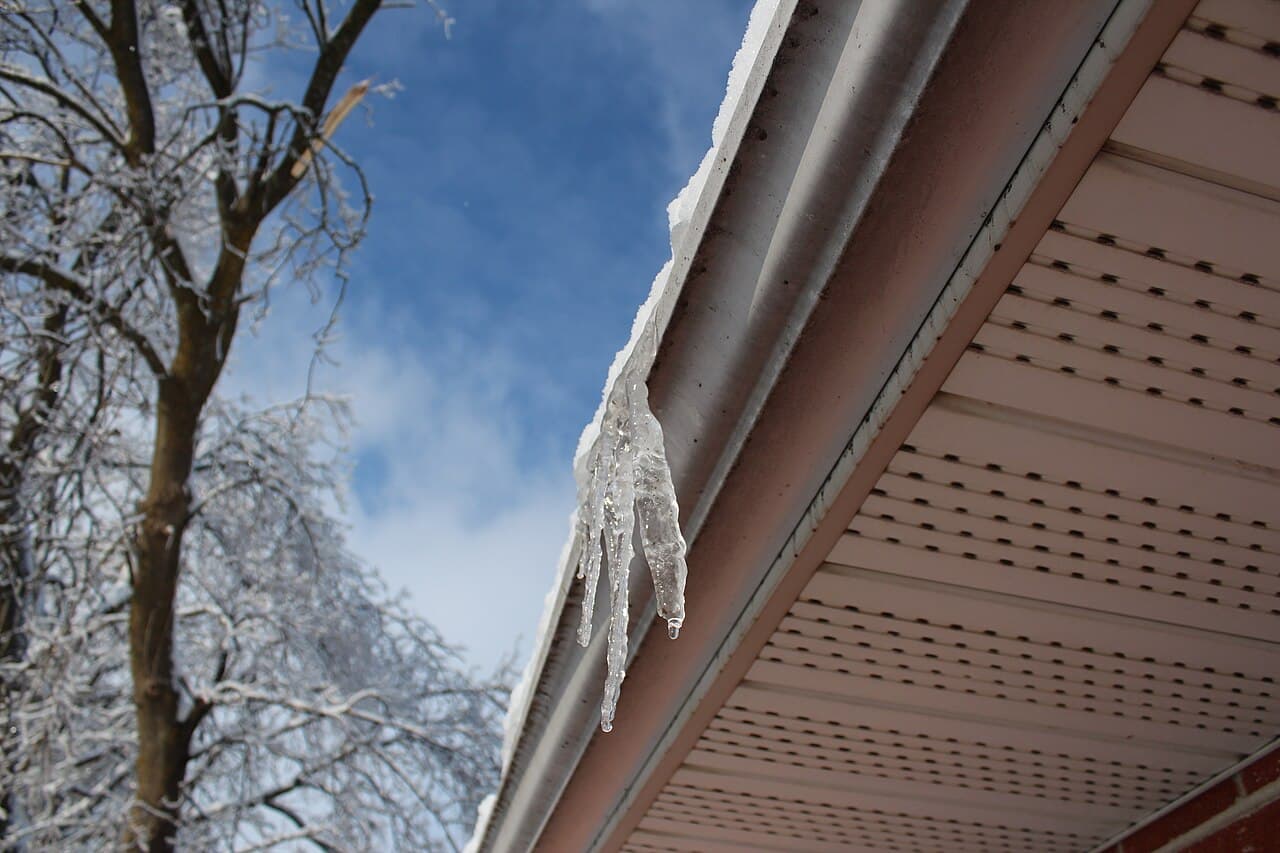
Keep the weight down
Clean on a schedule. The Northern Virginia Soil and Water Conservation District says gutters should be cleaned of debris at least once a year, and more often if you have trees close to the house.[1] Wet leaves and roof grit are heavy, and they dam the water behind them. The district also notes that gutter guards can reduce how often gutters need cleaning,[1] though a guard does nothing for a hanger that is already loose.
Clean before winter. Ice is the heaviest load a gutter carries. The Building America Solution Center, a U.S. Department of Energy guide, advises homeowners to make sure gutters are clean as winter approaches, or fit screen leaf guards, so they drain and do not fill with water that could freeze.[2] It also notes that gutters can fill with snow, which may freeze and become part of an ice dam already forming on the roof.[2] A late-fall clean, after the leaves are down, matters most.
Keep downspouts clear. A gutter only empties as fast as its downspouts. Amerimax rates that a 2-by-3-inch downspout drains 186 gallons per minute and a 3-by-4-inch one drains 434,[3] and it recommends larger or more downspouts for wide roof areas, heavy downpour areas and gutter systems that overflow.[3] Flush each one with a hose after cleaning; if it backs up, clear it before the next storm. See how to keep downspouts from clogging for more.
Watch for overflow. The conservation district says streaks or watermarks on the outside of the gutters and downspouts, and erosion along the drip line, are signs the gutters overflow when it rains and need cleaning.[1] Overflow often means a stretch is holding water, and held water is weight.
Keep the support strong
Hanger spacing. Amerimax's installation sheet calls for one hanger every 24 inches, or every 18 inches in areas with heavy ice and snow loads.[3] When you clean, measure the spacing on any run that looks wavy, and add hangers where the gaps are wider.
Hanger condition. Wiggle each hanger as you go. Smooth spikes tend to back out over the years, and a loose one is easiest to deal with before the gutter starts to dip. Screw-in hidden hangers set into firm wood usually hold better.
The slope. Gutters should fall toward the downspout, and the Building America guide says they should slope at least 1/16 inch per foot of run toward the downspouts.[2] A stretch that holds a puddle a day after rain has lost its fall. Fix it early; how to adjust gutters so they drain properly walks through it.
Dry fascia. Hangers are only as strong as the board they are screwed into, and fascia rots where water drips through joints or runs behind the gutter. Reseal leaking joints promptly. Sealant makers are specific about conditions: OSI's directions say surfaces must be clean, dry and free of old caulk, grease, dust and other contaminants,[4] and its gutter sealant goes on between 40°F and 120°F.[4] The full method is in how to fix a leaking gutter seam.
Protect gutters from damage
The Building America guide notes that vinyl and aluminum gutters can crack or dent from impacts from ladders and tree branches.[2] Two habits prevent most of that damage. Lean ladders on the wall, never on the gutter. And keep branches trimmed back from the roof edge so they cannot fall on, rub or drop debris into the run.
Ladder safety for routine checks
Virginia Commonwealth University's ladder program says to pull the base out so its distance from the wall is one-fourth the height to the point of support,[5] and the top should extend at least 3 feet above the eave, gutter or roofline.[5] It also rules out ladders on slippery surfaces such as snow, ice or oily deposits,[5] so winter ice in the gutter is not a ladder job. Before raising the ladder, look up: Virginia's Overhead High Voltage Line Safety Act forbids work that puts a person or a ladder within 10 feet of any overhead high voltage line.[6]
Stop and call a pro if
- The gutters are above the first storey or can only be reached from the roof.
- The fascia is soft, stained or crumbling where the hangers attach.
- A run has already dropped, kinked or pulled away from the house; why gutters sag explains the causes.
- The gutter overflows even when clean, which may mean it needs larger gutters or more downspouts. In Virginia, a Class C licence covers construction, removal, repair or improvement jobs with a single contract over $1,000 and under $30,000,[7] so check the licence of anyone quoting that work.
Browse the roofing answers, gutter repair on Loclis or exterior pros around Blacksburg. If your gutters need refastening or new hangers, describe the gutter repair once and licensed local businesses quote it.
Common questions
- How often should I check my gutter hangers?
- Every time the gutters are cleaned is a practical rhythm, since you are already on the ladder. The Northern Virginia Soil and Water Conservation District says to clean at least once a year, more often with trees close to the house, so that is at least one hanger check a year.
- Do gutter guards stop sagging?
- They can help by keeping leaves out, and the Northern Virginia Soil and Water Conservation District notes that gutter guards can reduce how often gutters need cleaning. They do not add support, so hangers still have to be tight and closely spaced.
- Should I knock ice out of my gutters?
- Not from a ladder in icy conditions. VCU's ladder rules rule out ladders on snow, ice or oily surfaces, and hacking at ice can bend the gutter. Keeping gutters clean before winter so they drain is the safer prevention.
- What hangers hold up best?
- Screw-in hidden hangers set into sound fascia generally grip better than smooth spikes, which tend to back out over the years. Whatever the type, spacing matters most: Amerimax calls for one every 24 inches, or every 18 inches in heavy ice and snow areas.
- Who should do gutter maintenance on a two-storey house?
- A pro with the right ladders or lift. Cleaning and hanger checks on a single-storey eave are reasonable homeowner work; higher eaves and anything reached from the roof are not.
Sources
- [1] Gutters and Downspouts: Wetness or Erosion Problems, Northern Virginia Soil and Water Conservation District, Fairfax County. Checked October 26, 2026.
- [2] Gutters and Downspouts, Building America Solution Center, Pacific Northwest National Laboratory, U.S. Department of Energy. Checked October 26, 2026.
- [3] Installing Metal Gutter Systems, Amerimax Home Products. Checked October 26, 2026.
- [4] OSI Gutter Sealant, Technical Data Sheet, Henkel Corporation (OSI). Checked October 26, 2026.
- [5] Portable Ladder Safety Program, Virginia Commonwealth University, Safety and Risk Management. Checked October 26, 2026.
- [6] Va. Code § 59.1-408, Prohibited activities (Overhead High Voltage Line Safety Act), Code of Virginia, Virginia General Assembly. Checked October 26, 2026.
- [7] Va. Code § 54.1-1100, Definitions (Contractors), Code of Virginia, Virginia General Assembly. Checked October 26, 2026.
Want a pro to handle it?
Describe the job once. Licensed local businesses send quotes, and you pay only when you book one.
Get a quote for Roofing