Why are there so many mosquitoes in my yard?
Usually because they are breeding close by. Mosquitoes grow up in standing water, need as little as a bottle cap of it, and can go from egg to adult in about two weeks. Clogged gutters, forgotten containers, low spots that hold rain, shady overgrowth where adults rest, and a neighbor's water within flying range are the usual reasons a yard fills with them.
Free to ask. Local shops send quotes, and you pay only when you book one.
By Kasra Taheri, Founder, LoclisPublished
Researched and drafted with AI, then checked claim by claim against the sources listed below before it was published. Prices and rules change; the dates beside each source say when it was last checked.
Step by step
Read when to stop and call a pro, further down this page, before you start.
Step 1: Note when you get bitten
Write down whether the biting is worst at dusk and dawn or in the middle of the day, and where in the yard it happens.[2]
Step 2: Walk the yard after rain
The day after a rain, check gutters, downspout extensions, containers, old tires, bird baths, ponds, tarps and ditches for standing water.[3]
Step 3: Look for wrigglers
Look closely into any water you find for wrigglers, the small larvae that live in the water and come up to the surface to breathe.[1]
Step 4: Check the shady containers
Check dark containers in the shade with leaves or algae in them, such as plant saucers, buckets and toys under shrubs or decks.[4]
Step 5: Watch low spots after rain
Note any part of the lawn that still holds water several days after rain, since standing water lasting about a week can breed mosquitoes.[5]
Step 6: Look at the shade
Look for tall weeds, overgrown beds and dense shrubs near where you sit, where adult mosquitoes rest during the day.[6]
Step 7: Ask neighbors and your locality
Ask neighbors about water on their side of the fence, and ask your local health department whether it inspects yards for breeding sites.[2]
A yard full of mosquitoes almost always has standing water nearby, often somewhere small you have not looked. The rest of the explanation is shade where adults rest, the weather, and water on the other side of the fence. Working through those in order usually finds the cause.
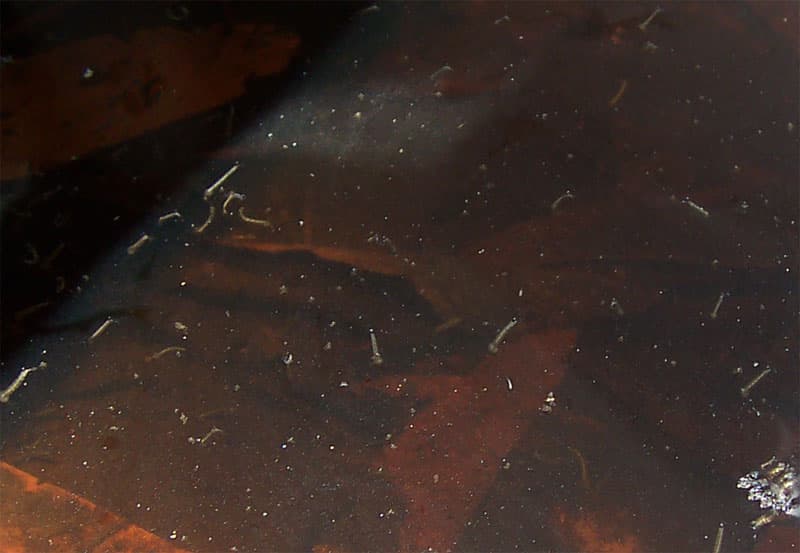
They are growing up nearby
The first three stages, egg, larva and pupa, all happen in water; only the adult flies.[1] The life cycle typically takes about two weeks, but depending on conditions it can range from 4 days to as long as a month.[1] In a warm Virginia summer that means a forgotten bucket can turn out a new batch of biters every couple of weeks.
They do not need much. Mosquitoes can breed in a container as small as a bottle cap.[2] And they plan ahead: Females lay eggs on or near water, on soil and at the base of some plants in places that may fill with water, and the eggs can survive dry conditions for a few months.[1] That helps explain why mosquitoes can seem to appear from nowhere after a rainy week that follows a dry spell: the eggs were already waiting.
Water you have not found yet
The usual sources are roof gutters, downspout extensions, artificial containers, old tires, bird baths, ornamental ponds, tarps on woodpiles and drainage ditches.[3]
The hard-to-find ones are small and shaded. Aedes aegypti, a container-breeding mosquito, lays its eggs in water with decaying leaves or algae in it, in wide-mouthed containers, and prefers dark containers in the shade.[4] It also uses tree holes and crevices in plants.[4] Check under decks and shrubs: plant saucers, a dog's outdoor water bowl, a kiddie pool, a tarp over the woodpile, the corrugated pipe at the end of a downspout, a clogged gutter you cannot see from the ground.
Ground that stays wet
Low spots in the lawn and slow-draining soil are a common, overlooked source. Virginia Cooperative Extension's guidance on grass swales warns that water standing in a grass swale longer than seven days in compacted or high-clay soil could lead to problems with mosquitoes.[5] Its rule of thumb is that water should soak in or flow through within four days after rainfall because mosquitoes breed in seven days.[5] If a patch of your yard is still a puddle most of the week after rain, it is a likely source, and a drainage fix may do more than any spray. See who to call for a wet yard.
Shade where adults rest
Some yards hold mosquitoes even when the water is elsewhere. Mosquitoes prefer to rest in protected sites during the day, so removing tall weeds and overgrowth is part of integrated mosquito management.[6] Dense foundation shrubs, an unmown strip along the fence, ivy, and the shady space under a deck give them somewhere to wait out the day close to where you sit.
Your neighbors' water
You can do everything right and still be bitten. The mosquitoes that can carry Zika virus typically fly less than a quarter of a mile from the water where they grew up.[7] A quarter mile reaches many yards, storm drains and ditches. It also explains why sprays fade so quickly: Mosquitoes that fly into your yard a few days after a treatment may be unaffected.[7]
Local programs can help with what is beyond your fence. The Fairfax County Health Department inspects county-maintained stormwater dry ponds for mosquito breeding from April through October and offers residents a free yard inspection to help find breeding sites.[2] Ask your own local health department what it offers, and report a neglected pool or a blocked ditch.
The time of day and the time of year
Mosquitoes are most active at dusk and dawn, and most species are active at night, but the Asian tiger mosquito is also active during the day.[2] If you are being bitten in the afternoon in the shade, look hard at small containers close by.
In Virginia, mosquito season runs from early May to early November.[8] Keep checking for water until the season ends, not just in early summer.
Stop and call a pro if
- Biting stays heavy after a few weeks of weekly water removal and you cannot find the source.
- Part of the yard holds water for days after every rain. A drainage or landscaping contractor can regrade it or add drainage.
- Gutters that hold water are too high to clear safely from a short ladder.
- You want the yard treated. Hire a licensed pest control business; read whether monthly mosquito treatments are worth it first.
Once you know the cause, how to get rid of mosquitoes in your yard and how to stop them breeding around your house cover the fixes. If gutters are the problem, see why gutters overflow. Browse mosquito control services, find pest control around Blacksburg, or read more pest control answers.
When you want a pro to look, describe the job on Loclis and licensed businesses can quote it in writing.
Common questions
- Why do mosquitoes suddenly get worse after a rain?
- Eggs laid on damp soil or inside containers can survive dry conditions for months and hatch when water returns. After a rain, gutters, saucers and low spots fill, and in warm weather a new batch can go from egg to adult in about two weeks, sometimes faster.
- Why am I bitten in the middle of the day?
- Most mosquito species bite at dusk, dawn and night, but the Asian tiger mosquito is also active in the daytime. Daytime biting in shady parts of the yard is a sign to look hard for small containers of water nearby.
- Could the mosquitoes be coming from my neighbor's yard?
- Yes. The mosquitoes that can carry Zika virus typically fly less than a quarter of a mile from where they grew up, which takes in many neighboring yards. Clear your own water first, then talk to neighbors, and report a neglected pool or blocked ditch to your local health department.
- Does a pond or creek cause mosquitoes?
- A large one usually does not. Virginia Cooperative Extension's guide says open bodies of water such as large ponds and streams are not mosquito-breeding areas, though small backyard ponds should be checked for larvae. Small, still, shaded water is the usual culprit.
- Why are there still mosquitoes after my yard was sprayed?
- Many residential sprays do not last long, mosquitoes from nearby fly in a few days later, and larvae already in standing water keep emerging over the next few weeks. Unless the breeding water is removed, the numbers rebuild.
Sources
- [1] Mosquito Life Cycle, U.S. Environmental Protection Agency. Checked October 27, 2026.
- [2] Mosquitoes, Fairfax County Health Department. Checked October 27, 2026.
- [3] Get Rid of Standing Water, Fairfax County Health Department. Checked October 27, 2026.
- [4] Success in Mosquito Control: An Integrated Approach, U.S. Environmental Protection Agency. Checked October 27, 2026.
- [5] Stormwater Management for Homeowners Fact Sheet 4: Grass Swales (SPES-12), Virginia Cooperative Extension, Virginia Tech. Checked October 27, 2026.
- [6] 2026 Pest Management Guide: Home Grounds and Animals, Nuisance Insects of the House and Yard, Virginia Cooperative Extension, Virginia Tech. Checked October 27, 2026.
- [7] Do I need to spray for mosquitoes at home?, National Pesticide Information Center, Oregon State University and U.S. EPA. Checked October 27, 2026.
- [8] Mosquitoes, Virginia Department of Health. Checked October 27, 2026.
Want a pro to handle it?
Describe the job once. Licensed local businesses send quotes, and you pay only when you book one.
Get a quote from a local pro