How do I get rid of mosquitoes in my yard?
Start with the water, not a spray. Most yard mosquitoes grow up in standing water close by, so tip out every container at least once a week, clear clogged gutters, fill low spots, and treat water you keep, such as rain barrels and ponds, with Bti dunks. Then cut back the tall weeds where adults rest, keep screens tight, and wear repellent outside.
Free to ask. Local shops send quotes, and you pay only when you book one.
By Kasra Taheri, Founder, LoclisPublished
Researched and drafted with AI, then checked claim by claim against the sources listed below before it was published. Prices and rules change; the dates beside each source say when it was last checked.
Step by step
Read when to stop and call a pro, further down this page, before you start.
Step 1: Walk the yard after a rain
The day after a rain, note every place water sits: gutters, downspout extensions, toys, tires, tarps, plant saucers, ditches and low spots in the lawn.[2]
Step 2: Dump containers every week
Dump water that collects in containers at least once a week, and store buckets and boats upside down or under cover so they stay dry.[3]
Step 3: Refresh bird baths and trays
Empty and change the water in bird baths, fountains, wading pools and potted plant trays at least once a week.[5]
Step 4: Treat water you keep
Put Bti mosquito dunks in rain barrels, ornamental ponds and other water you cannot empty, and follow the package label.[6]
Step 5: Clear clogged gutters
Clear gutters that hold stagnant water, working only from the ground or a short ladder on a single-storey roofline.[4]
Step 6: Fill low spots
Fill in small areas of the lawn that do not drain properly so they stop holding water after rain.[2]
Step 7: Cut back resting spots
Mow tall grass and cut back weeds and overgrowth, where adult mosquitoes rest during the day.[4]
Step 8: Repair screens
Patch or replace torn window and door screens so mosquitoes that hatch nearby stay outside.[3]
Step 9: Wear repellent outside
Use an EPA-registered insect repellent when you are in the yard, and follow the instructions on the product label.[3]
You get rid of yard mosquitoes mostly by taking away the water they breed in. Spraying kills the adults that happen to be flying that week. Removing standing water stops the next ones from hatching, and it costs nothing.
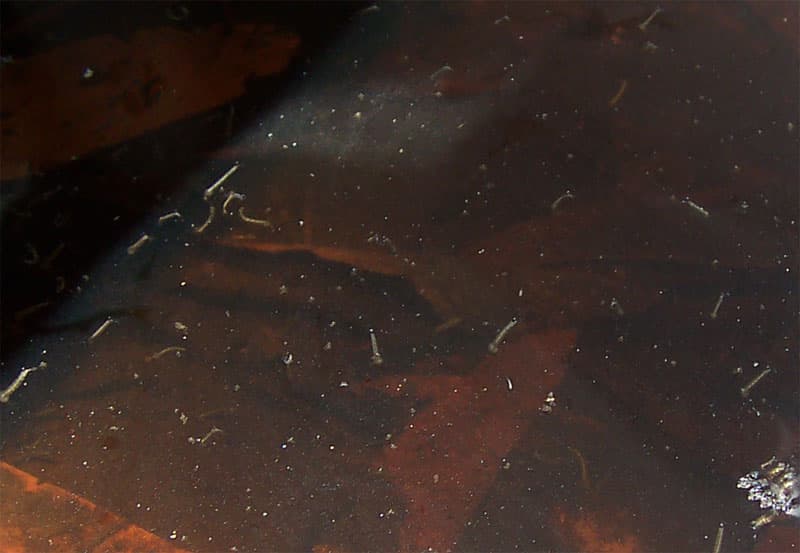
Why the water comes first
Mosquitoes need standing water to develop, and they can breed in a container as small as a bottle cap.[1] Eggs hatch into larvae, the larvae turn into pupae, and only then does a biting adult fly off. Mosquitoes live in standing water for at least a week before they start flying.[2] That gives you a simple rule: if you empty every container once a week, nothing in it has time to grow up.
Where to look
Walk the yard the day after a rain. Common sources include roof gutters, downspout extensions, artificial containers, old tires, bird baths, ornamental ponds, tarps on woodpiles and drainage ditches.[2]
The places people miss are usually small and shaded: plant saucers, kids' toys, a wheelbarrow, a recycling bin with no drain holes, a sagging grill cover, the folds of a tarp. Aedes aegypti, one of the container-breeding mosquitoes, lays its eggs in water that holds decaying leaves or algae, in wide-mouthed containers, and prefers dark containers in the shade.[5] Look under decks and behind sheds as well as in the open.
Tip out what you find. Throw away containers you do not need, and turn the rest upside down or put them under cover.
Water you want to keep
Rain barrels, bird baths and ornamental ponds are all places where mosquitoes can breed.[3] You do not have to give them up:
- Bird baths, fountains and wading pools. Empty and change the water in bird baths, fountains, wading pools, rain barrels and potted plant trays at least once a week.[5]
- Rain barrels and ponds. Use larvicide dunks made with Bti. Bti is a naturally occurring bacterium found in soils, and its toxins affect only the larvae of mosquitoes, black flies and fungus gnats.[6] It can be used in flower pots, tires and bird baths, and in larger water such as ponds.[6] Read the label first: Some Bti products are allowed on certain drinking water, such as cisterns, and others are not.[6] A tight lid or fine screen over a rain barrel's opening also helps keep egg-laying females out.
- Garden ponds. Backyard garden ponds can be stocked with predatory fish that feed on mosquito larvae.[4]
- Pools. Keep swimming pool water treated and circulating.[5] A covered pool that collects rain on top of the cover needs that water pumped off.

Make the yard a worse place to rest
Adult mosquitoes spend the day out of the sun and wind. Mosquitoes prefer to rest in protected sites during the day, so removing tall weeds and overgrowth is part of integrated mosquito management.[4] Keep grass mowed, cut back the weedy strip along the fence, thin dense shrubs near where you sit, and clear brush piles. A fan blowing across a porch or patio often helps keep them off you as well.
Protect yourself while numbers drop
Most mosquito species are active at night and are busiest at dusk and dawn, but the Asian tiger mosquito also bites during the day.[1] So repellent is worth wearing for daytime yard work, not only at sunset. Use an EPA-registered insect repellent outdoors and follow the label.[3] For children, the Virginia Department of Health says do not use insect repellent on babies under 2 months old, and never use oil of lemon eucalyptus or para-menthane-diol on children under 3.[3]
Indoors, the fix is old-fashioned. Use screens on windows and doors and repair any holes or tears in them.[3]
What about spraying?
A spray kills adult mosquitoes resting on the plants it hits, but it does nothing to the larvae still growing in a clogged gutter. In its table of household insects, Virginia Cooperative Extension's 2026 pest management guide discourages homeowner applications of mosquito control measures outdoors, because of concerns over water contamination and the impact on non-target animals.[4] If weeks of water removal have not been enough, a licensed company is the better route. Read whether monthly mosquito treatments are worth it and whether spraying is safe for kids and pets before you sign up.
Your local government may help for free. The Fairfax County Health Department offers a free yard inspection to help find mosquito breeding sites and gives prevention tips, but it does not spray for nuisance mosquitoes.[1] Call your own local health department to ask what it does where you live.
Stop and call a pro if
- Mosquitoes stay heavy after a few weeks of weekly water removal and you cannot find where they are coming from.
- The gutters that are holding water are on a second storey or a steep roofline. That is a job for a gutter cleaner, not a ladder you are unsure of; see how often gutters should be cleaned.
- Part of the yard stays soggy for days after every rain. That is a drainage problem; see who to call for a wet yard.
- The water is somewhere you cannot reach or fix, such as a neglected pool or a blocked ditch on a neighbor's land. Report it to your local health department.
- You want a pesticide applied to the yard. Hire a Virginia-licensed pest control business; see what licences pest control companies need.
For why some yards are worse than others, read why there are so many mosquitoes in your yard, and for the season-long routine see how to stop mosquitoes breeding around your house. Browse mosquito control services, find pest control around Blacksburg, or read more pest control answers.
When you want help, describe the job on Loclis and licensed businesses can quote it in writing.
Common questions
- What is the fastest way to cut mosquitoes in my yard?
- Dump every container of standing water and clear clogged gutters the same day, then repeat at least once a week. Mosquitoes spend at least a week in water before they fly, so a weekly round stops new adults from emerging. Adults already flying will die off or move on over the following weeks.
- Are mosquito dunks safe around kids, pets and birds?
- Dunks that contain Bti target only the larvae of mosquitoes, black flies and fungus gnats, and EPA says Bti has no toxicity to people and minimal toxicity to honey bees. Use them as the label directs, and check the label before putting one in water anyone might drink.
- How long until I notice fewer mosquitoes?
- Not overnight. Mosquitoes spend at least a week in water before they fly, and adults already in the yard keep biting for a while. Expect the change to show over a few weeks of steady weekly rounds, and keep going through the season so new breeding spots do not undo the work.
- Should I spray my yard myself?
- Virginia Cooperative Extension's 2026 guide discourages homeowner outdoor mosquito applications because of water contamination and harm to non-target animals. If water removal is not enough, hire a licensed pest control business, and ask how it will protect ponds, pollinators and play areas.
- Will my county come and spray my yard?
- Usually not for nuisance mosquitoes, and programs vary by locality. Fairfax County, for example, does not spray for nuisance mosquitoes but will inspect a yard for free to help find breeding sites. Call your local health department to ask what it offers.
- When does mosquito season end in Virginia?
- The Virginia Department of Health gives mosquito season as early May to early November. Keep the weekly water round going until biting stops in the fall, and start again in spring before the first warm spell.
Sources
- [1] Mosquitoes, Fairfax County Health Department. Checked October 27, 2026.
- [2] Get Rid of Standing Water, Fairfax County Health Department. Checked October 27, 2026.
- [3] Mosquito Prevention, Virginia Department of Health. Checked October 27, 2026.
- [4] 2026 Pest Management Guide: Home Grounds and Animals, Nuisance Insects of the House and Yard, Virginia Cooperative Extension, Virginia Tech. Checked October 27, 2026.
- [5] Success in Mosquito Control: An Integrated Approach, U.S. Environmental Protection Agency. Checked October 27, 2026.
- [6] Bti for Mosquito Control, U.S. Environmental Protection Agency. Checked October 27, 2026.
Want a pro to handle it?
Describe the job once. Licensed local businesses send quotes, and you pay only when you book one.
Get a quote from a local pro