Why are yellow jackets so aggressive in late summer?
By late summer a yellowjacket colony is at its largest, the insects it hunts are getting scarce, and thousands of workers are out looking for sugar and protein, so they find your soda, fruit and trash. Near the nest, the colony is crowded and easily agitated. Covering food, closing trash and not swatting prevent most stings.
Free to ask. Local shops send quotes, and you pay only when you book one.
By Kasra Taheri, Founder, LoclisPublished
Researched and drafted with AI, then checked claim by claim against the sources listed below before it was published. Prices and rules change; the dates beside each source say when it was last checked.
Step by step
Read when to stop and call a pro, further down this page, before you start.
Step 1: Cover food and drinks
Keep food and beverages covered until they are eaten, and clean up spills and leftovers promptly.[6]
Step 2: Check before you sip
Look into a can or bottle before drinking, and keep your thumb over the opening of a can between sips when yellowjackets are around.[6]
Step 3: Close the trash
Use trash cans with tight-fitting, preferably self-closing lids and a liner, and empty and clean them often.[5]
Step 4: Move the trash away
Keep trash cans away from tables, doors and other places people gather.[5]
Step 5: Pick up fallen fruit
Rake up apples, peaches and other fallen fruit and throw it away.[5]
Step 6: Skip the scents
Avoid scented soaps, shampoos, deodorants, perfume and cologne outdoors, since they tend to attract foraging yellowjackets.[5]
Step 7: Eat outside earlier
Hold outdoor meals earlier in the day, since yellowjackets tend to get more active as the day heats up.[2]
Step 8: Walk away, do not swat
When a yellowjacket lands near you, move away calmly instead of slapping at it.
Step 9: Check the yard for nests
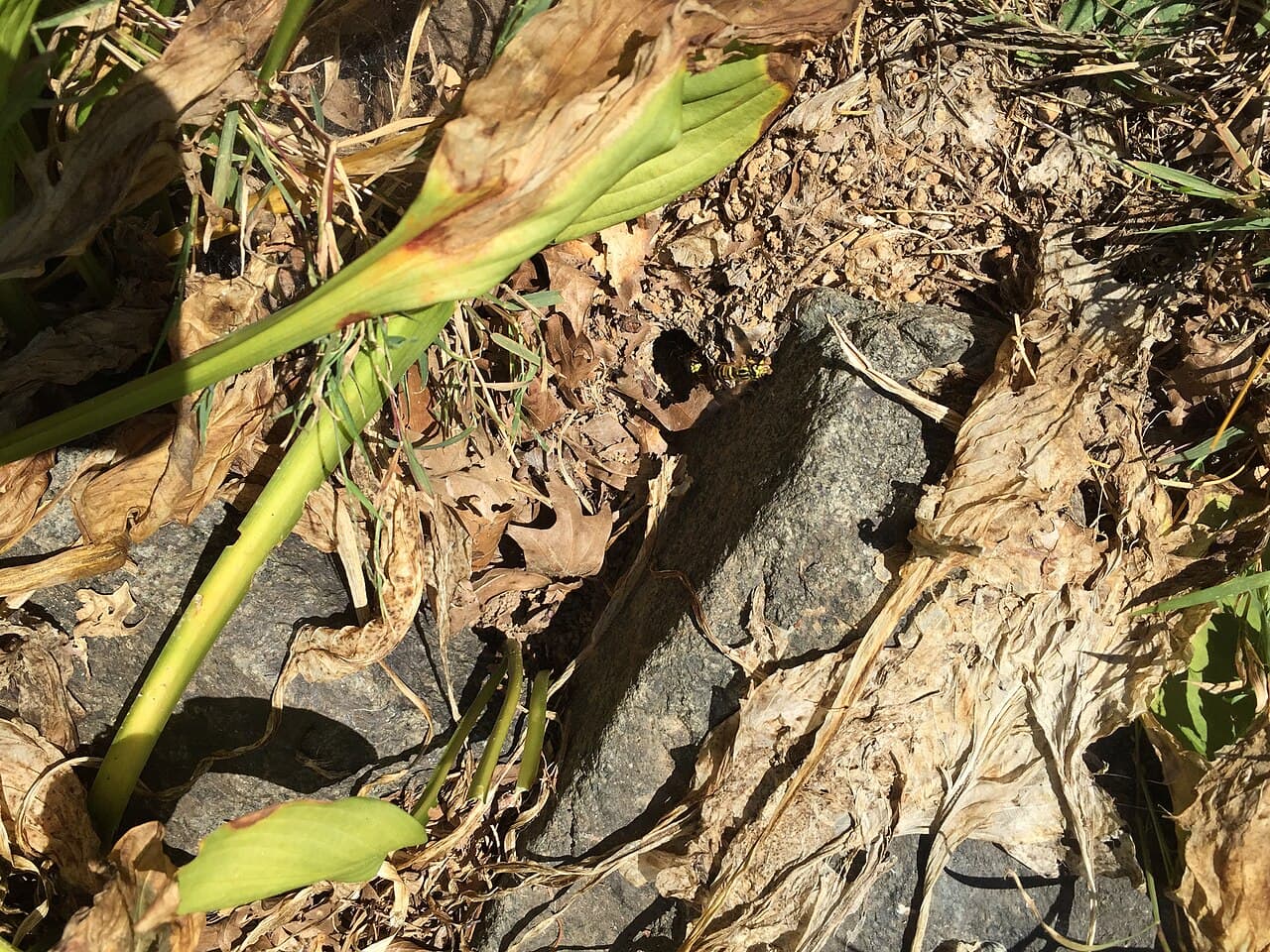
In daytime, before mowing or trimming, look for steady traffic in and out of holes in the lawn, rock walls and landscape timbers.[5]
Step 10: Put traps at the edges
If you use yellowjacket traps, set them around the edge of the area you want to protect, not beside the table.[5]
Late summer is when a yellowjacket colony is biggest and hungriest. The nest has grown all season, the insects the workers hunt are getting scarce, and they switch to sugar, which is why they turn up in your drink, your fruit and your trash. Near the nest, a crowded late-season colony is quick to defend itself. Most stings come from those two situations.
What changes in late summer
The colony is at its peak. In Virginia, yellowjacket colonies are at their largest from late summer until early autumn.[1] Each nest was started in spring by a single queen[1] and has been adding workers ever since. By then the colony is nearly mature, and huge numbers of workers are out foraging for food for the developing queens.[5]
The menu changes. Through early summer the workers mostly hunt other insects and feed that protein to the larvae.[1] With insect prey becoming scarce, they scavenge widely, and they are particularly fond of sweets such as fruit, soft drinks and ice cream, though they will also take meat and fish.[5] Adult yellowjackets feed on liquids produced by their larvae, and later in the year on nectar, ripe fruit and other sugar sources.[1] In autumn there are also fewer flowering plants and sources of nectar, which pushes foragers toward human food.[4]
The nest gets edgy. Late in the season, new queens and males leave the nest to mate, the social order of the nest may begin to break down, and the workers might be more easily agitated and defensive of a disturbed nest.[4] Fairfax County's park authority puts it simply: "Yellow jackets are more aggressive during the fall."[3]
Why they actually sting
There are two different situations, and they call for different fixes.
Foragers at your food. Workers foraging away from their nest are seldom aggressive and usually will not sting unless provoked, and most stings happen when a forager is slapped or trapped against skin.[5] The usual stings come from swatting, from a wasp crawling into a soda can, or from one caught in a sleeve. Swelling from a sting inside the mouth can be especially dangerous,[5] which is why checking a can before you drink matters.
Workers at the nest. Near the nest it is different. An attacking yellowjacket releases an alarm pheromone that excites its nestmates to attack as a group, and each female can sting more than once.[1] Vibration near a nest, such as a lawn mower or electric hedge clippers, can trigger a defensive response.[4] Late summer is when a ground nest you never noticed has grown big enough to boil out when the mower passes.
What works and what does not
The steps on this page are the ones that help most: covered food, closed and distant trash, no fallen fruit, no strong scents. Start early in the season. Once yellowjackets have found a regular food source, they are hard to repel.[3]
Some popular fixes do less than people hope:
- Traps. Traps catch some workers, but late-season nests often contain thousands of individuals and trapping seldom makes a noticeable difference.[5] Placed beside the table, they can draw more wasps than they catch.[5]
- Bug zappers. Bug zappers have no value in reducing yellowjacket foragers.[1]
- Bug spray. Conventional mosquito and tick repellents will not prevent persistent foraging.[5] Long sleeves and long pants are a better option.[5]
- Hunting down the nest. Treating one nest may not stop them either, because workers can fly a mile from their colony looking for food.[1] If you do find a nest in the lawn, see how to get rid of yellow jackets nesting in the ground.
When it ends
Cold weather. Nests begin to fail in the fall as the new queens leave and the remaining workers die off with cold weather.[1] Abandoned nests are not reused the following year,[1] and the mated queens spend the winter in sheltered spots before each starts a new nest in spring.[1] Keeping them from settling on the house is covered in how to keep wasps from building nests on your house.
Stop and call a pro if
- The wasps are coming from a wall, soffit, attic or crawlspace of the house.
- The nest is next to a door, a path, a deck or a play area and you cannot treat it safely yourself.
- Anyone in the house is allergic to stings. Hives, difficulty breathing or swallowing, wheezing or similar signs of an allergic reaction need medical attention immediately.[6]
- The nest is large, overhead, or needs a ladder.
For the hiring side, see when to call a pro for a wasp nest. You can also browse wasp and stinging insect services, look up pest control around Blacksburg, or read the other pest control answers.
If there is a nest you want gone, describe it on Loclis and licensed local pest control businesses can quote.
Common questions
- When are yellow jackets worst in Virginia?
- From late summer until early autumn, when colonies are at their largest. They usually fade with the first cold weather, when the workers die off and the nests fail.
- Do yellow jackets sting for no reason?
- Rarely. Away from the nest they usually sting when slapped, stepped on or trapped against skin, including inside a can or a sleeve. Near the nest, any disturbance, even the vibration of a mower, can set off a group attack.
- Why are there so many yellow jackets at my trash cans?
- Late-season workers are hunting for sugar and protein, and open trash is an easy meal. Tight, self-closing lids, liners, frequent emptying and moving the cans away from doors and tables help. Once they find a regular food source they are hard to repel.
- Do yellow jacket traps or bug zappers help?
- Traps catch some workers but seldom make a noticeable difference against late-season colonies, and they can draw more wasps if placed beside the table. Bug zappers have no value against yellowjacket foragers.
- Will killing the nest stop yellow jackets at my picnic?
- Not always. Workers can fly a mile from their colony, so the ones at your table may come from a nest you will never find. Covering food and closing trash usually does more.
Sources
- [1] Yellowjackets in Virginia (ENTO-49NP), Virginia Cooperative Extension, Virginia Tech. Checked October 27, 2026.
- [2] Baldfaced Aerial Yellowjacket (3006-1449), Virginia Cooperative Extension, Virginia Tech. Checked October 27, 2026.
- [3] Bees, Hornets and Wasps, Fairfax County Park Authority. Checked October 27, 2026.
- [4] Social Wasps: Yellowjackets, Hornets, and Paper Wasps, University of Maryland Extension. Checked October 27, 2026.
- [5] Controlling Wasps, Hornets, and Yellowjackets (ENTFACT-620), University of Kentucky Department of Entomology. Checked October 27, 2026.
- [6] Foraging Yellowjackets (ENTFACT-634), University of Kentucky Department of Entomology. Checked October 27, 2026.
Want a pro to handle it?
Describe the job once. Licensed local businesses send quotes, and you pay only when you book one.
Get a quote from a local pro