When should I call a pro for a wasp nest?
Call a licensed pest control company when the nest is inside a wall, soffit, attic or crawlspace, when it is large or needs a ladder to reach, when anyone in the house is allergic to stings, or when a nest you treated is still active. A small paper wasp comb within reach, or a ground nest in open lawn, is often a homeowner job.
Free to ask. Local shops send quotes, and you pay only when you book one.
By Kasra Taheri, Founder, LoclisPublished
Researched and drafted with AI, then checked claim by claim against the sources listed below before it was published. Prices and rules change; the dates beside each source say when it was last checked.
Step by step
Read when to stop and call a pro, further down this page, before you start.
Step 1: Look from a distance
Note what the nest looks like, where it is, how high it is, and whether wasps are flying into the house or only around the outside.
Step 2: Decide if it can wait
If the nest is far from doors, paths and play areas, consider leaving it, since colonies die off once the weather turns cold.[3]
Step 3: Take photos
Photograph the nest or the entrance hole with your phone's zoom, along with anything that shows height, such as a window or gutter.
Step 4: Ask for written quotes
Ask two or three companies for the method, the number of visits included, and whether the dead nest is removed and the opening sealed.
Step 5: Check the licence
Ask each company for its current Virginia pesticide business license and the certified commercial applicator responsible for the work.[5]
Step 6: Agree on any repair
If a wall must be opened, settle in writing who repairs it, and check the contractor licence of whoever does repair work over $1,000.[7]
Step 7: Keep people clear
Until the visit, keep children, pets and the mower away from the nest and do not plug or spray into any opening in the house.
Call a pro when the nest is inside the house, out of reach, or close to someone who is allergic to stings. A licensed pest control company is the right call for wasps going into a wall, soffit, attic or crawlspace, for a large hornet nest overhead or anything that needs a ladder, and for a nest you have already treated that is still busy. A small paper wasp comb you can reach from the ground, or a yellowjacket hole in open lawn, is often a homeowner job.
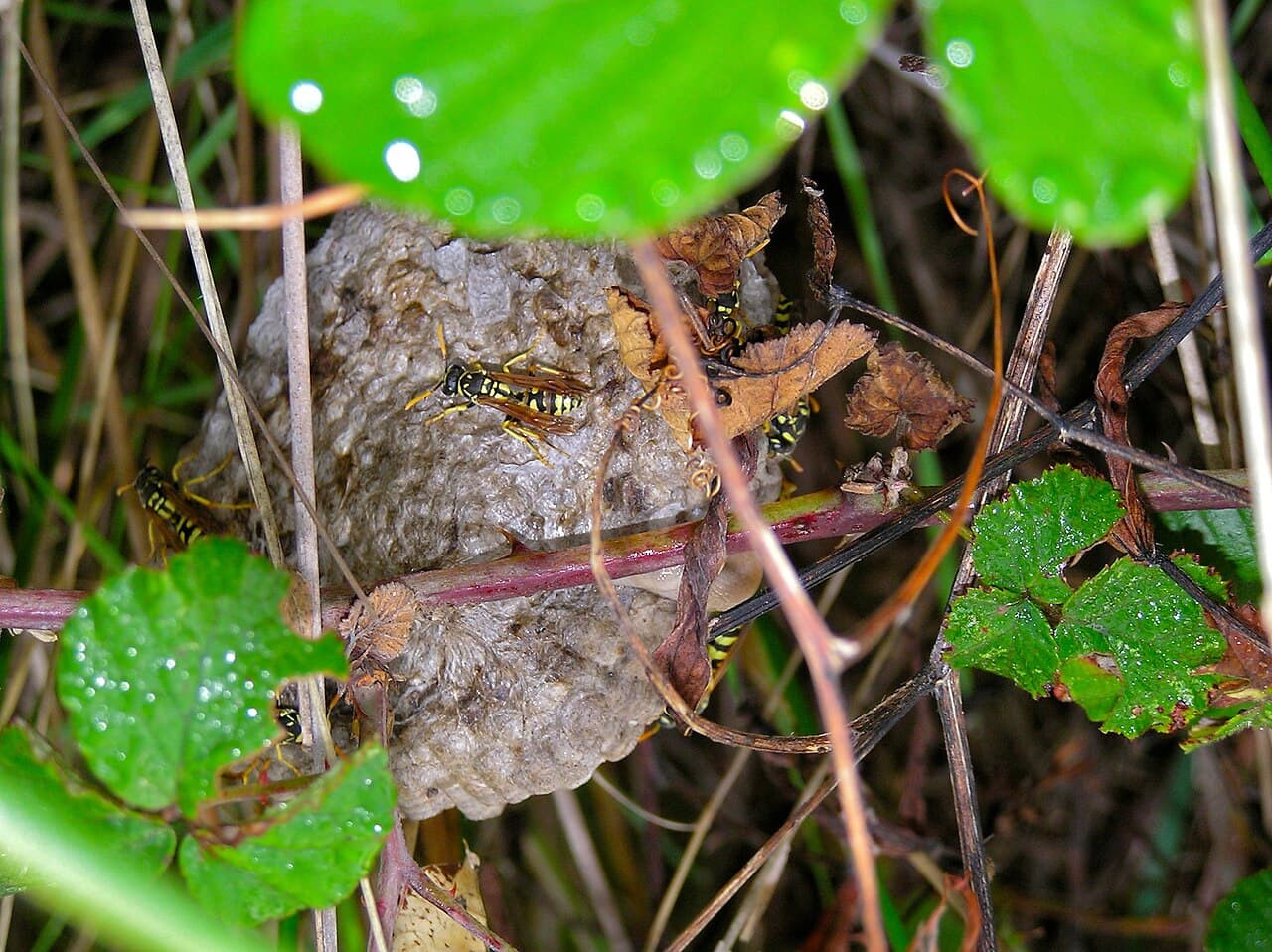
Nests that call for a pro
Inside the walls, attic or crawlspace. Virginia Cooperative Extension says yellowjackets nesting in the voids of interior walls may justify the cost of a licensed pest control operator, who has specialized equipment and materials for indoor nests.[1] A wall nest may be some distance from the hole you can see, which makes it hard to reach with insecticide.[1] Plugging the hole is the common mistake: the workers may chew a new entrance through the wall into the living area.[1] And a product labeled for outdoor use must not be used inside the home.[1]
Large covered nests. Hornets are far more difficult and dangerous to control than paper wasps.[3] A baldfaced hornet nest, the large gray one shaped like a bloated football, may contain hundreds of wasps that are extremely aggressive when disturbed.[3] If the paper envelope breaks during treatment, the wasps scatter in all directions.[3]
European hornets. These big reddish-brown and yellow hornets are a special case.[4] European hornets nest in concealed places such as hollow trees, wall voids and attics, fly at night as well as by day, and may be attracted to a flashlight.[4] That can make the night-time treatment that works on other wasps harder with them.
Anything you need a ladder for. University of Kentucky entomologists say it is usually prudent to call a professional when reaching a nest takes a ladder or is otherwise difficult.[3] A ladder with wasps coming at you can turn a sting into a fall.
A household with a sting allergy. About two million people in the U.S., roughly one percent of the population, are hypersensitive to the venom and can have a life-threatening allergic reaction.[3] If that is anyone in your house, they should not be near the nest, and hiring it out is the safer choice.
Honey bees, not wasps. Fuzzy bees clustered on a branch or going into a wall are a beekeeper's call, not an exterminator's. See who removes honey bees in Virginia without killing them, and if you are unsure which you have, how to tell bees from wasps.
Nests you can often handle yourself
A small paper wasp comb within reach. Paper wasps do not appear to be particularly aggressive unless they are defending their nest,[2] and an accessible paper wasp nest can be eliminated fairly easily with a retail wasp and hornet spray.[3] Treat it at night from a distance, never from directly underneath, and take it down a few days later.[2][3] Keeping new ones from starting is covered in how to keep wasps from building nests on your house.
A yellowjacket hole in open lawn. A labeled spray and dust after dark usually does it; see how to get rid of yellow jackets nesting in the ground.
A nest nobody goes near. A nest high in a tree at the edge of the yard can usually be left until cold weather ends it.
What to check before you hire
In Virginia, no person may apply or recommend a pesticide commercially without a pesticide business license and a certified commercial applicator.[5] To get the license, VDACS requires a certificate of insurance showing at least $100,000 for property damage, $100,000 for injury to or death of one person, and $300,000 per occurrence.[6] Pesticide business licenses expire on March 31 each year,[6] so ask for the current one. More in whether pest control companies need a licence in Virginia.
Then ask what the price covers. Wall and attic nests should be removed after the yellowjackets are dead when possible, because the dead wasps and brood can attract other insects or mice.[1] If that means opening drywall or siding, whoever does the repair is a contractor under Virginia law, and a Class C licence covers a single job over $1,000 and under $30,000.[7] For what drives the price, see what wasp nest removal costs in Virginia.
Stop and call a pro if
- Wasps are going into the house: a wall, soffit, vent, attic or crawlspace.
- The nest is large, covered in gray paper, or overhead.
- Reaching it means a ladder.
- Anyone nearby is allergic to stings, or you have been stung many times at once.
- You have treated the nest and it is still active the next day.
You can browse wasp and stinging insect services, look up pest control around Blacksburg, or read the other pest control answers.
When it is a job for a pro, describe the nest on Loclis and licensed local pest control businesses can quote.
Common questions
- Who do I call for a wasp nest in Virginia?
- A pest control company. A business that applies pesticides for pay in Virginia needs a pesticide business license from VDACS and a certified commercial applicator. For honey bees, call a beekeeper first instead.
- Should I call a pro for wasps in my wall?
- Yes. Wall nests are hard to reach, a product labeled for outdoor use must not be used inside the home, and plugging the hole can send the wasps into the living space. Virginia Cooperative Extension says a wall nest may justify the cost of a licensed pest control operator.
- Can I remove a small paper wasp nest myself?
- Usually, if you can reach it from the ground and nobody in the house is allergic. Treat it at night with a labeled wasp and hornet spray from a distance, do not stand directly under it, and knock it down a few days later.
- Is a big gray nest in a tree dangerous?
- It belongs to baldfaced hornets, which can be very aggressive when disturbed. If it is high in a tree and away from where people go, leaving it until cold weather is often the simplest choice. If it is close to the house or a path, call a pro.
- What should I ask a pest control company?
- The method and product, how many visits are included, whether the dead nest is removed and the opening sealed, who repairs any wall that is opened, and the company's current Virginia pesticide business license.
Sources
- [1] Yellowjackets in Virginia (ENTO-49NP), Virginia Cooperative Extension, Virginia Tech. Checked October 27, 2026.
- [2] Paper Wasps (ENTO-435NP), Virginia Cooperative Extension, Virginia Tech. Checked October 27, 2026.
- [3] Controlling Wasps, Hornets, and Yellowjackets (ENTFACT-620), University of Kentucky Department of Entomology. Checked October 27, 2026.
- [4] Social Wasps: Yellowjackets, Hornets, and Paper Wasps, University of Maryland Extension. Checked October 27, 2026.
- [5] Code of Virginia § 3.2-3924. Annual business license required, Virginia General Assembly, Legislative Information System. Checked October 27, 2026.
- [6] Pesticide Business License, Virginia Department of Agriculture and Consumer Services. Checked October 27, 2026.
- [7] Code of Virginia § 54.1-1100. Definitions (contractors), Virginia General Assembly, Legislative Information System. Checked October 27, 2026.
Want a pro to handle it?
Describe the job once. Licensed local businesses send quotes, and you pay only when you book one.
Get a quote from a local pro