How do I keep wasps from building nests on my house?
Seal the cracks and gaps where queens spend the winter, then check eaves, porch lights, shutters, grills and railings every few weeks in spring and knock down any new nest while it is only a few cells. Take down old nests, close trash and skip sugary attractants. Leave anything high or inside a wall to a pro.
Free to ask. Local shops send quotes, and you pay only when you book one.
By Kasra Taheri, Founder, LoclisPublished
Researched and drafted with AI, then checked claim by claim against the sources listed below before it was published. Prices and rules change; the dates beside each source say when it was last checked.
Step by step
Read when to stop and call a pro, further down this page, before you start.
Step 1: Seal gaps in late winter
Before spring, caulk or fill cracks, holes and crevices in walls and foundations you can reach from the ground, where no insects are going in and out.[2]
Step 2: Fix screens and door sweeps
Make sure windows and doors have tight-fitting screens and door sweeps that close the gap.[2]
Step 3: Close up the usual hideouts
Keep the grill lid closed, cover unused light fixtures and mailbox gaps, and empty birdhouses you do not want used.
Step 4: Take down old nests
In winter, when no wasps are on them, knock down last year's paper nests, since European paper wasps will reuse old nests.[1]
Step 5: Walk the house in spring
Every few weeks from spring into early summer, look under eaves, gutters, ledges, shutters, porch lights and railings for a new nest.[4]
Step 6: Treat small nests early
If you find a small nest you can reach from the ground, spray it at night with a labeled wasp and hornet spray from a distance, never from directly underneath.[4]
Step 7: Knock it down after a few days
Wait a few days to be sure the colony is dead, then scrape or knock the nest down.[4]
Step 8: Remove the attractants
Use tight-sealing trash lids, empty the cans often, clean up spilled food and drink, and rake up overripe fruit.[1]
Step 9: Cut back night lighting
Turn off outdoor lights you do not need, or switch to motion-activated fixtures and warmer-colored LED bulbs.[5]
Step 10: Put wood items away
Store tool handles, cardboard and outdoor furniture cushions under cover where wasps cannot strip fibers from them for nest building.[1]
Make the house a worse place to start a nest, then catch the ones that start anyway while they are tiny. Seal the gaps where queens spend the winter, close up the sheltered spots wasps like, and walk the outside of the house every few weeks in spring. A new nest with a single queen on a few cells is a small job; the same nest in August is not.
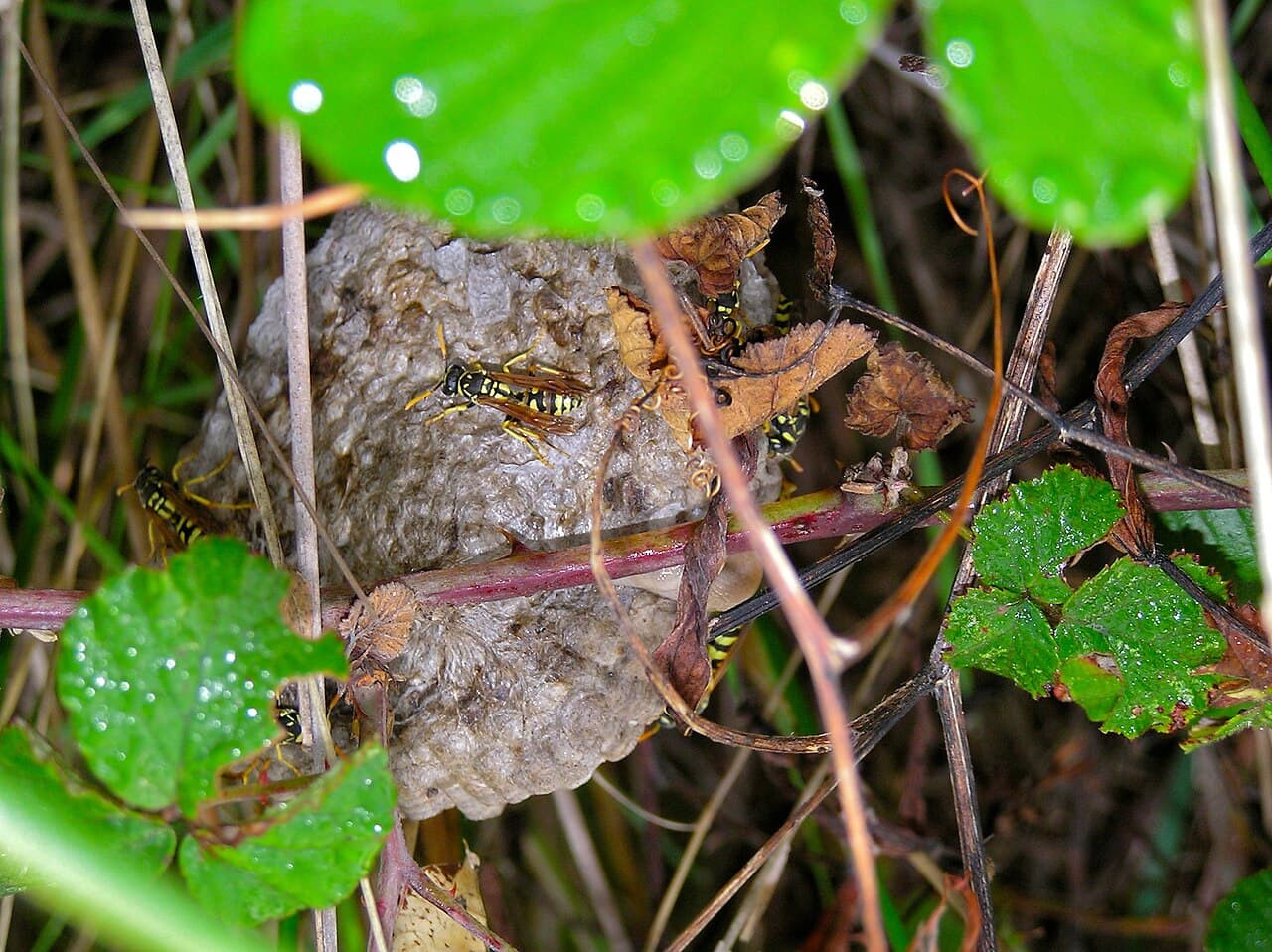
Where wasps build on a house
Most nests on a house belong to paper wasps. Paper wasps readily build nests around buildings, usually in a protected site such as under the eaves or in the space behind a loose board.[1] Homeowners have found them around outdoor light fixtures, in unused grills and in birdhouses.[1] Others turn up under gutters and ledges, in attics and sheds, behind shutters, and inside porch lights and mailboxes.[4]
What they want is a dry, sheltered overhang close to food and nest material. Those are the places to check and, where you can, to close up.
Why spring is the time to act
Social wasp colonies only last one year.[5] Mated queens spend the winter in sheltered spots, including wall voids and attics where temperatures stay above freezing, and each queen starts a new nest in a new place every spring.[2] Sealing cracks, holes and crevices in walls and foundations keeps those queens from getting in to start nests.[2]
A new paper wasp nest begins as several hexagonal cells hanging from a stalk, and workers expand it outward as the colony grows.[1] A social wasp nest has only a handful of individuals in spring and potentially hundreds by autumn.[5] Checking every few weeks from spring into early summer catches nests while they are still small.
Old nests matter too. Our native paper wasps build new nests each year, but European paper wasps will reuse old ones,[1] so knock last year's nests down in winter.
Take away what draws them in
Nest material. Workers collect fibers from exposed wood and dry plant stalks, and sometimes strip them from decking, outdoor furniture and tool handles left outside, or use cardboard, newspaper and cloth.[1] Putting tools and cardboard away gives them less to work with near the house.
Food. Adult paper wasps feed on nectar, ripe fruit juice and other sugary liquids, and they are a frequent nuisance around trash cans with spilled soda and around hummingbird feeders.[1] Tight lids, clean cans and picked-up fruit help. If a hummingbird feeder by the door draws wasps, move it farther from the house.
Light. European hornets fly at night as well as by day and may be drawn to porch lights and light leaking through blinds or curtains.[5] Turning off lights you do not need, or using motion sensors, cuts down on night visitors and the insects they hunt there.
Go easy on blanket spraying
Spraying the whole house with insecticide is not a substitute for the steps above. Broad spectrum insecticides also kill beneficial insects, including bees, butterflies and ladybugs.[3] Paper wasps are excellent predators of caterpillars,[1] so a nest far from doors and paths can often be left. Save the spray for a specific nest where people walk, and follow the label.
If you are not sure whether you are looking at wasps or bees, see how to tell bees from wasps. Carpenter bees drilling round holes in trim are a different problem; see how to keep carpenter bees from coming back.
Stop and call a pro if
- Wasps are going into a gap in the siding, soffit, vent or foundation. Do not plug the entrance of a nest in a wall: the workers may chew a new way out into the living area.[2] Have it treated first, then seal.
- The nest is above the first floor, at a roof peak, or anywhere you would need a ladder to reach.
- It is a large, gray, covered nest rather than an open comb. Those belong to hornets or yellowjackets, and a hornet nest may contain hundreds of wasps.[4]
- Anyone in the house is allergic to stings.
For the details, see when to call a pro for a wasp nest and what wasp nest removal costs in Virginia. You can also browse wasp and stinging insect services, look up pest control around Blacksburg, or read the other pest control answers.
If a nest is out of reach or in a wall, describe it on Loclis and licensed local pest control businesses can quote.
Common questions
- When do wasps start building nests in Virginia?
- In spring. Mated queens come out of their winter shelters and each starts a new nest in a new place. That is the easiest time to check the house, because the nests are only a few cells and a single queen is tending them.
- Should I knock down old wasp nests?
- Yes, in winter when nothing is living in them. Native paper wasps build new nests each year, but European paper wasps will reuse old ones, so clearing last year's nests removes a ready-made start.
- Does spraying the eaves with insecticide keep wasps away?
- It is not the first thing to try. Broad spectrum insecticides also kill bees, butterflies and ladybugs, and sealing gaps, checking for new nests in spring and removing attractants deal with the cause. If you do use a product, follow its label.
- Why do wasps keep coming back to the same spot?
- The spot suits them: sheltered, dry and close to food. Old nests left in place can be reused by European paper wasps. Take down old nests, close the gap or hideout, and check that spot first each spring.
- Can I seal the hole where wasps are going into my wall?
- Not while they are active. Workers in a wall may chew a new way out into the living area. Have the nest dealt with first, then seal the gap once nothing is flying in or out.
- Are paper wasps worth keeping around?
- Away from doors and paths, often yes. Paper wasps are excellent predators of caterpillars and are not particularly aggressive unless their nest is disturbed. The nests worth removing are the ones near doors, windows, busy paths and play areas.
Sources
- [1] Paper Wasps (ENTO-435NP), Virginia Cooperative Extension, Virginia Tech. Checked October 27, 2026.
- [2] Yellowjackets in Virginia (ENTO-49NP), Virginia Cooperative Extension, Virginia Tech. Checked October 27, 2026.
- [3] Bees, Hornets and Wasps, Fairfax County Park Authority. Checked October 27, 2026.
- [4] Controlling Wasps, Hornets, and Yellowjackets (ENTFACT-620), University of Kentucky Department of Entomology. Checked October 27, 2026.
- [5] Social Wasps: Yellowjackets, Hornets, and Paper Wasps, University of Maryland Extension. Checked October 27, 2026.
Want a pro to handle it?
Describe the job once. Licensed local businesses send quotes, and you pay only when you book one.
Get a quote from a local pro