How do I get rid of yellow jackets nesting in the ground?
Find the entrance in daylight from a distance, then come back late at night when the workers are inside and treat the hole with a wasp and hornet spray followed by an insecticidal dust labeled for yellowjackets. Check it the next day and repeat if it is still busy. Never pour gasoline, burn, flood or bury the nest.
Free to ask. Local shops send quotes, and you pay only when you book one.
By Kasra Taheri, Founder, LoclisPublished
Researched and drafted with AI, then checked claim by claim against the sources listed below before it was published. Prices and rules change; the dates beside each source say when it was last checked.
Step by step
Read when to stop and call a pro, further down this page, before you start.
Step 1: Make sure they are yellowjackets
Watch from a distance: yellowjackets fly in and out of a hole in steady traffic, while a lone large wasp digging in sandy soil beside a pile of dirt is usually a cicada killer, which is not considered a stinging hazard unless directly disturbed.[4]
Step 2: Find every entrance in daylight
Locate the nest during the day when workers are flying in and out on a regular basis, and look for a second hole nearby.[1]
Step 3: Decide whether it needs treating
If the nest is well away from paths, play areas and the mower's route, you can leave it, since colonies die off once the weather turns cold.[2]
Step 4: Buy a product labeled for the job
Get a wasp and hornet spray and an insecticidal dust whose labels list yellowjackets or ground nests, and read the directions before you go out.[5]
Step 5: Dress for it
Wear long sleeves, long pants tucked into socks, gloves and closed shoes, and keep children and pets indoors.
Step 7: Keep the light off the hole
Set the flashlight on the ground and aim the beam to the side of the entrance rather than straight into it.[2]
Step 8: Spray, then dust
Spray the insecticide into the entrance first, then puff the dust into and around the hole so returning workers carry it inside.[1]
Step 9: Leave right away
Walk away without waiting to see the result, and do not cover or block the hole.
Step 10: Check the next day
Watch the entrance the next day; if workers are still flying, treat again at night, and expect a large nest to need several treatments.[1]
Step 11: Wait before mowing over it
Keep people and the mower away from the spot until several days have passed with no wasps going in or out.
Treat a ground nest at night, with the right products, and leave the hole open. Find the entrance during the day from a safe distance, come back after dark when the workers are inside, and apply a wasp and hornet spray followed by an insecticidal dust labeled for yellowjackets. Check the next day and repeat if it is still active.
Know what you are dealing with
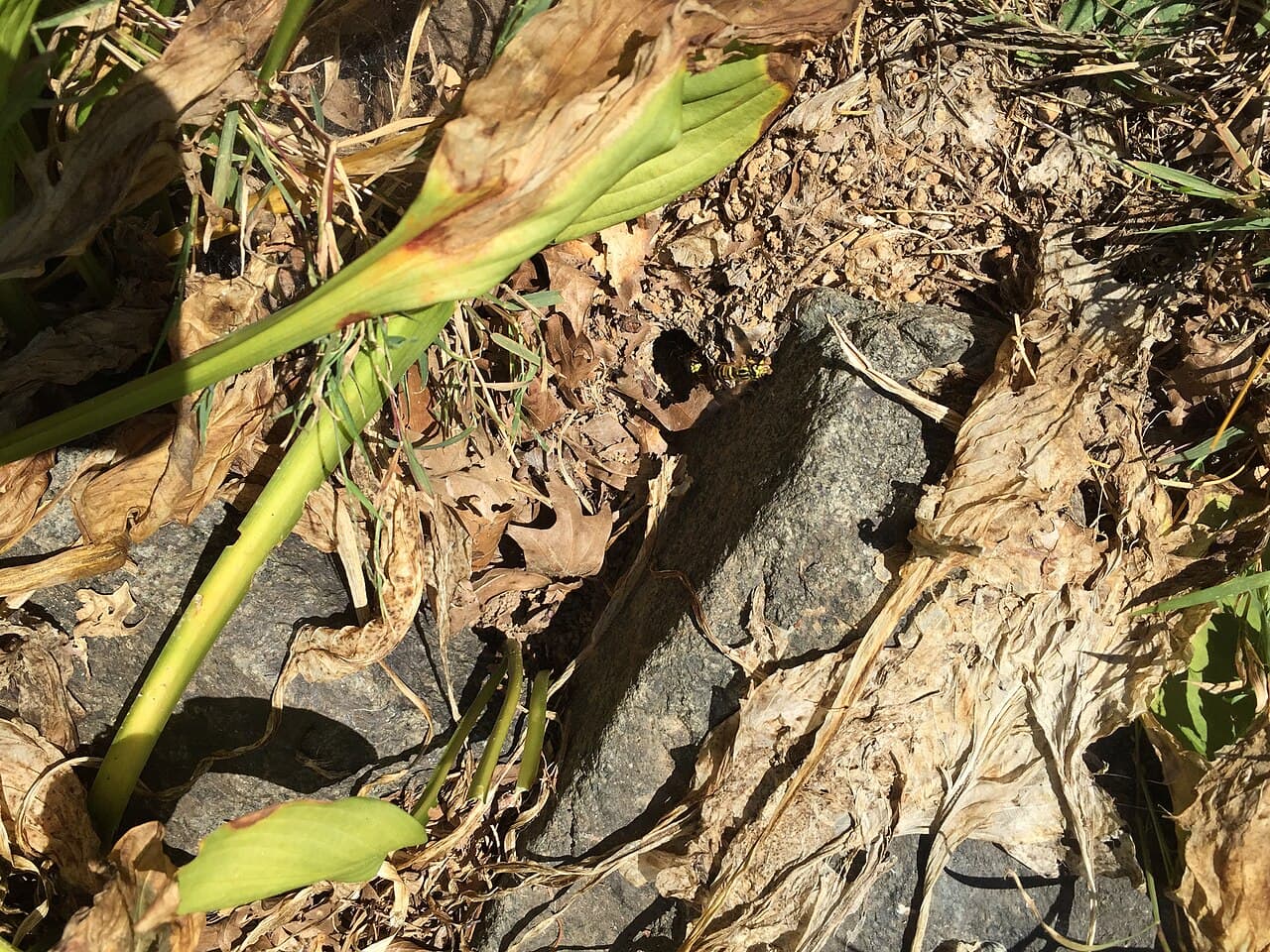
Ground-nesting yellowjackets often move into an old rodent burrow, or a space beneath rocks, gutter splash blocks or landscape timbers.[2] Their nests often have more than one entrance hole.[1] You usually find them by accident, when the mower or a string trimmer passes over the hole and a cloud of wasps comes up.
That reaction is the reason to be careful. Each female can sting more than once, and an attacking yellowjacket releases an alarm pheromone that sets its nestmates on the intruder as a group.[1] Vibration near the nest, such as a lawn mower or electric hedge clippers, can set off that defence.[3]
Not every wasp in a hole is a yellowjacket. In July and August, large orange-and-black wasps digging tunnels and leaving piles of loose soil are usually cicada killers.[4] They do not generally defend their nests as vigorously as other wasps, and male cicada killers have no stinger at all.[4] They rarely need treating. If you are not sure what you have, see how to tell bees from wasps.
Leave it or treat it
A nest at the back of the lot, away from paths, play areas and the mower's route, can often be left alone. Abandoned nests are not reused the following year, and each queen starts a new nest in a new spot each spring.[1] Mow around it until a killing frost in late autumn, when the nest stops being a threat.[3]
Treat the nest when people walk, play or mow near it, or when a dog keeps digging at it.
What you need
- A wasp and hornet aerosol whose label lists yellowjackets.
- An insecticidal dust labeled for outdoor wasps, with a squeeze bulb or bellows duster.
- A flashlight you can set down on the ground.
- Long sleeves, long pants, gloves and closed shoes.
Read both labels before you go out. Pesticide labels are legally enforceable,[5] and they set who may use a product and where, how, how much and how often it may be used.[5]
Why night, and why dust
At night most of the workers are in the nest and less active,[2] so fewer are out to defend it and more of them are in the path of the treatment. Spray mostly reaches the wasps near the entrance; dust is what usually reaches the rest. Dust tends to work better than spray when the nest sits some distance from the hole, as it does deep in an old burrow or a rock wall, because it penetrates farther and is carried through the colony.[2] The workers walk through it on their way in and out and take it deeper.
That is also why the hole stays open: blocking it keeps the workers from walking through the dust.
What not to do
- Do not try to bury the nest, and do not pour gasoline, diesel, bleach or other harmful chemicals into it, or try to smoke or burn the yellowjackets out.[1]
- Home remedies such as flooding the burrow are unlikely to work and raise the risk of stings as agitated wasps escape.[3]
- Do not shine the light straight into the hole or stand over it while you work.
- Do not use a product whose label does not list yellowjackets or wasps.
One nest is not every yellowjacket you will see. Treating one nest will not stop every yellowjacket in the yard, because workers can fly a mile from their colony looking for food.[1] If they are pestering a cookout, the fix is covered food and closed trash; see why yellow jackets are so aggressive in late summer.
Stop and call a pro if
- Anyone in the house is allergic to stings. Do not be the one treating the nest. Signs of a serious allergic reaction include hives, widespread itching, difficulty breathing or swallowing, swelling of the face, throat or mouth, dizziness and a rapid pulse, and anyone with those symptoms needs medical attention immediately.[2]
- The wasps are going into the house, through siding, a foundation gap, a vent or a crawlspace. Do not plug the hole. Yellowjackets that nest in walls may chew a new way out into the living space.[1] A wall nest may justify the cost of a licensed pest control operator, who has the equipment for it.[1]
- The nest is above ground and large. Bald-faced hornets build a large, gray nest resembling a bloated football, typically attached to a tree, bush or side of a building, and those nests are often out of reach.[2] Anything that needs a ladder is a job for a pro.
- You have treated twice and the hole is still busy, or you cannot find where the wasps are coming from.
For help deciding, see when to call a pro for a wasp nest and what wasp nest removal costs in Virginia. You can also browse wasp and stinging insect services, look up pest control around Blacksburg, or read the other pest control answers.
If the nest is in a wall or too close for comfort, describe the job on Loclis and licensed local pest control businesses can quote.
Common questions
- Can I just pour boiling water or gasoline down the hole?
- No. Virginia Cooperative Extension warns against gasoline, diesel, bleach and fire, and flooding a burrow tends to send angry wasps out at you. Boiling water is the same kind of home remedy. A labeled spray and dust at night works better and is far safer.
- Should I cover the hole with dirt or a rock?
- No. Virginia Cooperative Extension advises against trying to bury an underground nest. Leave the hole open so the workers keep walking through the dust you applied.
- What time of day should I treat a ground nest?
- Late at night, after the workers have gone back into the nest. Find the hole during the day, then come back after dark with a flashlight set on the ground and aimed to the side of the entrance.
- Will the nest come back next year?
- Not the same nest. Old nests are not reused, and each queen starts a new one in a new place in spring. Walking the yard in early summer, before you mow, is the easiest way to catch a new one while it is small.
- Do yellowjacket traps get rid of a ground nest?
- No. Traps catch some foraging workers but do not eliminate them, and a mature colony is far larger than what a trap catches. They do nothing to the nest itself.
- Is it safe to wait until winter?
- If the nest is away from where people walk, play or mow, yes. Colonies die off once the weather turns cold. A nest beside a path, a play area or the mower's route is the one worth treating now.
Sources
- [1] Yellowjackets in Virginia (ENTO-49NP), Virginia Cooperative Extension, Virginia Tech. Checked October 27, 2026.
- [2] Controlling Wasps, Hornets, and Yellowjackets (ENTFACT-620), University of Kentucky Department of Entomology. Checked October 27, 2026.
- [3] Social Wasps: Yellowjackets, Hornets, and Paper Wasps, University of Maryland Extension. Checked October 27, 2026.
- [4] Cicada Killer Wasps (ENTFACT-004), University of Kentucky Department of Entomology. Checked October 27, 2026.
- [5] Introduction to Pesticide Labels, U.S. Environmental Protection Agency. Checked October 27, 2026.
Want a pro to handle it?
Describe the job once. Licensed local businesses send quotes, and you pay only when you book one.
Get a quote from a local pro