Why does my leaf blower die when I give it gas?
A blower that idles but dies when you squeeze the trigger is usually starved of fuel or air: old or badly mixed fuel, a dirty air filter, a clogged fuel filter or tank vent, a fouled spark plug or a plugged spark arrestor screen. Work through those cheap checks in order. If it still dies, the carburetor needs a shop.
Free to ask. Local shops send quotes, and you pay only when you book one.
By Kasra Taheri, Founder, LoclisPublished
Researched and drafted with AI, then checked claim by claim against the sources listed below before it was published. Prices and rules change; the dates beside each source say when it was last checked.
Step by step
Read when to stop and call a pro, further down this page, before you start.
Step 1: Stop it and pull the plug boot
Stop the engine, let it cool, and disconnect the spark plug before you work on the blower.[1]
Step 2: Look at the fuel
If the mix is more than 30 days old, or 90 with a stabilizer, empty the tank into an approved container and refill with fresh, correctly mixed fuel.[1]
Step 3: Shake the can
Shake the fuel container thoroughly before each fill, because stored two-stroke fuel may separate.[1]
Step 4: Clean or replace the air filter
Take the filter out of its case and replace it if it is saturated with dirt, soaked with fuel mix or damaged; otherwise brush it clean.[1]
Step 5: Replace the fuel filter
Hook the fuel line and filter out of the tank and fit a new filter on the line.
Step 6: Check the tank vent
A plugged vent starves the carburetor as the tank empties, so clear any vent opening in the cap or housing.[1]
Step 7: Inspect the spark plug
Pull the plug and replace it if it is fouled with fuel or carbon, worn or has a damaged electrode.[1]
Step 8: Test it
Refit the plug boot, refuel away from the work area, start the blower and open the throttle gradually.
Start with the fuel and the filters
A blower that idles but dies when you open the throttle is almost always starved of fuel or air. At idle the engine needs very little of either, so a restriction can hide. Open the throttle and demand jumps; the engine cannot keep up and stalls.
The troubleshooting chart in ECHO's two-stroke trimmer manual for an engine that runs but dies or does not accelerate properly lists a dirty air filter, a dirty fuel filter, a plugged fuel vent, a dirty or worn spark plug, improper carburetor adjustment, a dirty or plugged cooling system and a dirty spark arrestor screen.[1] Most of that list is a ten-minute job with no special tools, so work through it in order, cheapest first.
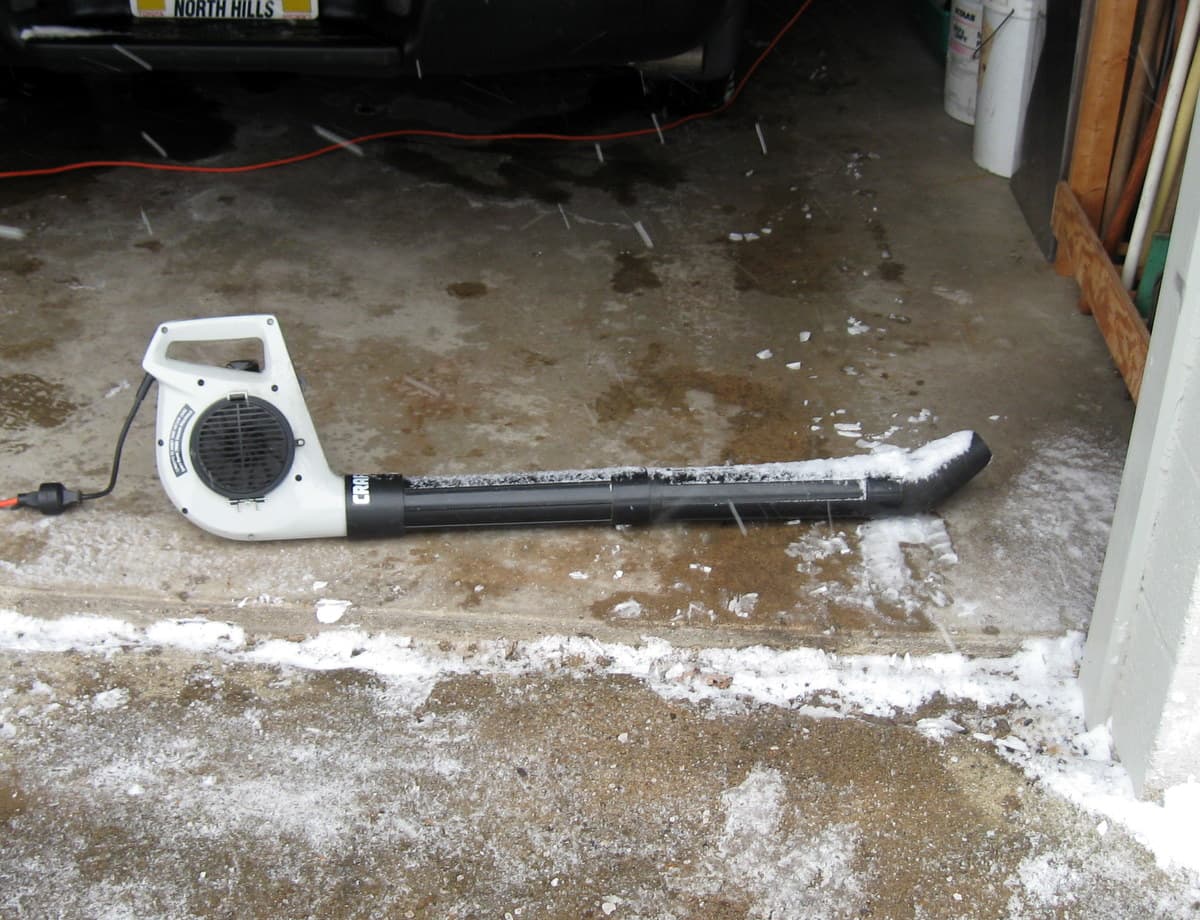
Fuel first
Old fuel is a common cause, especially for a blower that sat all winter. Gas begins to degrade in as little as 30 days.[3] ECHO's manual is specific for two-stroke engines: "Stored fuel ages. Do not mix more fuel than you expect to use in thirty (30) days, ninety (90) days when a fuel stabilizer is added."[1] It also warns: "Stored two-stroke fuel may separate. ALWAYS shake fuel container thoroughly before each use."[1]
Ethanol adds to the problem. Gasoline is not water soluble, but ethanol is,[2] so ethanol blends can pick up contaminants and leave them in the fuel system, and Penn State Extension notes that seasonally used equipment is especially prone to trouble.[2] Use the fuel and oil mix your manual calls for. ECHO, for one, says "Alternative fuels, such as E-15 (15 % ethanol), E-85 (85 % ethanol) or any fuels not meeting ECHO requirements are NOT approved for use in ECHO 2-stroke gasoline engines."[1]
If your fuel is old, empty the tank into an approved container, take it to a household hazardous waste drop-off rather than pouring it out, and refill with fresh, correctly mixed fuel.
Then air, filter and vent
A clogged air filter chokes the engine from the other side. Take it out of its case. ECHO says to replace it if the element is saturated with dirt, soaked with fuel mix, has holes, or the seal is worn or does not fit tightly.[1] A filter that is only dusty can be brushed clean.
The fuel filter sits on the end of the fuel line inside the tank. It is cheap, and a clogged one is a classic cause of a blower that cuts out under load. Hook the line out of the tank, pull the old filter off and fit a new one. The tank vent matters too: if it plugs, the tank draws a partial vacuum as fuel is used and the carburetor goes hungry. Make sure any vent opening in the cap or housing is clear.
Plug and exhaust
Pull the spark plug and look at it. A plug that is wet with fuel, coated in carbon, worn or cracked should be replaced with the type and gap your manual specifies. The muffler on a two-stroke has a spark arrestor screen that can clog with carbon; ECHO's instruction is "Replace screen if it is cracked, plugged, or has holes burned" in it.[1] Only touch the muffler when it is completely cold.
Leave the carburetor screws alone
Turning the small mixture screws feels like the obvious fix, but ECHO's manual says "Carburetor adjustments, other than idle speed, must be performed by an authorized ECHO dealer."[1] ECHO says every unit is set at the factory in compliance with emission regulations.[1] If fresh fuel, clean filters and a good plug do not cure it, the carburetor is gummed up or worn, and that is a shop job.
Stay safe while you test
Before any of the above, ECHO's rule is: "ALWAYS stop engine, disconnect spark plug, and make sure all moving parts have come to a complete stop" before clearing debris or servicing the unit.[1] When you refuel, never do it with the engine hot or running, and "Move at least 3m (10 ft.) from refueling location before starting the engine."[1]
Stop and call a pro if
- It still dies after fresh fuel, filters and a good plug. The carburetor, its diaphragms or a cracked fuel line is the likely cause, and those need bench work.
- You smell raw fuel or see it leaking from the tank, the lines or the carburetor.
- The plug is wet again soon after you replace it, or the engine floods repeatedly.
- The engine runs rough with a loud or metallic noise. Keep running it and you risk a seized piston.
- You would have to adjust the mixture screws. Leave that to a dealer.
Getting help in Virginia
Ask a shop for an itemised written estimate before it starts; what leaf blower repair costs in Virginia explains the usual charges and when replacing is smarter. Mowers fail in similar ways, so why a lawn mower will not start is a useful comparison. Browse leaf blower repair shops or read more small engine repair answers.
When you are ready, describe the blower and local small engine shops can quote it.
Common questions
- Why does my blower idle fine but die when I squeeze the trigger?
- Idling needs very little fuel and air; opening the throttle asks the engine for much more. If something restricts either, such as stale fuel, a dirty filter or a plugged vent, the engine runs on the small amount it gets at idle and stalls when the demand jumps. That is why the fixes are filters, fuel and vent, not the throttle itself.
- Can old gas really cause this?
- Yes, it is a common cause. Briggs & Stratton says gas begins to degrade in as little as 30 days. ECHO's manual says not to mix more two-stroke fuel than you expect to use in 30 days, or 90 days with a stabilizer. Drain the old fuel and start with a fresh, correctly mixed batch.
- Should I turn the carburetor screws to fix it?
- No. ECHO's manual says carburetor adjustments other than idle speed must be performed by an authorized dealer. The factory setting complies with emission regulations, and turning the screws rarely fixes a blower that is being starved by a dirty filter or old fuel.
- Does ethanol in pump gas matter?
- It can. Penn State Extension notes that ethanol, unlike gasoline, mixes with water and can carry contaminants into the engine, and that seasonally used equipment is especially prone to difficulties. ECHO's manual does not approve E-15 or E-85 in its two-stroke engines. Check your blower's manual for the fuel it allows.
- It still dies after the new fuel, filters and plug. What now?
- The carburetor is the usual remaining suspect, with a worn fuel line or diaphragm close behind. Those are shop repairs. A written estimate before work starts tells you whether fixing the blower makes sense against replacing it.
Sources
- [1] Grass Trimmer/Brush Cutter Operator's Manual, model SRM-410U, ECHO Incorporated. Checked October 27, 2026.
- [2] Fuel Ethanol: Hero or Villain?, Penn State Extension. Checked October 27, 2026.
- [3] Storing Your Equipment, Briggs & Stratton. Checked October 27, 2026.
Want a pro to handle it?
Describe the job once. Licensed local businesses send quotes, and you pay only when you book one.
Get a quote for Small Engines