Why is my crawl space wet?
Usually one of five things: rain from the roof or yard running toward the foundation, groundwater rising through the soil, a leaking pipe or condensate line, humid summer air condensing on cool pipes and framing through open vents, or bare soil giving off moisture. When water appears, and what it looks like, points to which one.
Free to ask. Local shops send quotes, and you pay only when you book one.
By Kasra Taheri, Founder, LoclisPublished
Researched and drafted with AI, then checked claim by claim against the sources listed below before it was published. Prices and rules change; the dates beside each source say when it was last checked.
Step by step
Read when to stop and call a pro, further down this page, before you start.
Step 1: Check right after rain
Look in within a day of a heavy rain; water that shows up only after storms points to roof runoff, grading or groundwater.[1]
Step 2: Walk the outside
Check that downspouts discharge well away from the house and that soil slopes away from the walls rather than toward them.[1]
Step 3: Look at the vents and door
Note any foundation vent or access door close to the soil, since low openings let surface water in.[1]
Step 4: Trace the pipes
With a flashlight, follow drain and supply lines for drips and wet spots, especially under bathrooms and the kitchen.[1]
Step 5: Check the condensate line
Follow the air conditioner's condensate drain from the unit to where it ends and look for leaks or a line ending on the floor.[1]
Step 6: Check dry-weather dampness
If pipes and ducts drip in July with no rain, suspect humid outside air condensing on cool surfaces.[1]
Step 7: Look at the floor
Note bare soil, gaps or torn seams in the plastic, and water pooled on top of it.[1]
Step 9: Log the humidity
Leave a hygrometer in the space for a week and compare dry days with wet ones.[5]
A crawl space gets wet from one of five places: rain running toward the foundation, groundwater coming up or through the walls, a plumbing or condensate leak, humid outdoor air condensing on cool surfaces, or bare soil evaporating into the air. Most wet crawl spaces have two or three of these at once. The fastest way to sort them out is to notice when the water shows up and what it looks like.
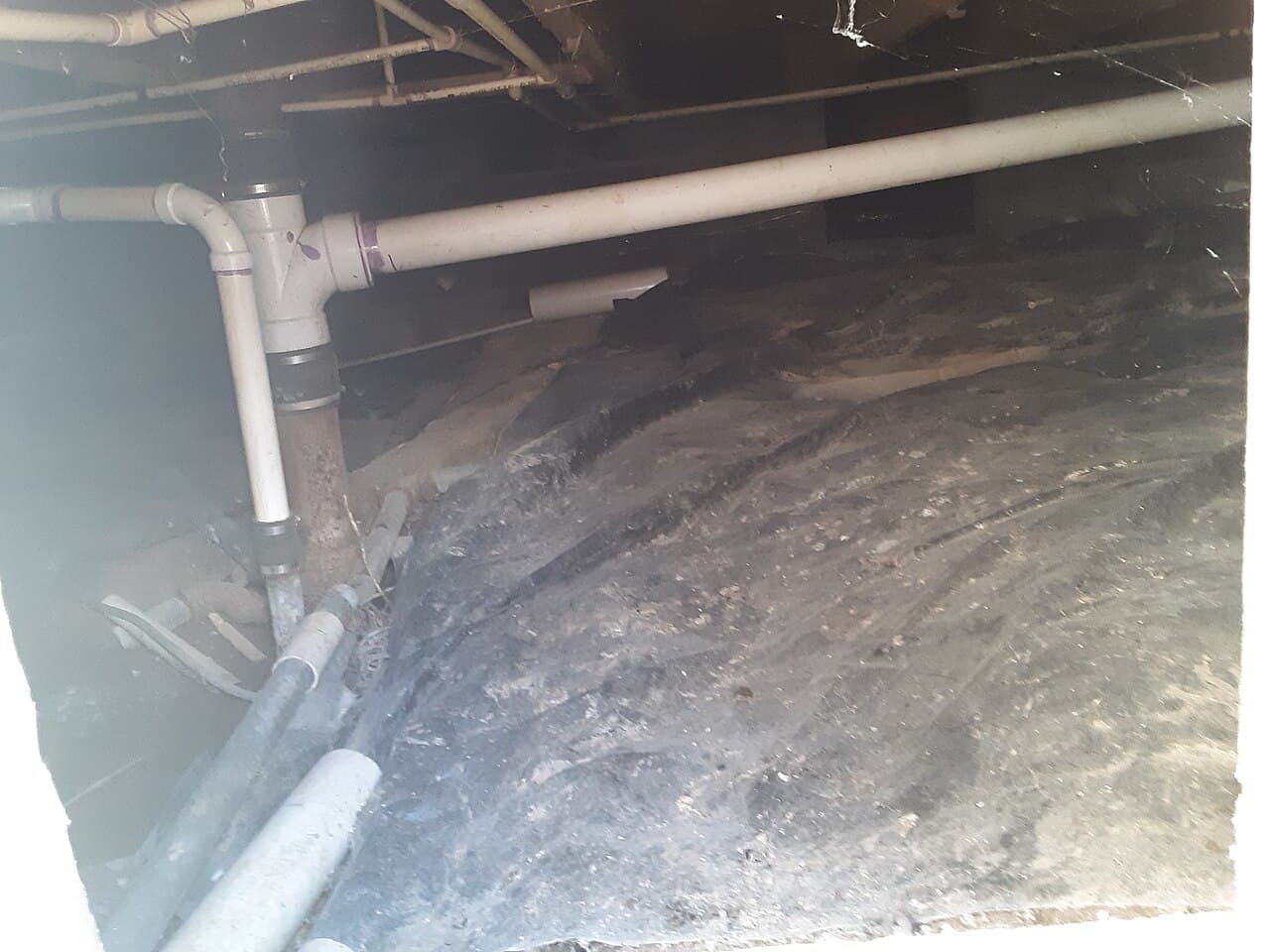
Wet after rain: water from outside
If the space is dry most of the time and wet after storms, the water is coming from outside. Virginia Cooperative Extension calls this kind of leak, rain through holes, cracks and gaps, the one that matters most: "This is the most important of the four modes of moisture migration because bulk moisture leaks represent pathways for liquid water to immediately move into building cavities".[3]
Common entry points:
- Roof runoff. All roof runoff must be directed away from the building a minimum of 10 ft or via an underground drain system.[1] A downspout dumping at the corner of the house is a frequent cause. See how to extend a downspout away from the foundation.
- Grading. The ideal is a 5% slope away from the foundation (6 in. within 10 ft).[1] Settled soil, flower beds and patios that tip toward the house send water to the wall. See why water pools near a foundation.
- Low vents and doors. Foundation vents and access doors near the soil let surface water pour in. The Department of Energy's crawl space guide says If the vents fall near or below grade, they will need to be filled in with block, brick, or concrete and sealed to prevent water entry,[1] and puts the access door at a minimum of 6 in. above exterior grade to prevent runoff or snowmelt from entering.[1]
- Groundwater. If the yard is already graded and drained and water still seeps up through the floor or in at the base of the walls, suspect groundwater. That usually means a site with high groundwater or water flow against the foundation that cannot be remediated in any other way,[1] and it calls for perimeter drains, waterproofing or a sump.
Wet in one spot: a leak
A puddle in the same place in dry weather is usually plumbing. Typically, standing water indicates a leaking pipe from above or groundwater entering the space from outside the building or under the floor.[1] Check under bathrooms, the kitchen and the laundry, and follow the air conditioner's condensate drain to where it ends. The DOE guide notes that an auxiliary drain pan with a separate drain beneath any cooling or evaporator coil is recommended to prevent condensate from flooding the crawlspace[1] if the main line clogs.
Wet in summer, no puddles: condensation
Dripping ducts, sweating pipes and damp joists in July with no rain point to condensation. Research for the Department of Energy found that vented crawlspaces located in mixed or hot-humid climates tend to increase the moisture level within the space instead of keeping it drier.[1] The guide explains why: This increased moisture then condenses on the colder wood surfaces of the floor framing, promoting fungal growth and wood damage.[1]
It is the same thing that happens on a cold glass. At 100% relative humidity, the air is saturated and water vapor will condense into a liquid; the temperature at which this happens is called the dew point.[3] Humid outdoor air comes in through the vents, meets a cold supply duct or a cold water pipe, and leaves water behind. Opening the vents wider in summer tends to make this worse, not better.
Damp all the time: the soil and other sources
Bare dirt never stops giving off water. Moisture in damp soil, such as in a crawl space, can evaporate into the air, raise the relative humidity in that space, and enter the building as a vapor.[6] The EPA's guidance says damp basements or crawlspaces may add as much water vapor to the air in a day as all the other internal sources combined.[4]
A ground cover only works when it is complete: Poor sealing practices of the polyethylene vapor barrier allow ground moisture to infiltrate through gaps or open seams in the barrier.[1] Other everyday sources:
- An open sump pit. Missing lids and an absence of sealing will allow moisture to enter and increase the relative humidity of the crawlspace.[1]
- Exhausts. Dryer vents and bath fans belong outdoors; the closed crawl space guidance lists exhausts from kitchens, bathrooms and clothes dryers that terminate outside the crawl space[2] as a basic requirement.
- Appliance discharges. The DOE's inspection list includes water softener discharge[1] among interior sources.
Why it matters
Moisture does damage slowly and then all at once. Fungi (molds) grow in air over 60% relative humidity,[3] and The moisture content of the wood in the crawlspace must remain below 17%.[1] Wet wood also draws insects; Virginia Cooperative Extension notes that when carpenter ants nest in a house, their presence indicates that there is water damage somewhere in the building.[7] After a leak, dry things out quickly; the EPA says that if wet materials are dried 24-48 hours after a leak or spill happens, in most cases mold will not grow.[5]
Once you know the source, see how to lower crawl space humidity for the fixes, and why a house smells musty from the crawl space if the smell has reached the rooms above.
Stop and call a pro if
- Water runs in at the walls or rises through the floor after rain, even with downspouts and grading corrected.
- A pipe is leaking, or the condensate line or pan is overflowing.
- Ducts are dripping, which may mean the air conditioner or the duct insulation needs an HVAC technician.
- Joists or the subfloor are soft, stained dark or sagging.
- You see mud tubes, winged insects or sawdust-like piles under wood.
- Mold covers more than a small patch.
- There is a sewage smell or a failed sump pump.
To decide who to call, see whether to hire a pest control or a waterproofing company. More is under pest control answers, and you can browse pest control businesses near Blacksburg.
Describe your wet crawl space once and get quotes from licensed pros.
Common questions
- Why is my crawl space wet when it has not rained?
- Look first for a plumbing or condensate leak. If none, it is likely condensation: in a Virginia summer, humid outside air coming through the vents meets pipes, ducts and framing cooler than its dew point and leaves water on them, the way a cold glass sweats.
- Is some moisture in a crawl space normal?
- Some is, but not puddles or dripping. Aim for air below 60 percent relative humidity, where mold does not grow, and wood below 17 percent moisture content. Readings above those for weeks at a time are a problem worth fixing.
- Why is there water on top of my vapor barrier?
- Plastic stops vapor rising from the soil, but water from above or from outside collects on it. Look for a leak overhead, condensation dripping from ducts or pipes, or rainwater coming in through a vent, the access door or the wall.
- Can a wet crawl space cause pest problems?
- It can make them more likely. Termites and carpenter ants do well in damp, dark places, and carpenter ants nest in water-damaged wood, so their presence suggests a moisture problem somewhere. A licensed pest control company should inspect if you see signs.
- Do I need a sump pump?
- Only if liquid water collects that you cannot stop at the source. Fix gutters, downspouts and grading first; if groundwater still comes in, a contractor may add an interior drain and sump. A sump does nothing for humid air, and its pit needs a sealed lid.
Sources
- [1] Guide to Closing and Conditioning Ventilated Crawlspaces (January 2013), U.S. Department of Energy, Building America Program (IBACOS for NREL). Checked October 26, 2026.
- [2] Designing Closed Crawl Spaces: A Quick Reference (February 2012), Advanced Energy, published by ENERGY STAR. Checked October 26, 2026.
- [3] ENERGY SERIES: What about Moisture? (2908-9020), Virginia Cooperative Extension, Virginia Tech. Checked October 26, 2026.
- [4] Moisture Control Guidance for Building Design, Construction and Maintenance (December 2013), U.S. Environmental Protection Agency. Checked October 26, 2026.
- [5] A Brief Guide to Mold, Moisture and Your Home, U.S. Environmental Protection Agency. Checked October 26, 2026.
- [6] Preservation Brief 39: Holding the Line: Controlling Unwanted Moisture in Historic Buildings, U.S. National Park Service. Checked October 26, 2026.
- [7] Carpenter Ants (3104-1573), Virginia Cooperative Extension, Virginia Tech. Checked October 26, 2026.
Want a pro to handle it?
Describe the job once. Licensed local businesses send quotes, and you pay only when you book one.
Get a quote from a local pro