How do I lower the humidity in my crawl space?
Measure it first, then work from the outside in: send roof water well away from the foundation, fix leaks and drips, cover all bare soil with plastic sheeting, keep exhausts and the sump sealed off, and run a dehumidifier rated for cool spaces. Aim for below 60 percent, ideally 30 to 50, and check the reading through the summer.
Free to ask. Local shops send quotes, and you pay only when you book one.
By Kasra Taheri, Founder, LoclisPublished
Researched and drafted with AI, then checked claim by claim against the sources listed below before it was published. Prices and rules change; the dates beside each source say when it was last checked.
Step by step
Read when to stop and call a pro, further down this page, before you start.
Step 1: Measure the humidity
Leave a hygrometer in the crawl space for a few days, including after rain, and note the highest reading; aim below 60 percent, ideally 30 to 50.[4]
Step 2: Move roof water away
Clean gutters and make sure each downspout empties at least 10 feet from the foundation, through a buried drain if needed.[1]
Step 3: Check the grading
Look for soil that slopes toward the house; the target is a slope of 5 percent away from the foundation, 6 inches of fall within 10 feet.[1]
Step 4: Aim sprinklers away
Run any lawn sprinklers near the house and turn heads that wet the foundation.[1]
Step 5: Look for drips
With a flashlight, check drain pipes, supply lines and the air conditioner condensate line for leaks, and have any you find repaired.[1]
Step 6: Cover the bare soil
Cover the ground with 6-mil polyethylene, lapping the seams 12 to 18 inches.[6]
Step 7: Close off the sump
Make sure any sump pit has a lid that fits tightly, since an open pit adds moisture to the air.[1]
Step 8: Send exhausts outside
Confirm the dryer, bathroom and kitchen exhausts end outdoors and not in the crawl space.[2]
Step 9: Choose the dehumidifier
Size it by how damp the space is and pick a model specified for temperatures below 65 degrees.[5]
Step 10: Set it up safely
Plug it into a properly grounded outlet and run its hose to a floor drain or sump, away from cords.[5]
Step 11: Set the humidistat
Set the built-in humidistat to your target so the unit cycles on and off by itself.[5]
Step 12: Keep the door shut
Keep the access door closed and weather-stripped so humid outside air stays out.[1]
Step 13: Recheck through summer
Read the hygrometer every week or two from late spring to early fall and empty or clear the drain as needed.
To lower crawl space humidity, stop the water at its sources first, then dry the air that is left. Most of the work is ordinary homeowner maintenance: gutters, grading, a plastic ground cover and a dehumidifier. The order matters, because a dehumidifier fighting rainwater and bare wet soil runs all summer and still loses.
It is worth doing. The EPA's moisture guidance warns that damp basements or crawlspaces may add as much water vapor to the air in a day as all the other internal sources combined,[3] and that air rises into the rooms above.
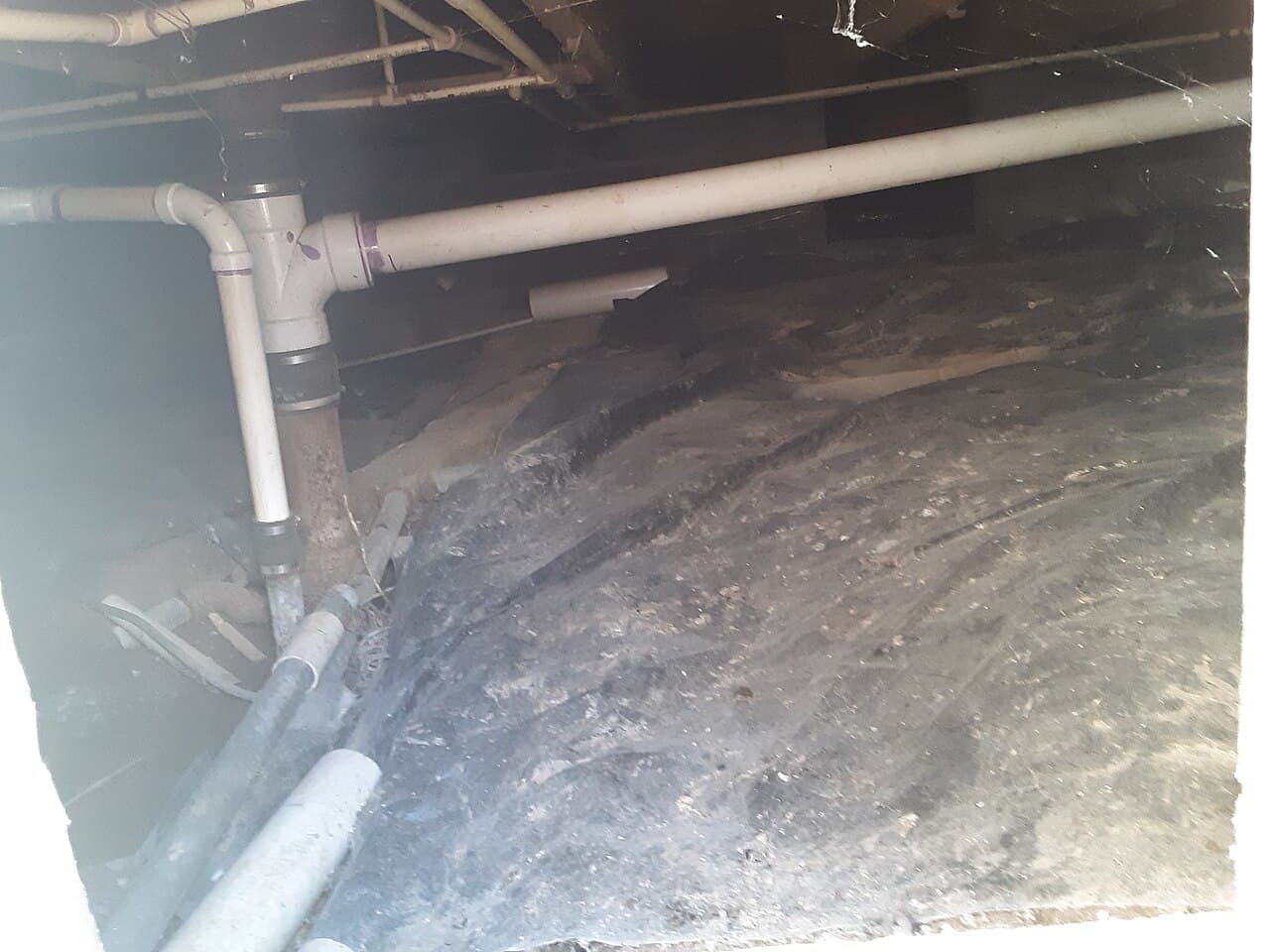
Know your number
Put a hygrometer, a small humidity gauge, in the crawl space and leave it for several days, including a day or two after rain. The EPA's advice for homes is to keep indoor humidity below 60 percent (ideally between 30 and 50 percent) relative humidity,[4] and Virginia Cooperative Extension explains the ceiling: Fungi (molds) grow in air over 60% relative humidity.[7]
Humidity is the air; the wood matters too. The Department of Energy's crawl space guide says The moisture content of the wood in the crawlspace must remain below 17%.[1] A contractor or inspector can check that with a moisture meter if the joists look stained or feel damp.
Damp wood also invites insects. Termites and carpenter ants are known to thrive in dark, damp places,[1] and Virginia Cooperative Extension notes that when carpenter ants nest in a house, their presence indicates that there is water damage somewhere in the building.[8]
Stop the water from outside
Rain is usually the biggest source and the cheapest to fix.
- Downspouts. Make sure each downspout empties at least 10 feet from the foundation, through a buried drain if needed.[1] See how to extend a downspout away from the foundation.
- Grading. Soil settles against foundations. The target is a 5 percent slope away from the foundation, 6 inches of fall within 10 feet.[1] If water collects along the wall after storms, start with why water pools near a foundation.
- Sprinklers and faucets. Turn sprinkler heads so they do not wet the foundation, and fix dripping outdoor spigots.
Remove the sources inside
- Leaks. Look along drain lines, supply pipes and the air conditioner's condensate line for drips and wet spots, and have leaks repaired promptly.
- Bare soil. This is a constant source. The Virginia Energy Savers Handbook calls for this: cover the ground with 6-mil polyethylene, lapping the seams 12 to 18 inches.[6] Lay it smooth, with the edges running a few inches up the walls and piers.
- The sump pit. Missing lids and an absence of sealing will allow moisture to enter and increase the relative humidity of the crawlspace.[1]
- Exhausts. Kitchen, bathroom and clothes dryer exhausts should end outside the crawl space,[2] never under the house.
Then dry the air
Size the dehumidifier to the dampness. ENERGY STAR's chart for portable units runs about 20 to 30 pints a day for a space that feels damp and smells musty at times (50 to 75 percent humidity), 25 to 40 for one that consistently feels and smells damp (75 to 90 percent), and 30 to 50 where walls or floors sweat or seepage is present (90 to 100 percent).[5] Those figures are for spaces under 2,000 square feet; go up a size for larger ones. A certified unit uses 20% less energy[5] than a comparable standard model, which matters for a machine that runs for months.
Pick one that works in the cold. Frost can form on the coils below 65 degrees,[5] and crawl spaces often sit below that in spring and fall. Choose a model specified for low temperatures or one with an anti-frost sensor.
Set it up safely. ENERGY STAR is direct about this: "Make sure the dehumidifier is connected to a properly grounded outlet. Keep drain hoses away from electrical cords and connections."[5] Run the hose to a floor drain or sump so the unit never stops on a full bucket. If there is no grounded outlet nearby, that is a job for a licensed electrician, not an extension cord. For choosing between models, see how to choose a dehumidifier for a basement; the same rules apply below the floor.
A word on the vents
Opening the foundation vents wider rarely helps in summer. Research for the Department of Energy found that vented crawlspaces located in mixed or hot-humid climates tend to increase the moisture level within the space instead of keeping it drier,[1] because humid outside air condenses on the cooler framing.
Closing them is not a quick fix either. Sealing vents without the rest of the work risks potentially creating a deadly situation if naturally ventilated types of combustion equipment are located in the crawlspace,[1] and a closed space still needs something to dry it: Crawlspaces must always have a drying mechanism.[1] That conversion is a bigger project; see how to encapsulate a crawl space and whether encapsulation is worth it in Virginia.
If something gets wet
Act fast after a leak. The EPA says that if wet materials are dried 24-48 hours after a leak or spill happens, in most cases mold will not grow.[4] Run the dehumidifier, open the access door on a dry day and fix the source before covering anything back up.
Stop and call a pro if
- Water stands on the floor or the liner after rain even with gutters and grading fixed.
- Humidity stays above 60 percent for weeks with a correctly sized dehumidifier running.
- A gas or oil furnace or water heater is in the crawl space and you are thinking about closing the vents.
- Mold covers more than a small patch. The EPA's do-it-yourself guidance applies only If the moldy area is less than about 10 square feet;[4] beyond that, hire a mold professional.
- Joists or the subfloor are soft, sagging or crumbling.
- You see mud tubes on the foundation, sawdust-like piles under wood or swarms of winged insects, which call for a licensed pest control inspection.
- There is no grounded outlet near where the dehumidifier must go.
More on keeping a crawl space dry over the long term and other pest control answers, or browse crawlspace and moisture services and pest control businesses near Blacksburg.
Describe your damp crawl space once and get quotes from licensed pros.
Common questions
- What humidity should a crawl space be kept at?
- Below 60 percent, the level above which mold grows, and ideally between 30 and 50 percent, the range the EPA gives for homes. Check with a hygrometer left in the space for several days in summer, when readings are usually highest.
- Will opening the crawl space vents lower the humidity?
- Usually not in a Virginia summer. Research for the Department of Energy found that vented crawl spaces in mixed and hot-humid climates tend to get wetter, because warm outside air brings in moisture that condenses on the cooler framing.
- Can I just close the vents myself?
- Not until someone has checked what burns fuel down there. A furnace or water heater that draws combustion air through those vents can become dangerous when they are closed, and a closed crawl space still needs a dehumidifier or conditioned air to dry it.
- Is a plastic ground cover enough on its own?
- It removes the largest steady source in many crawl spaces, the damp soil, but it does nothing about rain getting in or humid outside air. Most crawl spaces need the ground cover plus drainage fixes, and many also need a dehumidifier.
- Does lower humidity help with bugs?
- It removes conditions some of them need. Termites and carpenter ants do well in dark, damp places, and carpenter ants nest in water-damaged wood, so drying the space makes it less attractive. It does not treat an existing infestation; that is a job for a licensed pest control company.
Sources
- [1] Guide to Closing and Conditioning Ventilated Crawlspaces (January 2013), U.S. Department of Energy, Building America Program (IBACOS for NREL). Checked October 26, 2026.
- [2] Designing Closed Crawl Spaces: A Quick Reference (February 2012), Advanced Energy, published by ENERGY STAR. Checked October 26, 2026.
- [3] Moisture Control Guidance for Building Design, Construction and Maintenance (December 2013), U.S. Environmental Protection Agency. Checked October 26, 2026.
- [4] A Brief Guide to Mold, Moisture and Your Home, U.S. Environmental Protection Agency. Checked October 26, 2026.
- [5] Dehumidifiers, ENERGY STAR (U.S. EPA). Checked October 26, 2026.
- [6] The Virginia Energy Savers Handbook (third edition), Virginia Department of Mines, Minerals and Energy. Checked October 26, 2026.
- [7] ENERGY SERIES: What about Moisture? (2908-9020), Virginia Cooperative Extension, Virginia Tech. Checked October 26, 2026.
- [8] Carpenter Ants (3104-1573), Virginia Cooperative Extension, Virginia Tech. Checked October 26, 2026.
Want a pro to handle it?
Describe the job once. Licensed local businesses send quotes, and you pay only when you book one.
Get a quote from a local pro