Why is my furnace running but not heating?
Usually the blower is running while the burners are off. The common reasons are a thermostat fan set to On, a clogged filter or closed vents that tripped the high-limit switch, a pilot, igniter or flame sensor fault, no fuel, a blocked condensate drain or vent pipe on a high-efficiency furnace, or a failing control board. Leaky ducts make warm air arrive lukewarm.
Free to ask. Local shops send quotes, and you pay only when you book one.
By Kasra Taheri, Founder, LoclisPublished
Researched and drafted with AI, then checked claim by claim against the sources listed below before it was published. Prices and rules change; the dates beside each source say when it was last checked.
This is a job for a licensed pro in Virginia
This page explains what the work involves, the permits, what a licensed pro does and what drives the cost. It does not give step-by-step instructions, because this work needs a licence, a permit or both, and doing it wrong can injure someone. Before you hire, check the licence on Virginia's DPOR record.
When a furnace runs but the house stays cold, the blower is usually moving air while the burners are not making heat. Bryant explains that a furnace can circulate unheated air whenever the blower runs without the burners making heat, including after a safety shutdown or with the thermostat fan set to On.[2] Start with what you can see and set yourself: the thermostat, the filter and the vents. If those are fine, the cause is inside the furnace, and a licensed HVAC technician should find it.
The useful question is what "running" looks like. A blower that runs nonstop, burners that light and then quit, a furnace that hums and clicks without lighting, and warm air that arrives lukewarm all point to different causes.
The blower runs, but the air is never warm
The thermostat. Carrier says the most common cause of a furnace blowing cold air is a thermostat fan set to On instead of Auto.[1] With the fan on, the blower runs between heating cycles and pushes room-temperature air. While you are at the thermostat, confirm the mode is Heat, the set temperature is higher than the room temperature, and a programmable thermostat's schedule has not shifted after a daylight saving change or a power outage.[1] On a battery-powered thermostat, Lennox notes that batteries do not have to be completely dead for a thermostat to malfunction.[3]
Startup. Cool air for the first minute is normal. Carrier notes that "some furnaces may delay the blower for approximately 30–60 seconds after the burners ignite",[1] and until the ducts warm up the first air out is cool. If it is still cold after a few minutes, keep going.
A safety shutdown from overheating. This is the classic "running but not heating" case. In Carrier's words, "If restricted airflow causes the furnace to overheat, a high-limit switch can shut down the burners while the blower continues running to cool the equipment."[1] The usual culprit is the filter: Carrier recommends replacing 1-inch furnace filters every 1–3 months.[1] Vents matter too: "Closing too many supply vents or blocking return grilles can restrict airflow through the system."[1] Carrier's list of airflow causes is blocked or closed vents, blocked return grilles, a failing blower motor and a dirty evaporator coil.[1] The first two you can fix; the last two are a technician's. For filter timing, see how often to change a furnace filter.
The furnace starts, then the burners go out
Ignition and pilot. Bryant: "A failed pilot light or electronic ignition prevents the burners from igniting, meaning the system cannot produce heat even if the fan pushes air through the ducts."[2] If your furnace is old enough to have a standing pilot, read whether to relight a pilot yourself first.
The flame sensor. Burners that light for a few seconds and then shut off often point here. "If the sensor becomes dirty, it may fail to detect the flame, causing the furnace to shut down the burners as a safety precaution."[1] The sensor sits in the burner compartment, so cleaning or replacing it is a service call. Bryant's guidance on repeated failures is clear: "If a pilot light repeatedly goes out or an electronic ignition system fails to establish a flame, Bryant recommends professional service rather than repeated attempts to restart the furnace."[2]
The control board. A modern gas furnace follows a fixed startup sequence, which Carrier gives as inducer motor, then ignitor, then gas valve.[1] A computerized board runs it, and Carrier warns that "if this board fails, the blower fan might run without the heat engaging".[1] A blinking light on the board is a fault code; note the pattern for the technician.
It hums or clicks, but nothing lights
Fuel. Lennox says the furnace is designed to shut off if it is not getting enough gas to heat.[3] Carrier suggests checking whether the other gas appliances in the home are working, and if they are not, contacting the utility. For oil or propane, check the tank levels.[1] If the tank is empty, the fix is a delivery.
The condensate drain on a high-efficiency furnace. Lennox says condensate blockages "may also halt heating in high-efficiency units".[3] In its words: "Some gas furnaces have condensate drain lines to help remove moisture. If there is a blockage to the lines, it could deactivate the burners".[3]
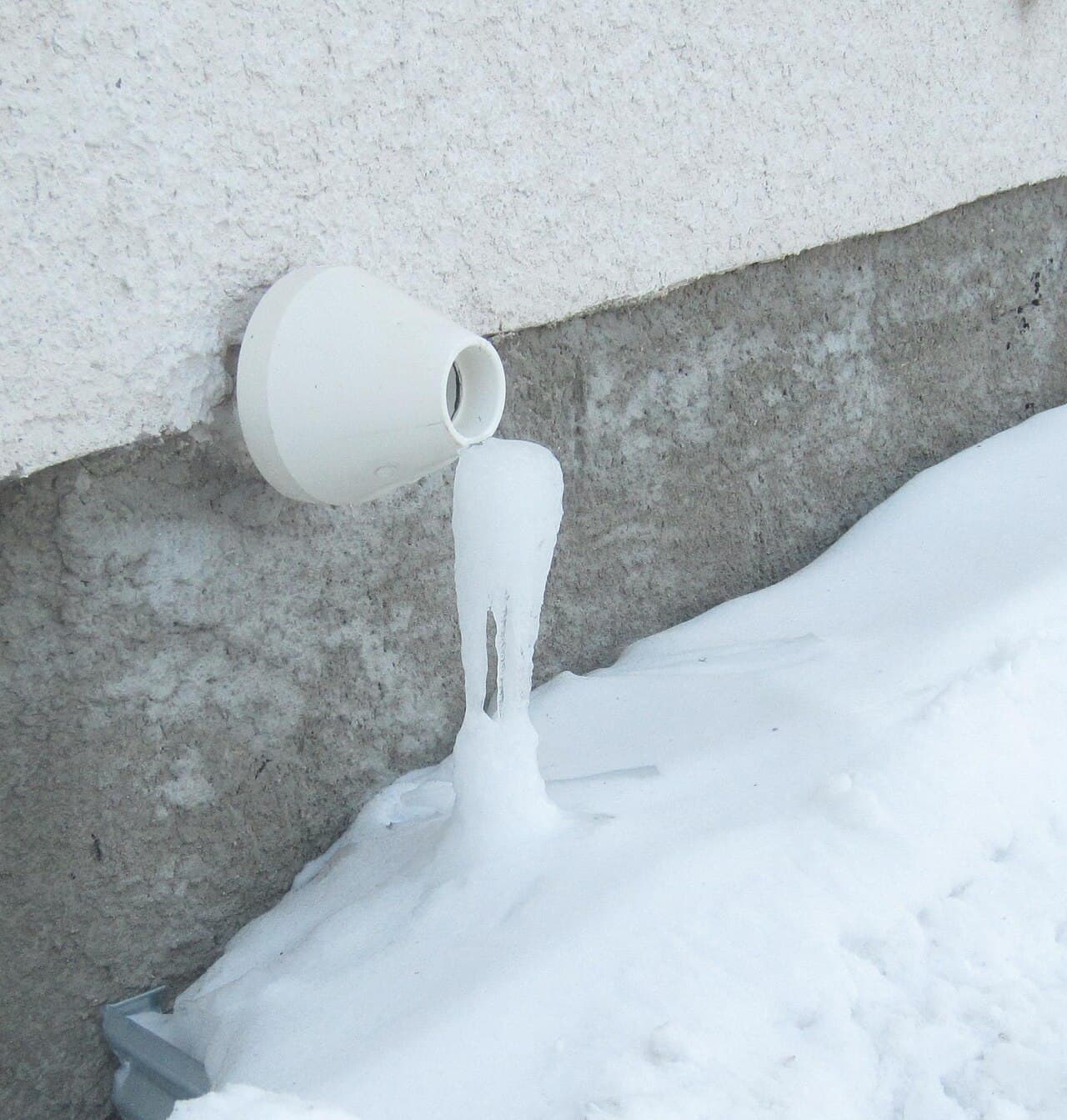
The intake or exhaust pipe. The same furnaces draw air and vent exhaust through pipes on the outside of the house. Lennox's warning about the intake pipe: "If this pipe becomes clogged or blocked, this impacts not only your furnace's efficiency, but it can also cause a dangerous buildup of carbon monoxide."[4] Columbia Gas of Virginia adds that "some direct-vent and high-efficiency appliances have side-wall vents and air intakes that can become obstructed during heavy snow fall."[5] After a storm, look at the pipes outside, like the one pictured, and keep snow and ice off them.
The air is warm, just not warm enough
If the air is hot at the register nearest the furnace and lukewarm in the far bedrooms, look at the ducts. Carrier: "Leaky ductwork allows warm air to escape into your attic or crawlspace before it reaches your living rooms."[1] In a typical house, about 20 to 30 percent of the air that moves through the duct system is lost to leaks, holes and poorly connected ducts.[6] But Bryant notes that "duct leaks generally do not explain a furnace producing genuinely cold air at the supply register",[2] so cold air everywhere still points back to the furnace.
A furnace that runs nearly nonstop on the coldest nights and still loses ground may be undersized, or the house may be losing heat faster than it should. That is a question for a load calculation and an energy assessment, not a part.
When to call a licensed pro
Once the thermostat, filter, vents, fuel and outside pipes are ruled out, what is left is inside the furnace: igniter, sensor, gas valve, limit switch, blower and control board. Burner trouble can also be a safety issue. ENERGY STAR: "a dirty burner or cracked heat exchanger causes improper burner operation."[7]
Call promptly when the burners light and quit, the furnace keeps cycling, a breaker trips, you see soot or the furnace will not restart after a snowstorm. For a gas smell or a carbon monoxide alarm, leave the house first. Columbia Gas tells customers not to use anything that could cause a spark, like a phone, light switch, appliance or flashlight, and to call 911 and its emergency number, 1-800-544-5606, from a safe location away from the building.[8] If another company supplies your gas, use its number.
In Virginia, no individual may engage in, or offer to engage in, work as a tradesman unless licensed, and the Code's definition of a tradesman covers heating, ventilation and air conditioning work done for the public for pay.[9][10] Check a business on DPOR's License Lookup[11] before it starts. For the visit and the bill, see what happens during a furnace repair visit and what it costs to fix a furnace that won't heat. If you have a heat pump, see why a heat pump blows cool air in winter.
Getting it fixed
Loclis lists DPOR-licensed HVAC businesses with their licence number and class. Find HVAC businesses in Blacksburg or another town, see furnace not heating repairs, or browse more HVAC repair answers.
If your furnace runs but the house will not warm up, describe what it is doing once and licensed local HVAC businesses quote the repair.
Common questions
- Why does my furnace blower run but the burners never light?
- Something in the startup sequence is failing: the pilot or igniter, the flame sensor, the gas supply, a safety switch or the control board. A blinking light on the control board is a fault code. Note the pattern for the technician rather than restarting the furnace over and over.
- My furnace runs but the air is only lukewarm. What does that mean?
- If the air is warm near the furnace but lukewarm in far rooms, leaky ducts are a likely cause; ENERGY STAR estimates that a typical house loses 20 to 30 percent of its duct air to leaks. If the air is cold even at the nearest register, the furnace is not making heat, which points back to the burners or controls.
- Can snow stop my furnace from heating?
- On a high-efficiency furnace it can. These furnaces draw air and vent exhaust through pipes on the outside of the house, and Columbia Gas of Virginia warns that side-wall vents and intakes can be blocked in heavy snow. A blocked pipe can shut the furnace down and can cause carbon monoxide to build up, so keep them clear and call if the furnace will not restart.
- Is it safe to keep running a furnace that is not heating?
- If you smell gas or a carbon monoxide alarm sounds, do not touch the thermostat, a light switch or anything else that could spark. Leave the house, then call 911 and your gas company from outside. Otherwise, Bryant says cold air is usually a safety mechanism, such as the limit switch tripping, rather than an immediate danger. Short cycling, strange noises or a pilot that will not stay lit are signs to call a professional rather than keep restarting it.
Sources
- [1] Why Is My Furnace Blowing Cold Air? 10 Common Causes & Fixes, Carrier. Checked October 26, 2026.
- [2] Why Is My Furnace Blowing Cold Air? Troubleshooting and Solutions, Bryant Heating & Cooling Systems. Checked October 26, 2026.
- [3] How to fix a furnace blowing cold air, Lennox. Checked October 26, 2026.
- [4] Four Ways to Prep Your Furnace for Winter, Lennox. Checked October 26, 2026.
- [5] Winter Weather Safety, Columbia Gas of Virginia. Checked October 26, 2026.
- [6] Duct Sealing, ENERGY STAR, U.S. Environmental Protection Agency. Checked October 26, 2026.
- [7] Maintenance Checklist, ENERGY STAR, U.S. Environmental Protection Agency. Checked October 26, 2026.
- [8] Report Gas Leaks, Columbia Gas of Virginia. Checked October 26, 2026.
- [9] Va. Code § 54.1-1129, Necessity for licensure, Code of Virginia, Virginia General Assembly. Checked October 26, 2026.
- [10] Va. Code § 54.1-1128, Definitions, Code of Virginia, Virginia General Assembly. Checked October 26, 2026.
- [11] License Lookup, Virginia Department of Professional and Occupational Regulation. Checked October 26, 2026.
Want a pro to handle it?
Describe the job once. Licensed local businesses send quotes, and you pay only when you book one.
Get a quote for HVAC Repair