Why is my leather couch cracking?
Leather cracks when it dries out and stiffens. The usual causes are heat from a radiator, vent or fireplace, direct sun, dry heated air, and years without any care. Move the couch away from the heat, clean it, and condition it. Cracks that are open, deep or flaking are not a conditioning job and need a repairer.
Free to ask. Local shops send quotes, and you pay only when you book one.
By Kasra Taheri, Founder, LoclisPublished
Researched and drafted with AI, then checked claim by claim against the sources listed below before it was published. Prices and rules change; the dates beside each source say when it was last checked.
Step by step
Read when to stop and call a pro, further down this page, before you start.
Step 1: Feel and photograph the cracks
Run a fingertip along the worst areas. Fine lines in the surface that you cannot catch a nail in are dryness; open splits, exposed backing or flaking are damage. Take clear photos either way.
Step 4: Read the care tag
Find the maker's care tag or guide and any warranty terms before you put anything on the leather. Bassett warns that cleaning agents may void its warranty.[3]
Step 6: Condition a hidden spot first
Test a small amount of leather conditioner on a hidden area, such as under a cushion, and wait to see that it does not darken or mark the leather.
Step 7: Condition the couch
Rub a thin layer of conditioner into the dry areas, let it soak in for a few minutes, then buff with a clean dry cloth.[1]
Cracking is dryness, heat and age
A leather couch cracks because the leather has dried out and lost its flexibility. Klaussner puts it simply: leather is like skin, and it needs moisture to stay lush and smooth, and when it dries out, it becomes more prone to cracking and scratching.[1]
So the useful question is why yours dried out. On most couches it is one of three things, and often all three together.
Heat, sun and dry air
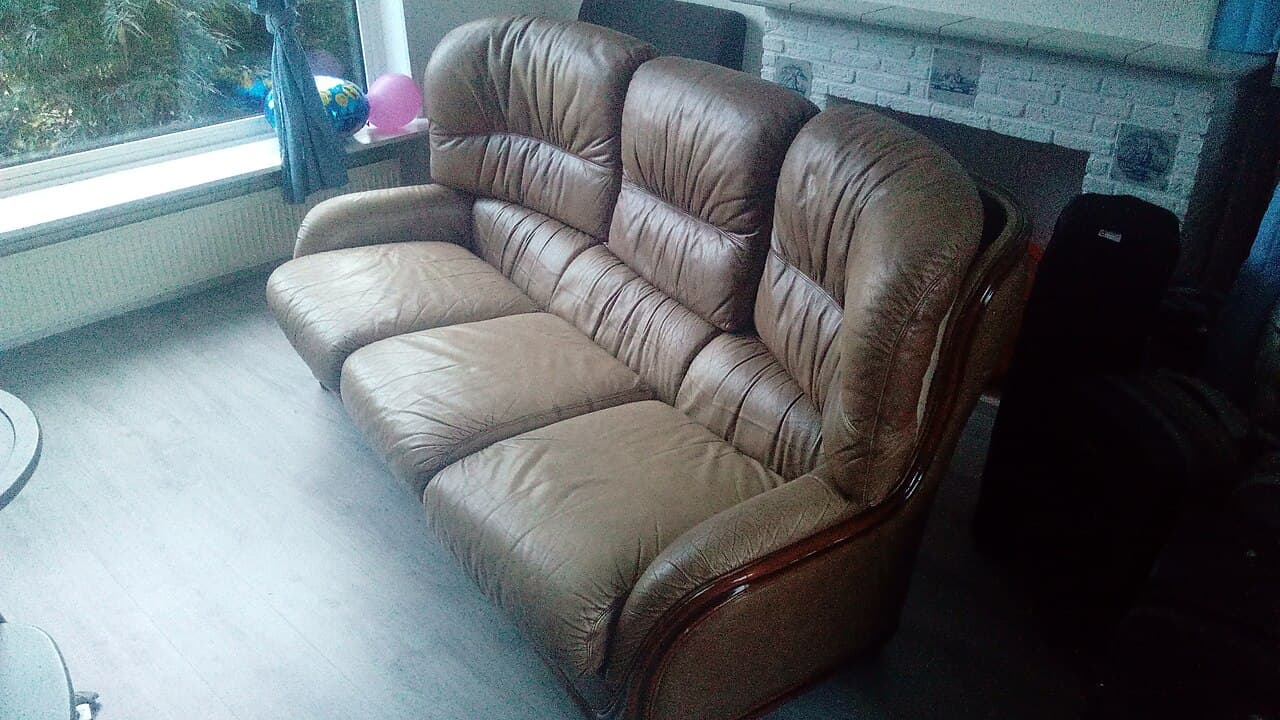
Heat sources. La-Z-Boy advises keeping leather furniture at least 12 inches away from radiators and other heat sources, because avoiding intense heat helps prevent the leather from drying and possibly cracking.[2] Bassett gives the same warning about fireplaces and air vents that can dry out leather.[3] A couch pushed against a baseboard heater or sitting over a floor vent is the classic cracked couch.
Sunlight. Bassett says to avoid placing furniture in direct sunlight, which can damage leather.[3] The cracking tends to show on the arm or cushion that faces the window, with the opposite side still supple.
Dry, heated air. Klaussner says leather gets dry and cracks more easily in dry climates or heated homes.[1] That can describe a living room in a Virginia winter with the heat on.
The National Park Service, writing about museum leather rather than sofas, describes the same mechanism: heating dries out, embrittles and deforms skin and leather objects, and direct sunlight and proximity to heating registers and radiators can easily damage them.[4] Its guidance lists the long-term effects of oxidative degradation as hardening, embrittlement, and cracking and crazing of the surface, and the cause as high temperatures and humidities and exposure to light.[4]
Age and skipped care
The third cause is time. A couch that has been sat on for ten years and never cleaned or conditioned will dry along the places that flex most: the seat front edge, the arm tops and the folds where the back meets the seat. Klaussner recommends a good leather conditioner every few months.[1] If yours has never had one, cracking in those flex lines is the expected result.
What to do first
Start with the cause, not the crack. Move the couch away from the heat and the window, then clean it and condition it. How to condition a leather couch has the full method. Before you put anything on the leather, find the care tag or the maker's guide and check the warranty terms. Bassett warns that cleaning agents may cause damage and void the warranty,[3] and its Guardian plan holders must notify Guardian within 30 days of a stain or damage occurrence.[3]
Be careful with home remedies. Bassett says never to use polishes, oils, ammonia, cleaning fluids, solvents or detergents to clean leather.[3] The National Park Service says the haphazard use of dressings has caused considerable deterioration within museum collections, and that conservators suspect saddle soap is behind surface cracking on many older leather objects.[4] A museum object is not a family sofa, but the lesson carries: more product is not better.
What conditioning can and cannot do
Conditioner helps leather that is dry and stiff but intact. It does not close an open split, rebuild missing surface or stop flaking. For those, Klaussner says a deep scratch or tear, with exposed leather underneath or rough edges, usually needs a leather repair kit,[1] and Bassett says that for deeper damage that worries you it is probably best to call a professional.[3]
Stop and call a pro if
- The cracks are open splits or you can see backing or foam through them.
- The surface is flaking or peeling in patches rather than showing fine lines.
- The couch is under warranty or a protection plan. Contact the maker or plan before treating it, because the plan's rules may depend on it.
- The cracking is spread across the whole couch, which usually means a re-cover or replacement is the honest answer.
- The leather is valuable or antique, where a wrong product is hard to undo.
Getting help in Virginia
For a scratch rather than a crack, see how to fix a scratch on a leather couch. If the damage runs through a seam or the whole covering, is it worth reupholstering a couch helps you decide. Browse local furniture repair services or more furniture repair answers.
When you are ready, describe the cracking on Loclis with a photo, and local repairers will quote it.
Common questions
- Can a cracked leather couch be fixed?
- Fine surface cracking from dryness can often be softened and slowed with a conditioner. Open splits and flaking cannot be brought back by conditioning. Klaussner says a deep scratch or tear, with exposed leather underneath or rough edges, usually needs a leather repair kit, and Bassett says it is probably best to call a professional for deeper damage that worries you.
- Does a heated home make leather crack?
- It can. Klaussner says leather gets dry and cracks more easily in dry climates or heated homes. La-Z-Boy advises keeping leather furniture at least 12 inches away from radiators and other heat sources, and Bassett says to keep it away from fireplaces and air vents that can dry it out.
- Does sunlight crack leather?
- Direct sun is a common contributor. Bassett says to avoid placing furniture in direct sunlight, which can damage leather, and the National Park Service lists direct sunlight among the things that can easily damage leather objects.
- Should I use saddle soap or household oil on cracked leather?
- Not on upholstery. Bassett says never to use polishes, oils, ammonia, cleaning fluids, solvents or detergents to clean leather, because cleaning agents may cause damage and void the warranty. For its museum collections, the National Park Service says conservators now suspect that saddle soap is behind surface cracking on many older leather objects.
- Will the warranty cover cracking?
- That depends on the maker's terms, so read them before you treat the leather. Bassett, for example, says that cleaning agents may void its warranty, and that holders of its Guardian plan must notify Guardian within 30 days of a stain or damage occurrence.
Sources
- [1] How to Fix Scratches on a Leather Couch (Easy Step-by-Step Guide), Klaussner Home Furnishings. Checked October 28, 2026.
- [2] Fabric and Leather Care, La-Z-Boy. Checked October 28, 2026.
- [3] How to Care for Leather, Bassett Furniture. Checked October 28, 2026.
- [4] Museum Handbook, Part I, Appendix S: Curatorial Care of Objects Made From Leather and Skin Products, National Park Service. Checked October 28, 2026.
Want a pro to handle it?
Describe the job once. Licensed local businesses send quotes, and you pay only when you book one.
Get a quote for Furniture