Why is my new HVAC system not keeping up?
In extreme weather, long run times can be normal: Bryant says an air conditioner can typically cool about 20°F below the outdoor temperature. If it struggles in ordinary weather, the usual causes are wrong sizing, an incorrect refrigerant charge, low airflow, leaky or undersized ducts, or thermostat and backup-heat settings. Ask the installer to come back and measure, under any workmanship warranty in your contract.
Free to ask. Local shops send quotes, and you pay only when you book one.
By Kasra Taheri, Founder, LoclisUpdated
Researched and drafted with AI, then checked claim by claim against the sources listed below before it was published. Prices and rules change; the dates beside each source say when it was last checked.
This is a job for a licensed pro in Virginia
This page explains what the work involves, the permits, what a licensed pro does and what drives the cost. It does not give step-by-step instructions, because this work needs a licence, a permit or both, and doing it wrong can injure someone. Before you hire, check the licence on Virginia's DPOR record.
A new system that seems to fall behind is not always a bad installation. An air conditioner has a practical limit on how far below the outdoor temperature it can cool, and in extreme weather long run times can be normal. When it struggles in ordinary weather, the cause is usually one of a short list: the wrong size, the wrong refrigerant charge, too little airflow, ducts that leak or cannot carry the air, or settings that fight the equipment. Most of those are the installer's to measure and correct.
First, is it really falling behind?
Air conditioners have a practical limit. Bryant says an air conditioner can typically cool about 20°F below the outdoor temperature, so on a 100°F day an indoor temperature of 78 to 80°F is reasonable.[1]
Systems are also sized for a design day, not for the extremes. Spotsylvania County's HVAC design worksheet, for example, uses an outdoor design temperature of 93°F for summer and 14°F for winter.[2] Ask your installer which design temperatures your system was sized for.
Heat pumps add a wrinkle. Carrier notes that it can be completely normal for a heat pump to run all the time in extreme temperatures,[3] and that a brief stretch of cooler air from the vents during a defrost cycle can be normal, and a typical defrost cycle lasts about 5 to 10 minutes.[3] Heat pump air also feels less hot than furnace air even when the house is holding its temperature.
The real warning sign is a system that cannot hold the temperature in mild weather, or one that is noticeably worse than the old one was on similar days.
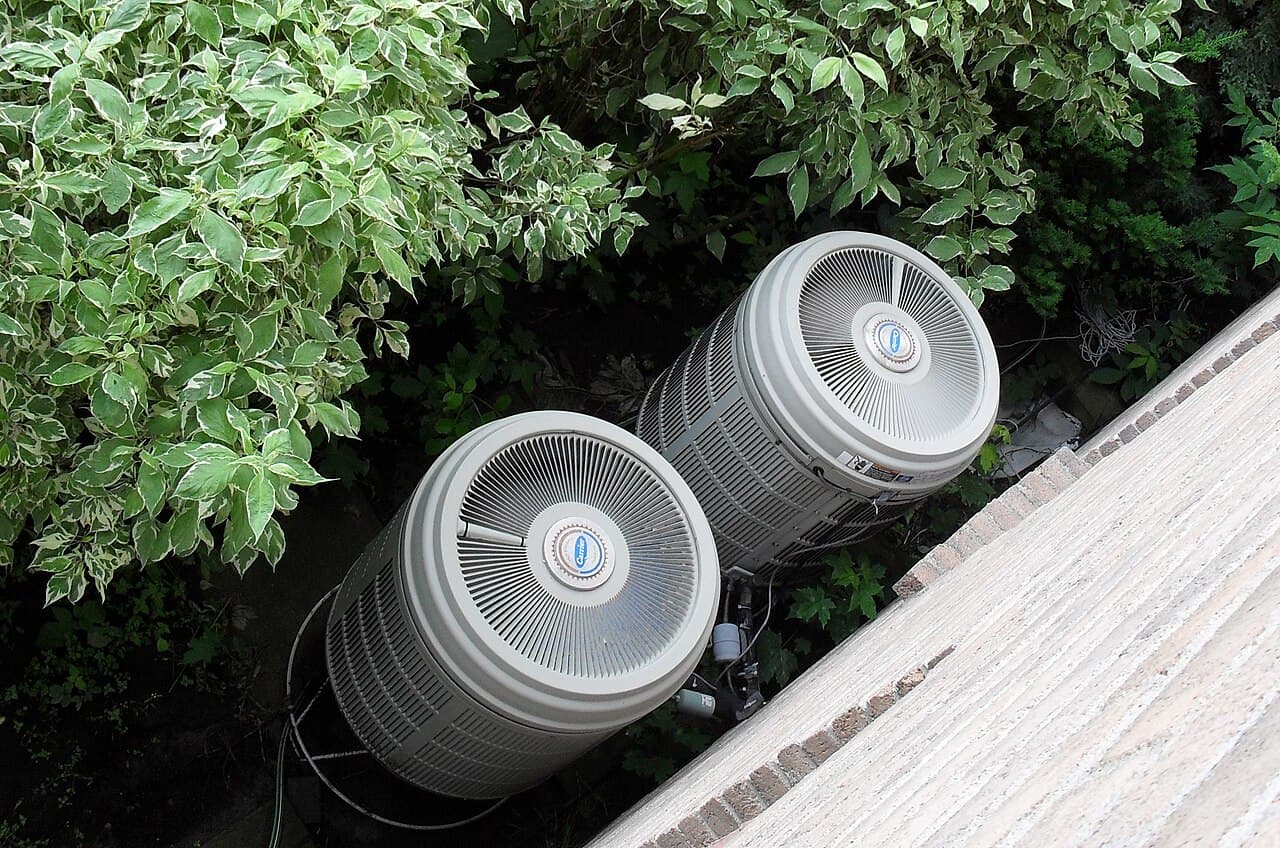
The usual causes in a new installation
Wrong size. An undersized unit struggles to keep up as outdoor temperatures rise, running constantly while the house stays warm.[4] Oversizing causes a different complaint. ENERGY STAR puts it directly: "Oversized equipment may cycle too frequently, resulting in less comfort".[5] Virginia Cooperative Extension explains why in humid weather: an oversized air conditioner will "short cycle," cooling the house too quickly to remove much moisture and leaving it cool and clammy.[6] People then turn the thermostat down, and each degree you lower the thermostat raises cooling bills by 3% to 5%.[6] Either problem usually traces back to a size picked from the old unit or the square footage instead of a load calculation.
Refrigerant charge. ENERGY STAR's quality-installation guidance asks the contractor to test and adjust the refrigerant charge,[5] because a system with too much or too little runs less efficiently. A new system that is short of refrigerant may also have a leak at a joint made during installation. Carrier warns that a refrigerant leak causes long run times and can lead to compressor failure, and that a suspected leak is a job for a professional.[4]
Airflow. Poor airflow can reduce efficiency and comfort, leave the air overly damp and shorten equipment life.[5] On a new system it often comes from blower settings that were never matched to the ducts, a filter or return that is too small, or closed and blocked registers.
Ducts. The new equipment is only as good as the ducts it feeds. In a typical house about 20 to 30 percent of the air moving through the ducts is lost to leaks, holes and poor connections.[7] ENERGY STAR's signs of poorly performing ducts include rooms that are hard to heat and cool, stuffy rooms that never feel comfortable, ducts in an attic, crawlspace or garage, and tangled or kinked flexible ducts.[7] A bigger system on the same leaky ducts often does not fix those rooms.
Uneven floors. If downstairs is fine and upstairs is hot, the system may be keeping up on average while the ducts deliver too little air upstairs. American Standard suggests zoning, with a separate thermostat for each zone, or a ductless mini-split for the upstairs.[9]
Heat pump thermostat settings
Thermostat settings can make a heat pump look as if it is falling behind. ENERGY STAR suggests you set the heat pump to "heat" or "cool" rather than auto, so it does not switch modes on unseasonably warm or cold days.[8] It also advises you to pick a comfortable temperature and leave it there, because heat pumps do not save energy by being turned down when you are away or asleep,[8] and to use the "auto fan" setting, or the lowest fan speed that spreads the heated or cooled air far enough.[8] If you are unsure how your thermostat is set up, ask the installer to walk you through it.
Heat pumps in a Virginia winter
In the mountains and the Shenandoah Valley, a heat pump will see colder nights than in Tidewater. ENERGY STAR says cold-climate models are tested down to 5°F and keep working below that, but pairing one with a backup heat source heats the house most efficiently at even lower temperatures.[8] If your system has backup heat strips or a furnace, ask the installer to show you how and when it switches over. If backup heat never seems to come on, or seems to run all the time, have the installer check both the settings and the system.
When to call a licensed pro
Call the installer, in writing, as soon as the system falls behind in ordinary weather. Check whether your contract includes a workmanship warranty. Diagnosis involves measuring refrigerant pressures and airflow inside the equipment, and EPA requires Section 608 technician certification for any activity that could reasonably be expected to violate the integrity of the refrigerant circuit, such as attaching hoses and gauges or adding or removing refrigerant.[11] Ask for the load calculation, the measured charge and airflow against the manufacturer's specifications, and a duct leakage test.
If the contractor will not come back, the Board for Contractors lists "Failure to honor the terms and conditions of a warranty"[10] among its prohibited acts, along with negligence or incompetence in the practice of contracting, and failure to abate a violation of the building code.[10] See how to file a complaint against a contractor in Virginia. For an older system, why an HVAC system runs all the time covers the other causes.
To see what a proper installation includes, read what installing a new HVAC system involves. Browse heating and cooling answers or find HVAC businesses in Blacksburg.
If you want a second opinion from another licensed business, describe the problem once and local HVAC businesses quote it.
Common questions
- Is it normal for a new air conditioner to run all day in a heat wave?
- It can be. Bryant says an air conditioner can typically cool about 20°F below the outdoor temperature, so on a 100°F day an indoor temperature of 78 to 80°F is reasonable. A system that falls behind in ordinary weather is the one to have the installer check.
- Can a new system be too big?
- Yes. Oversized equipment may cycle on and off too often, which ENERGY STAR says results in less comfort and a shortened lifespan, and Virginia Cooperative Extension warns it leaves the house cool and clammy because it does not run long enough to remove moisture.
- My new heat pump blows lukewarm air in winter. Is it broken?
- Not necessarily. Heat pump air feels cooler than furnace air, and a short burst of cool air during a defrost cycle can be normal. If the house will not reach the set temperature in mild weather, or the outdoor unit stays iced over, call the installer.
- What should I ask the installer to check?
- Ask for the load calculation the size was based on, the measured refrigerant charge and airflow against the manufacturer's specifications, the thermostat and backup-heat settings, and a duct leakage test. Ask for the readings in writing.
- The installer will not fix it. What can I do?
- Put the problem, and any warranty terms in your contract, in writing to the contractor first. If that fails, you can file a complaint with DPOR, since failing to honor a warranty and negligent work are both prohibited acts for a Virginia contractor.
Sources
- [1] What Temperature to Set Air Conditioner in Summer, Bryant Heating & Cooling Systems. Checked October 26, 2026.
- [2] Residential Permit Application, Mechanical HVAC Only, Spotsylvania County Community Development. Checked October 26, 2026.
- [3] Heat Pump Troubleshooting, Carrier. Checked October 26, 2026.
- [4] Why Is My AC Not Blowing Cold Air? 7 Common Causes, Carrier. Checked October 26, 2026.
- [5] HVAC Quality Installation, ENERGY STAR, U.S. Environmental Protection Agency. Checked October 26, 2026.
- [6] ENERGY SERIES: What about the Air Conditioning System? (2901-9001, BSE-289NP), Virginia Cooperative Extension, Virginia Tech. Checked October 26, 2026.
- [7] Duct Sealing, ENERGY STAR, U.S. Environmental Protection Agency. Checked October 26, 2026.
- [8] Air-Source Heat Pumps, ENERGY STAR, U.S. Environmental Protection Agency. Checked October 26, 2026.
- [9] Top Solutions for House Hot Upstairs, Cold Downstairs, American Standard Heating & Air Conditioning. Checked October 26, 2026.
- [10] 18VAC50-22-260, Filing of charges; prohibited acts, Virginia Administrative Code, Board for Contractors. Checked October 26, 2026.
- [11] Homeowners and Consumers: Frequently Asked Questions, U.S. Environmental Protection Agency. Checked October 26, 2026.
Want a pro to handle it?
Describe the job once. Licensed local businesses send quotes, and you pay only when you book one.
Get a quote for HVAC Repair