Why is my new sprinkler system not reaching parts of the lawn?
Most coverage gaps are spacing, aim or nozzle problems. Run each zone and flag the dry spots. Check that every head pops up straight, reaches the next head, is aimed at the lawn and has a clean nozzle, then measure with a catch-can test. If gaps remain, tell the installer in writing. Pooling water or a weak zone means a pro.
Free to ask. Local shops send quotes, and you pay only when you book one.
By Kasra Taheri, Founder, LoclisPublished
Researched and drafted with AI, then checked claim by claim against the sources listed below before it was published. Prices and rules change; the dates beside each source say when it was last checked.
Step by step
Read when to stop and call a pro, further down this page, before you start.
Step 1: Run one zone at a time
Use the controller's manual mode to start by activating one zone or program at a time on your controller[2], and walk the zone while it runs.
Step 2: Flag every dry spot
Push a flag into the lawn at each dry patch and note which head should cover it.
Step 3: Check the heads
Look for heads that do not pop up fully or are tilted as they can unexpectedly spray to the wrong areas.[1] Straighten or raise them.
Step 4: Redirect spray off hardscape
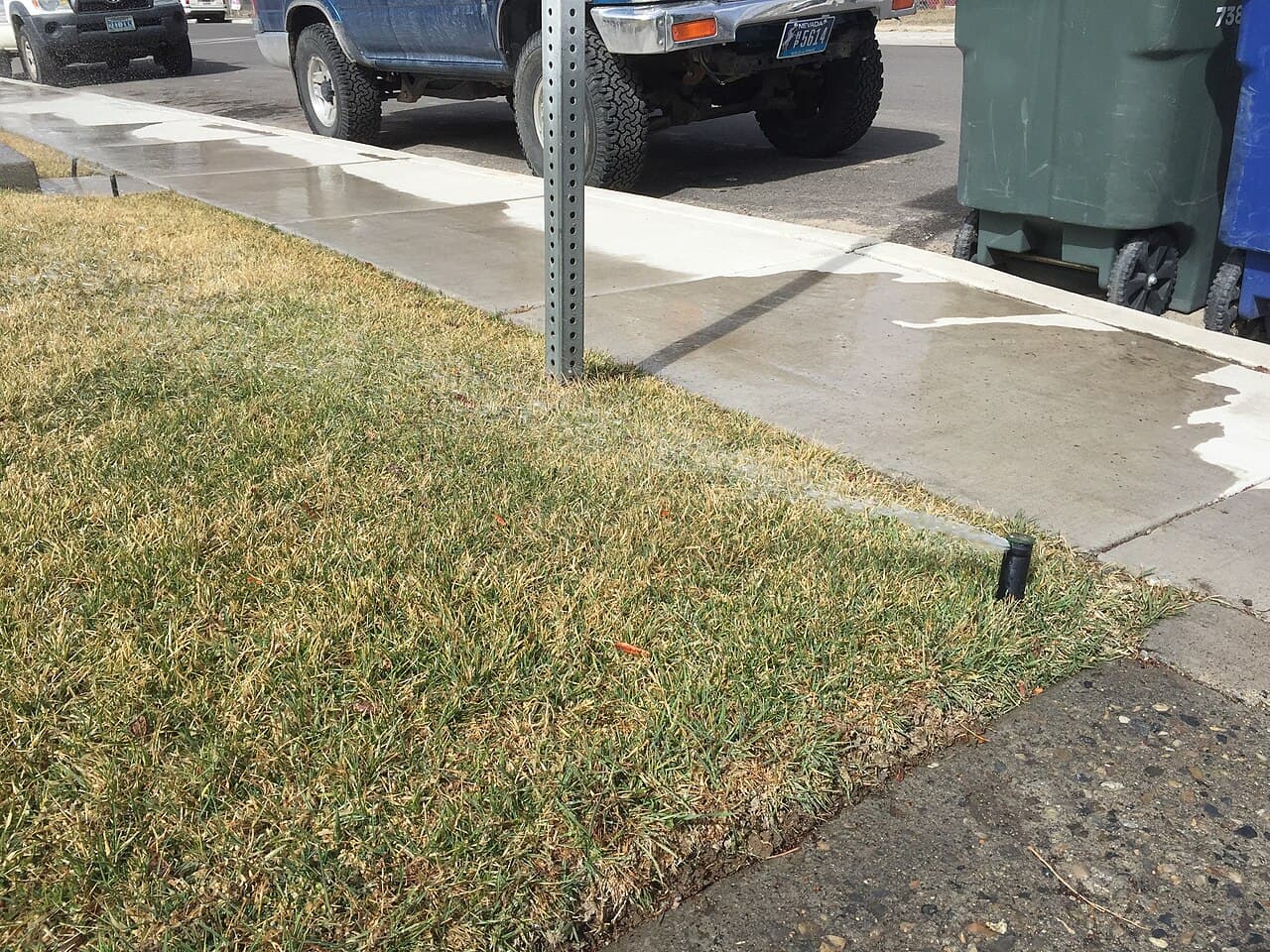
Turn any head spraying a driveway, sidewalk or wall back toward the lawn.[1]
Step 5: Adjust arc and distance
Use a small flat screwdriver on the top of the spray head to set the pattern and distance, following the nozzle's own instructions.[2]
Step 6: Clean or replace the nozzle
Turn off the zone, then remove the old nozzle and its filter screen and fit a new screen and a nozzle with the right pattern.[2]
Step 7: Run a catch-can test
Set out at least five wide-mouthed containers at 20, 40, 60, 80 and 100 percent of the sprinkler's throw, run the zone and compare the water collected.[3]
Step 8: Write to the installer
If gaps remain on a new system, send the installer your flag map and measurements in writing.[5]
Start by watching each zone run
Sprinklers that miss part of a lawn are usually a spacing, aim or nozzle problem, not a sign the whole system is broken. The fastest way to find which is to watch it work. Rain Bird, the manufacturer, suggests you start by activating one zone or program at a time on your controller[2] and walk around to see how each head waters. Most controllers have a manual run function for this, and app-based ones do it from your phone.
Put a flag in the ground at every dry or brown patch, then match each one to the head that should be covering it. That tells you whether you have one bad head or a layout that never reached the spot.
The usual causes
Heads too far apart. EPA's WaterSense program gives the test: Each sprinkler should be able to reach the sprinkler head next to it, known as head-to-head coverage.[1] If a spray stops short of the next head, you get a dry band between them. Aim matters too: Make sure to properly direct sprinkler for uniform coverage to avoid dry spots in the landscape.[1]
Heads that do not pop up, or are tilted. WaterSense tells owners to Look for heads that do not pop up fully or are tilted as they can unexpectedly spray to the wrong areas.[1] A head that settled, got buried under new sod or was knocked by a mower can throw water at the sky or the sidewalk instead of the grass.
Spray landing on hardscape. Water on pavement runs to the storm drain, not the lawn. Extension's advice is plain: Water the lawn — not driveways, sidewalks, or roads — by adjusting sprinkler heads.[3]
Misting from high pressure. A fine fog drifts in the wind and never reaches the far edge. WaterSense says to Avoid overspraying or misting due to high pressure.[1] and suggests it: Consider installing spray sprinkler bodies with integral pressure regulation which maintain consistent water pressure so that nozzles can operate efficiently.[1]
The wrong or clogged nozzle. A nozzle with the wrong arc or throw distance leaves gaps, and a plugged one under-sprays. Swapping one is a small job: Remove the old nozzle and filter screen.[2] Then fit a new screen and a nozzle with the right pattern and throw distance.
Too many heads on one zone. If a zone was designed with more heads than the water supply can feed, the far ones weaken. That is a design fault, so it is the installer's to correct, not something to patch with new nozzles.
Measure it with a catch-can test
If the cause is not obvious, measure. Virginia Cooperative Extension describes the audit as placing at least five broad, wide-mouthed containers at distances of approximately 20, 40, 60, 80, and 100 percent of the maximum throw of the sprinkler(s)[3]. Run one zone for a set time and compare how much water each container collects. Extension's reason for doing it: it will help to diagnose and prevent either dry or saturated areas that can lead to an unhealthy turf[3]. It also gives you numbers to show the installer.
Run time can look like a coverage problem on a new lawn. Extension notes that smaller amounts of water applied every three to four days may be required to allow water to enter the soil without causing runoff[3]. A spot that stays dry in one zone but soggy next to it often means two zones overlap badly.
What you can safely adjust
Run the zone, flag the dry spots, then work head by head. Straighten tilted heads and raise any that sit low, adjust arc and distance with a small flat screwdriver on the top of a spray head, and clean or replace a clogged nozzle and its filter screen. Re-run the zone after each change so you can see whether the flag is still dry.
Leave buried pipe, valves and the backflow assembly alone. Those are the installer's work.
If the system is new, tell the installer in writing
A new system with coverage gaps is a workmanship question, and the installer should hear about it first. DPOR advises: Be sure to address all problems or complaints directly to your contractor in writing, so that you both have a record.[5] Attach your flag map and catch-can numbers. If the installer does not respond, DPOR says: If the contractor refuses to make corrections, you should file a written complaint with the Board for Contractors[5].
Stop and call a pro if
- Water pools on the lawn between cycles. WaterSense says: Between irrigation cycles, look for areas of the landscape with water pooling on the surface; that could be a sign of an underground leak.[1]
- A whole zone is weak or will not run. That points to a valve, buried pipe or the water supply, not a nozzle.
- Joints at the heads leak. Leaking joints can also be a sign of too much water pressure or particles in the water.[1]
- The fix means cutting into the line or opening the backflow assembly. Both belong to a licensed contractor.
- The installer will not return. Use the written complaint route above.
Getting help in Virginia
EPA's WaterSense program lists what a certified irrigation professional does, including Audit: Test your irrigation system to ensure it performs efficiently.[4] It also says to start by confirming that the contractor is licensed and bonded, then ask for training and professional certifications[4]. For the layout and permit side, read what installing an in-ground system involves, what a system costs in Virginia and whether you need a permit or backflow preventer. More in irrigation answers and irrigation businesses.
When you are ready, describe the coverage problem once and licensed local contractors can quote it.
Common questions
- What is head-to-head coverage?
- It means each sprinkler throws far enough to reach the head next to it. EPA's WaterSense program says each sprinkler should be able to reach the sprinkler head next to it. When it does, the overlap fills in the thin edges of each spray and the lawn gets even water.
- How do I find out where my new system is missing the lawn?
- Run one zone at a time and flag each dry spot, then set out wide-mouthed containers at several distances from a head and compare how much water each collects. Virginia Cooperative Extension describes this audit as a way to find dry or saturated areas.
- Why do my new sprinklers produce a fine mist?
- Usually the water pressure is too high for the nozzle. WaterSense says to avoid overspraying or misting from high pressure and suggests spray bodies with built-in pressure regulation. Mist drifts in wind and wastes water before it reaches the grass.
- Can I fix the gaps myself?
- You can aim heads, set their arc and distance and clean or replace a nozzle. Do not dig into pipe or valves, and leave the backflow assembly alone. If the layout leaves gaps, it is the installer's problem to fix.
- Who do I complain to if the installer will not fix it?
- Write to the contractor first so you both have a record. DPOR says that if the contractor refuses to make corrections, you should file a written complaint with the Board for Contractors.
Sources
- [1] Sprinkler Spruce-Up, U.S. Environmental Protection Agency, WaterSense. Checked October 27, 2026.
- [2] 3 Simple Repairs and Upgrades for Your Pop-Up Sprinklers This Spring, Rain Bird Corporation (manufacturer). Checked October 27, 2026.
- [3] Summer Lawn Management: Watering the Lawn (430-010), Virginia Cooperative Extension, Virginia Tech. Checked October 27, 2026.
- [4] Irrigation with a Pro, U.S. Environmental Protection Agency, WaterSense. Checked October 27, 2026.
- [5] What You Should Know Before You Hire a Contractor, Virginia Board for Contractors, DPOR. Checked October 27, 2026.
Want a pro to handle it?
Describe the job once. Licensed local businesses send quotes, and you pay only when you book one.
Get a quote from a local pro