Can a homeowner replace a thermostat in Virginia without a license?
Yes, in your own home. Virginia's contractor licensing law does not apply to work on a primary residence you own and live in, and its tradesman licence covers HVAC work done for the public for pay. A standard low-voltage thermostat also needs no permit. The building code still applies, and a line-voltage thermostat is electrical work best left to a licensed pro.
Free to ask. Local shops send quotes, and you pay only when you book one.
By Kasra Taheri, Founder, LoclisUpdated
Researched and drafted with AI, then checked claim by claim against the sources listed below before it was published. Prices and rules change; the dates beside each source say when it was last checked.
Step by step
Read when to stop and call a pro, further down this page, before you start.
Step 1: Confirm it is your own home
The owner exemption covers a primary residence you own and use yourself; if you rent, ask the owner before changing anything.[1]
Step 2: Confirm it is low voltage
Take the cover off and check for a 120 V or 240 V label or thick wires with wire nuts, which mean line voltage.[8]
Step 3: Check the permit exemption fits
A thermostat under 50 volts needs no permit unless its wiring runs in a plenum, through fire-rated construction or is part of a fire alarm or similar system.[6]
Step 4: Check compatibility
Run the new thermostat maker's compatibility check with your terminal letters before you buy.[9]
Step 5: Follow the maker's instructions
Turn off the system's power, photograph and label the wires, and move them terminal by terminal as the install guide shows.[8]
Step 6: Dispose of mercury properly
If the old thermostat contains mercury in a sealed tube, keep it out of the trash and ask your local waste office where to take it.[8]
Step 7: Hire licensed help for the rest
For line voltage, a new C wire or work inside the furnace, hire an HVAC business and check its licence on DPOR first.[7]
Yes. A homeowner can replace the thermostat in their own house in Virginia without a licence, and a standard low-voltage thermostat needs no permit either. The licences in Virginia law are for people who do the work for others for pay. Two limits matter: you still have to meet the building code, and a line-voltage thermostat, the kind on many electric baseboard heaters, is electrical work that belongs with a licensed pro.
The owner exemption
Virginia's contractor licensing chapter, Title 54.1, Chapter 11 of the Code, lists who it does not apply to. One exemption is "Any person who performs or supervises the construction, removal, repair, or improvement of no more than one primary residence owned by him and for his own use during any 24-month period."[1] Swapping the thermostat in the home you own and live in falls inside that.
Landlords have a parallel exemption for "the repair or improvement of residential dwelling units owned by him that are subject to the Virginia Residential Landlord and Tenant Act."[1] If you rent, the thermostat belongs to the owner, so ask before you change it.
The exemption is not a pass on safety rules. The same section says anyone exempt under those owner provisions must still comply with the Uniform Statewide Building Code.[1]
Why the tradesman licence does not reach you
Virginia's tradesman licence is for "any individual who engages in, or offers to engage in, work for the general public for compensation in the trades of electrical, plumbing and heating, ventilation and air conditioning."[2] Section 54.1-1129 adds that "no individual shall engage in, or offer to engage in, work as a tradesman"[3] without that licence. Work on your own home, unpaid, is not work for the general public for compensation.
The licensing regulations define HVAC work as including "the installation, alteration, repair, or maintenance of heating systems, ventilating systems, cooling systems"[5] and related equipment. That is why the person you hire matters, as covered below.
Permits for a thermostat
Virginia's building code lists work that needs no permit. The first item: application for a permit and any related inspections are not required for the installation of wiring and equipment that operates at less than 50 volts.[6] Thermostats for central furnaces, heat pumps and boilers are usually low-voltage: Honeywell's T5, for example, runs on 24 VAC power and is compatible with most heating, cooling, and heat pump systems.[8] A like-for-like swap of that kind of thermostat is covered.
The exemption has exceptions. It does not apply when such installations "are located in a plenum, penetrate fire rated or smoke protected construction,"[6] or are part of a fire alarm, smoke control or similar safety system. If a new wire would have to pass through a fire-rated wall or ceiling, or you are unsure, call your local building department and ask.
You can also choose to have it inspected: when an owner asks for a permit for exempt work, the building official issues one and the related inspections are required.[6]
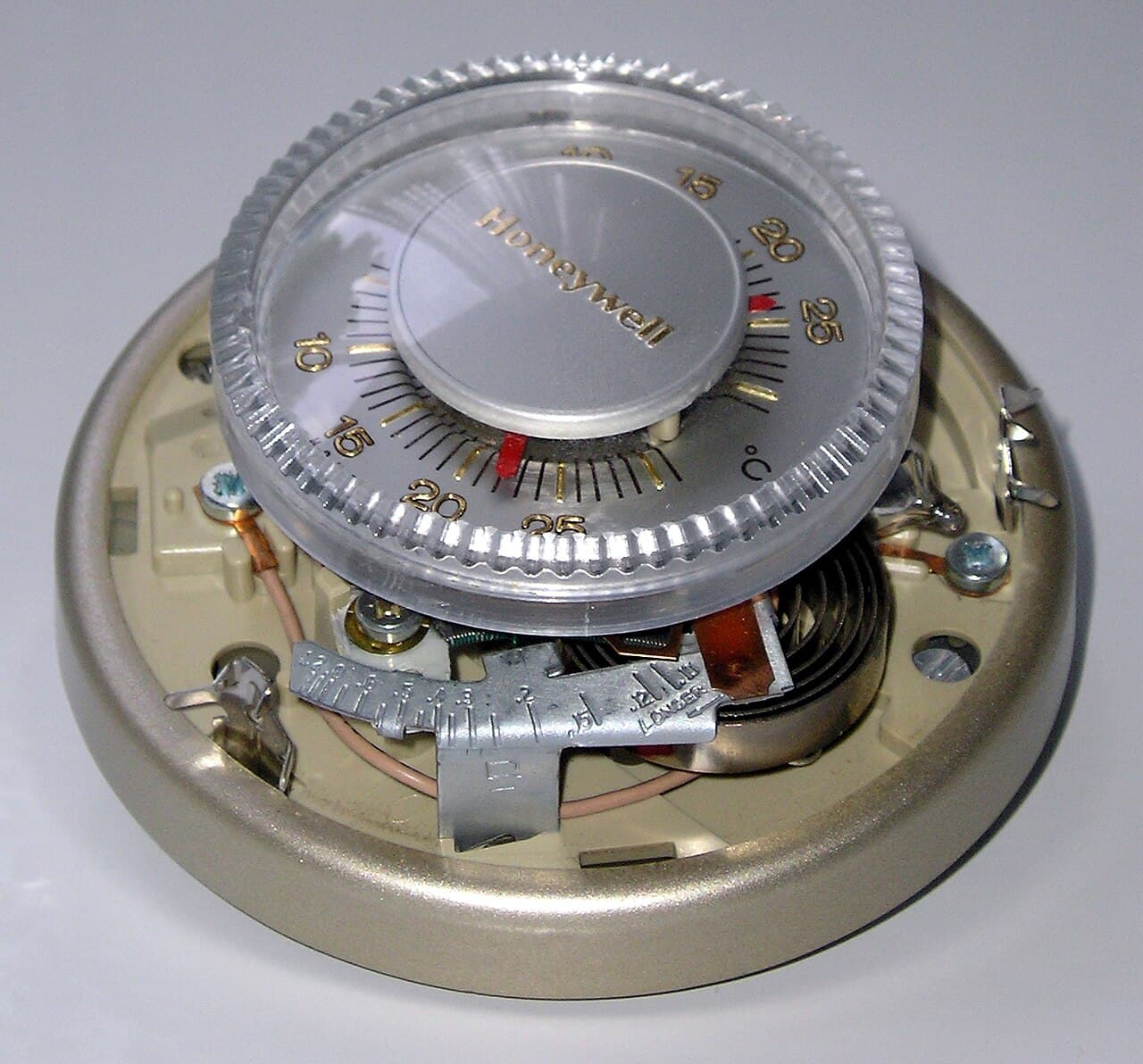
Where it stops being a homeowner job
Line-voltage thermostats. A thermostat marked 120 or 240 volts is wired into a household circuit, not a low-voltage control circuit, so the under-50-volt permit exemption does not cover it. Whether swapping one needs a permit is not settled by the code's text alone: it lists electric wiring[6] among work that needs a permit, but it also exempts replacing "general use snap switches, dimmer and control switches"[6] in Groups R-3, R-4 and R-5.[6] Ask your local building official whether your swap needs a permit before you start. Either way, Google's Nest help says: "High voltage thermostats should only be installed or uninstalled by a professional due to the high voltage that they carry."[9]
Dual fuel and other complex systems. If a heat pump and a furnace share the thermostat, Google says "you will need to have a trained professional set up your thermostat," because "choosing incorrect options for a dual fuel system can result in damage to your system."[9] Google also recommends professional installation for dual transformer systems with more than one R wire and for whole-home humidifiers and dehumidifiers.[9]
Work inside the equipment. Adding a C wire at the furnace control board, fitting a power adapter in the air handler or running a new cable is a step past swapping the wall unit. Hand that to an HVAC technician.
Mercury. Honeywell's install guide says: "If this product is replacing a control that contains mercury in a sealed tube, do not place the old control in the trash."[8] This is a disposal question, not a licence one; your county or city waste office can tell you where to take it.
Hiring someone instead
If you pay someone, they need to be licensed. The tradesman licence applies to individuals, though people working under the supervision of a tradesman licensed in that specialty do not need their own tradesman licence.[3] Businesses need a contractor licence once a job is big enough: contracts over $1,000 but less than $30,000 are Class C work,[4] and the Code adds: "The Board shall require a master tradesmen license as a condition of licensure for electrical, plumbing, and heating, ventilation, and air conditioning contractors."[4]
Before you book, look the business up on DPOR's licence search.[7] For a broader look at HVAC licences, see whether an HVAC technician needs a licence in Virginia.
Stop and call a pro if
- The old thermostat is 120 or 240 volts, or has thick wires joined with wire nuts.
- The new thermostat needs a C wire and there is no spare wire at the wall.
- You have a dual fuel system (a heat pump with a furnace), two R wires from the wall, or a whole-home humidifier or dehumidifier.[9]
- You smell gas or burning at any point. Leave the thermostat and call your gas company or an HVAC technician.
- A new wire has to go through a fire-rated wall or ceiling, or the job is part of a fire alarm or similar system.
- The system does not run properly after the swap and the wiring matches your photo.
If you are doing it yourself, how to replace a thermostat walks through the work, and what an HVAC company charges covers the alternative. Loclis lists DPOR-licensed HVAC businesses with licence number and class: see HVAC businesses in Blacksburg, thermostat installation or all heating and cooling answers.
To have it done, describe the job once and licensed local HVAC businesses quote it.
Common questions
- Do I need a permit to replace a thermostat myself?
- Not for a standard low-voltage thermostat. Virginia's building code exempts wiring and equipment that operates at less than 50 volts from a permit and inspections, unless it runs in a plenum, goes through fire-rated or smoke-protected construction, or is part of a fire alarm or similar safety system. You can still ask for a permit if you want an inspection.
- Can my handyman replace my thermostat?
- Virginia requires a tradesman licence for anyone who does heating, ventilation and air conditioning work for the public for pay, unless they work under the supervision of a tradesman licensed in that specialty. Thermostats control the heating and cooling system, so the safe choice is a licensed HVAC business, and you can check its licence on DPOR's lookup.
- I am a landlord. Can I replace the thermostat in my rental?
- The contractor licensing chapter exempts owners doing repairs or improvements to their own residential rental units covered by the Virginia Residential Landlord and Tenant Act. You must still follow the building code, and a line-voltage thermostat is electrical work to hire out.
- I rent. Can I put in a smart thermostat?
- The thermostat is part of your landlord's property, so ask first and get the answer in writing. Keep the old thermostat so it can go back on when you move out.
- What about the thermostat for my baseboard heaters?
- Those are usually line-voltage thermostats, marked 120 or 240 volts. Google's Nest help says only a professional should put one in or take one out, and the less-than-50-volt permit exemption does not cover them. Hire a licensed electrician or HVAC business.
Sources
- [1] § 54.1-1101. Exemptions; failure to obtain certificate of occupancy; penalties, Code of Virginia, Virginia General Assembly. Checked October 26, 2026.
- [2] § 54.1-1128. Definitions (Tradesmen), Code of Virginia, Virginia General Assembly. Checked October 26, 2026.
- [3] § 54.1-1129. Necessity for licensure, Code of Virginia, Virginia General Assembly. Checked October 26, 2026.
- [4] § 54.1-1100. Definitions (Contractors), Code of Virginia, Virginia General Assembly. Checked October 26, 2026.
- [5] 18VAC50-30-10. Definitions (Tradesman Rules and Regulations), Virginia Administrative Code, Virginia General Assembly. Checked October 26, 2026.
- [6] 13VAC5-63-80. Section 108 Application for permit (Virginia Uniform Statewide Building Code), Virginia Administrative Code, Virginia General Assembly. Checked October 26, 2026.
- [7] License Lookup, Virginia Department of Professional and Occupational Regulation. Checked October 26, 2026.
- [8] T5 Smart Thermostat RCHT8610WF Quick Install Guide (33-00498EF-03), Resideo Technologies (Honeywell Home). Checked October 26, 2026.
- [9] Nest thermostat compatibility, Google Nest Help. Checked October 26, 2026.
Want a pro to handle it?
Describe the job once. Licensed local businesses send quotes, and you pay only when you book one.
Get a quote for HVAC Repair