Can a tire with a nail in it be patched?
Often yes, if the nail is in the tread and the tire has not been driven flat. Virginia's inspection rules allow a plug or patch in the tread area only and never in the sidewall. Leave the nail in, check the pressure, drive slowly to a tire shop, and have it repaired from the inside rather than relying on a roadside plug alone.
Free to ask. Local shops send quotes, and you pay only when you book one.
By Kasra Taheri, Founder, LoclisPublished
Researched and drafted with AI, then checked claim by claim against the sources listed below before it was published. Prices and rules change; the dates beside each source say when it was last checked.
Step by step
Read when to stop and call a pro, further down this page, before you start.
Step 1: Leave the nail where it is
A nail that is still in the tire is plugging its own hole, so do not pull it out before you reach a shop.
Step 2: Check the pressure
Use a gauge to read the tire's pressure, and compare it with the other three tires and with the figure on the sticker in the driver's door jamb.
Step 3: Note where the nail is
Look at whether the nail sits in the tread, the flat part that meets the road, or in the shoulder or sidewall. Virginia's inspection rules allow a plug or patch in the tread area only.[1]
Step 4: Top up only if it holds air
If the tire is low but not flat, add air at a gas station or with a compressor and see whether it holds. If it will not hold, do not keep driving on it.
Step 5: Switch to the spare if it is flat
If the tire is flat or going flat, put on the spare following your owner's manual, and note that Virginia's inspection rules reject a space saver emergency spare left on any axle.[1]
Step 6: Go straight to a tire shop
Drive slowly and directly, and tell the shop how far you drove on the tire at low pressure.
Step 7: Ask for the repair to be done from the inside
Ask the shop to take the tire off the wheel, inspect the inner liner, and repair the hole from the inside rather than pushing a plug in from outside.
Step 8: Rebalance and recheck
Have the wheel balanced when it goes back on, and check the pressure again after a day.
Often, yes. A nail in the tread of a tire that has not been driven flat can usually be repaired, and Virginia's inspection rules treat a proper plug or patch as acceptable. A nail in the sidewall cannot be repaired. Where the nail sits, and how the tire was driven after it went in, decide the answer.
Where the nail is decides it
Virginia's state safety inspection rules reject a tire with a cut or puncture into the fabric, but that does not include a plug or patch used as a repair.[1] The same rule limits where a repair may be: plugs and patches must be in the tread area only, and they are not permitted in the sidewall.[1]
In practice that gives you three cases:
- Nail in the middle of the tread. The usual repairable case.
- Nail at the shoulder, where the tread curves into the sidewall. Ask the shop to judge it. If the hole is outside the flat tread area, the answer is likely a replacement.
- Nail in the sidewall. Replace the tire. The sidewall flexes constantly and the rules do not allow a repair there.
Damage from driving on it
A slow leak from a nail is a small problem. A tire driven flat is a bigger one, because the sidewall can be crushed and damaged inside without showing it outside. The inspection rules reject a tire worn so that the fabric or steel cord is visible, and one with knots or bulges in the sidewall, a broken belt under the tread, or tread separating from the fabric.[1] A shop that takes the tire off the wheel can look for those signs. If it finds any, the tire is not a repair candidate.
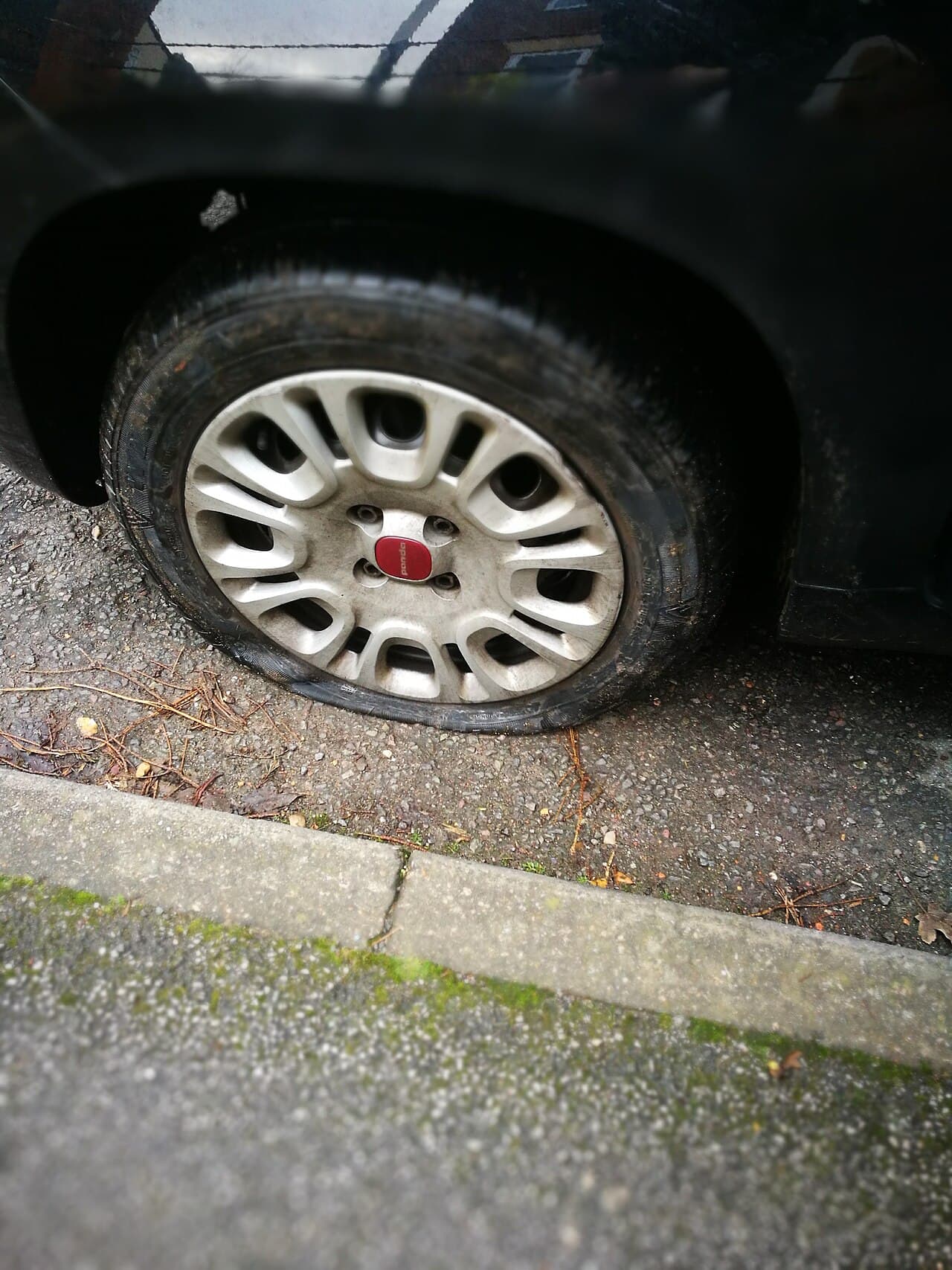
What to do with the nail in it
Do not pull it. Check the pressure, top up if the tire holds air, and drive slowly to a shop. If it is flat, change to the spare following your owner's manual. A compact spare is a short-term fix: Virginia's inspection rules reject a vehicle with a space saver emergency spare intended for temporary use installed on any axle,[1] so get the repair done before your next inspection.
When wheels come off, whoever puts them back should tighten the lug nuts to the manufacturer's specification. The state's brake inspection rules give the same warning: if wheels are removed, lug nuts must be torqued to the manufacturer's specifications.[2] If you changed the wheel yourself, have the torque checked at the shop.
What a proper repair looks like
Ask for these three things:
- The tire comes off the wheel. The shop inspects the inside liner and the area around the hole for damage.
- The repair is made from the inside. A patch or a combination plug-and-patch seals the inner liner and fills the hole. A rope plug pushed in from outside alone leaves the inside unexamined.
- The shop tells you its limit. Reputable shops follow the tire or repair-material maker's rules for hole size and position, and will tell you if yours is outside them. Ask what the rule is and who sets it.
Most shops charge a modest fee for this, and some honor a road hazard warranty if you bought one with the tires. Ask before the work starts. How much does a flat tire repair cost in Virginia? covers what makes the price move.
Stop and call a pro if
- The tire is flat and you cannot change it safely. On a busy road, a soft shoulder or a slope, do not jack the car. Call roadside help.
- The nail is in the sidewall or the shoulder. It cannot be repaired in the sidewall.[1]
- You see a bulge, a knot or exposed cord. The inspection rules reject these,[1] and the tire needs replacing.
- The tire has lost air repeatedly after a repair. The hole may be bigger than it looked, or the wheel's bead or rim may be leaking.
- You cannot read the pressure or the tire will not hold air at all. Do not drive on it.
Getting help in Virginia
Read more automotive repair answers. For a related inspection question, see will a cracked windshield fail Virginia state inspection.
When you are ready, describe the tire problem once and local shops quote it.
Common questions
- Should I pull the nail out to see how bad it is?
- No. While the nail is in, it blocks most of the leak. Pull it and the tire can go flat in minutes. Leave it for the shop, who can see the angle and size of the hole when it is removed.
- Can a nail in the sidewall be patched?
- Virginia's inspection rules say plugs and patches are allowed in the tread area only and are not permitted in the sidewall. A sidewall puncture means a new tire.
- Will a patched tire pass a Virginia safety inspection?
- Yes, if the repair is in the tread. The rules reject a cut or puncture into the fabric, but state that this does not include a plug or patch used as a repair. The tire must still meet the other tire rules, such as tread depth of at least 2/32 of an inch.[^va-130]
- What if I drove on the tire while it was flat?
- Tell the shop. A tire driven flat can be damaged inside where you cannot see it, so a shop that removes it from the wheel can look for that. The inspection rules reject a tire with fabric or steel cord visible, a broken belt or tread separation, and a tire like that is replaced rather than repaired.
- Is a roadside plug kit a proper repair?
- Treat it as a way to get home. A plug pushed in from outside leaves the inside of the tire unexamined, so have a shop take the tire off the wheel and inspect and repair it from the inside.
Sources
- [1] 19VAC30-70-130, Tires; wheels; rims, Virginia Administrative Code, Department of State Police. Checked October 27, 2026.
- [2] 19VAC30-70-80, Service brakes, Virginia Administrative Code, Department of State Police. Checked October 27, 2026.
Want a pro to handle it?
Describe the job once. Licensed local businesses send quotes, and you pay only when you book one.
Get a quote for Automotive