Why does my tire keep losing air?
A tire that keeps losing air has a slow leak, most often a small puncture in the tread, a leaking valve stem, or a poor seal where the tire meets the wheel. Check the pressure cold against the door-jamb sticker, find the leak with soapy water, and have a shop repair it from the inside. Do not keep topping it up indefinitely.
Free to ask. Local shops send quotes, and you pay only when you book one.
By Kasra Taheri, Founder, LoclisPublished
Researched and drafted with AI, then checked claim by claim against the sources listed below before it was published. Prices and rules change; the dates beside each source say when it was last checked.
Step by step
Read when to stop and call a pro, further down this page, before you start.
Step 1: Check all four tires cold
Measure the pressure with a gauge before driving, and compare it with the recommended cold pressure on the placard or tire inflation pressure label.[1]
Step 2: Find the right number
Use the sticker in the driver's door jamb or the owner's manual, not the maximum pressure printed on the tire's sidewall.[2]
Step 3: Inflate to that pressure
Add air until the gauge reads the recommended figure, and write down the date and the starting pressure.
Step 4: Spray the tire with soapy water
Mix dish soap and water in a spray bottle and wet the tread, both sidewalls, the valve stem and the ring where the tire meets the wheel.
Step 5: Look for bubbles
Growing bubbles mark the leak. Check the valve core and cap first, since a loose core is the easiest cause to fix.
Step 6: Look for a nail or screw
Check the tread for anything stuck in it. Leave it in place and go to a shop, as described in the answer on patching a tire with a nail in it.
Step 7: Recheck in a day or two
Measure again when the tire is cold. A drop of more than a pound or two in a few days means a real leak, not just weather.
Step 8: Book a shop repair
Have the tire taken off the wheel and inspected, with the repair made from the inside, rather than topping it up every week.
A tire that keeps losing air almost always has a slow leak you can find in ten minutes with a gauge and a spray bottle. The usual causes are a small puncture in the tread, a valve stem or valve core that is not sealing, or a poor seal where the tire meets the wheel. Weather can make a normal tire look low, so rule that out first.
Check the pressure the right way
Each tire, including the spare, should be checked monthly when cold and inflated to the pressure the vehicle manufacturer recommends on the vehicle placard or tire inflation pressure label.[1] "Cold" means the car has sat for a few hours, because driving heats the air and raises the reading.
The proper tire pressure is usually found on a sticker in the driver's side door jamb or the glove box and in the owner's manual, and the maximum pressure printed on the tire's sidewall is not the number to use.[2] Measure all four, not only the one that looks low. If every tire is down by about the same amount after a cold night, the cause is the temperature, not a leak. If one tire is lower than the rest and keeps dropping, it has a leak.
What your dashboard light is telling you
A tire pressure warning light is required to come on within 20 minutes once a tire falls 25 percent below the manufacturer's recommended cold pressure.[1] That is a long way below the sticker figure, so a tire can be leaking well before the light appears. The federal standard says the system is not a substitute for proper tire maintenance, and that it is the driver's responsibility to keep correct pressure even if the light has not come on.[1]
A flashing light that then stays on means the system itself has a fault.[1][4] A compact spare can make the light come on or blink.[4] Check the manual for your car, since the reset steps differ by maker.
Where slow leaks come from
- The tread. A nail, screw or sharp stone that has worked in. Many sit in the tread for weeks. Look for anything embedded, and feel for it with a gloved hand.
- The valve stem and core. The small valve in the stem can loosen or wear, and the rubber stem cracks with age. A missing cap lets dirt in.
- The bead. This is the ring where the tire seals against the rim. Corrosion on the wheel's edge, common on older aluminum wheels, and winter road salt can leave a gap that bleeds air slowly.
- The wheel itself. A cracked wheel, or one bent by a pothole, can leak. Virginia's inspection rules reject rims or wheels that are bent, cracked or damaged so as to affect safe operation.[3]
- The sidewall. A cut or bulge here is not a repairable area. Virginia's inspection rules reject a tire with knots or bulges in its sidewalls, a broken belt under the tread, or tread separating from the fabric.[3]
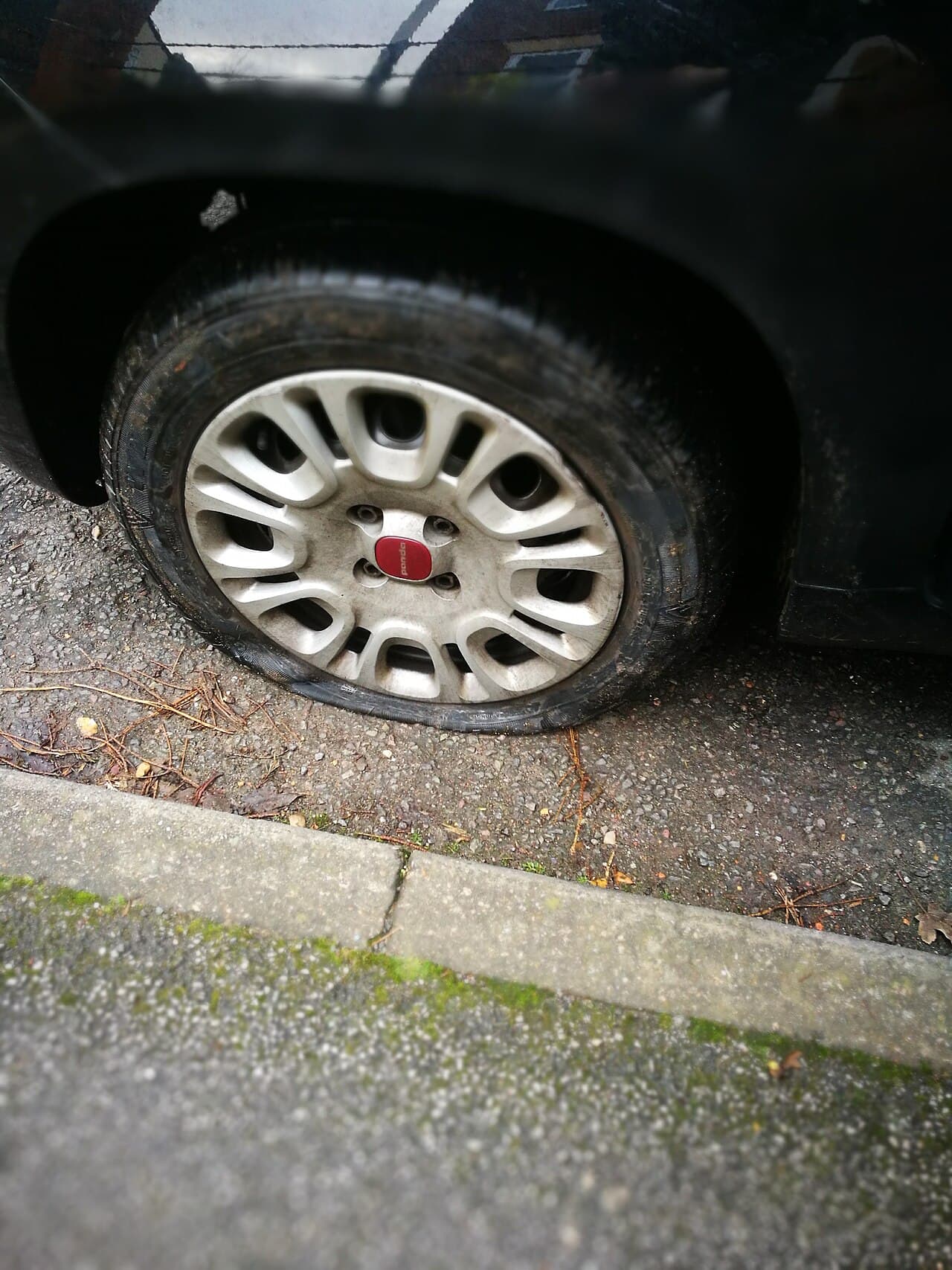
Find the leak with soapy water
Fill the tire to the sticker pressure, then spray a mix of dish soap and water over the tread, the sidewalls, the valve stem and the full ring around the wheel's edge. Slow bubbles that grow and cluster mark the leak. Check the valve first: tighten the valve core with a valve-core tool if bubbles come from the stem, and fit a cap.
If the bubbles come from the tread and something is stuck in it, leave it there and drive slowly to a shop. Can a tire with a nail in it be patched? explains what is repairable. Plugs and patches must be in the tread area only and are not permitted in the sidewall.[3]
Why not just keep topping it up
Because under-inflation costs more than the air. Driving on a significantly under-inflated tire causes it to overheat and can lead to tire failure, and under-inflation also reduces fuel efficiency and tire tread life and may affect handling and stopping.[1] Under-inflated tires can lower gas mileage by about 0.2% for every 1 psi drop in the average pressure of all tires.[2]
When the leak is not in the tread
A bead leak is often fixed in a shop by taking the tire off, cleaning the corrosion from the wheel's edge and mounting the tire again with fresh sealant on the bead. A leaking valve stem is a small, cheap replacement while the tire is off. A cracked wheel needs the shop's assessment, and often replacement. Ask the shop what it found and where, and ask to see the leak if you want to. How much does a flat tire repair cost in Virginia? covers what changes the price.
Stop and call a pro if
- The tire is flat or very low. Do not drive on it. Put on the spare following your owner's manual, or call roadside help if you cannot do that safely.
- You see a bulge, a knot or exposed cord. The inspection rules reject these,[3] and the tire needs replacing.
- The leak is at the sidewall or the wheel. A sidewall is not a permitted repair area, and a wheel needs a shop's assessment.
- Bubbles show at the bead, or the wheel looks corroded or bent. This needs a shop with a tire machine.
- The tire loses air again after a repair. The first repair may have missed the actual leak.
- All four tires read correct but the light is flashing and then staying on. The monitoring system needs a scan.
Getting help in Virginia
Read more automotive repair answers, or browse tire repair shops.
When you are ready, describe the tire problem once and local shops quote it.
Common questions
- How much air loss is normal?
- A little. Tires lose a small amount of pressure over weeks, and cold weather lowers it further, so a pound or two over a month or a cold snap is not a fault. A tire that needs air every few days, or that is clearly lower than the other three, has a leak.
- Why does my tire pressure light come on when it gets cold?
- Cold air takes up less volume, so the pressure in every tire falls. The federal standard requires the light to come on within 20 minutes once a tire is 25 percent below the manufacturer's recommended cold pressure, so a tire that was already a little low can cross that line on a cold morning.[^cfr138] Inflate to the sticker pressure when the tires are cold.
- Can I just keep adding air?
- As a short-term measure, yes, if the loss is slow and you are heading to a shop. As a routine, no. Driving on a significantly under-inflated tire causes it to overheat and can lead to tire failure.[^cfr138] Find the leak.
- My tire pressure light is on but the tires look fine. Why?
- You cannot judge pressure by eye. Check each tire with a gauge. If all four are correct and the light flashes, then stays on, the monitoring system has a fault and a shop can scan it.[^cfr138]
- Does a leaking tire fail a Virginia inspection?
- The inspection rules list tire conditions that fail, such as exposed cord, bulges, a broken belt, or a bent or cracked wheel.[^va-130] A slow leak is not itself on that list, but the cause often is, so get it repaired before inspection.
Sources
- [1] 49 CFR 571.138, Standard No. 138; Tire pressure monitoring systems, Electronic Code of Federal Regulations, U.S. Government Publishing Office and National Archives. Checked October 28, 2026.
- [2] Gas Mileage Tips: Keeping Your Vehicle in Shape, U.S. Department of Energy and U.S. EPA, fueleconomy.gov. Checked October 28, 2026.
- [3] 19VAC30-70-130, Tires; wheels; rims, Virginia Administrative Code, Department of State Police. Checked October 28, 2026.
- [4] Indicator Coming On/Blinking (HR-V 2024 Owner's Manual), American Honda Motor Co.. Checked October 28, 2026.
Want a pro to handle it?
Describe the job once. Licensed local businesses send quotes, and you pay only when you book one.
Get a quote for Automotive