How long does a car alternator last?
There is no fixed life to quote. An alternator is normally replaced when a test shows it has failed or is failing, not on a schedule. Wear at the brushes and bearings is the usual end, so a sound belt helps, and the first noise or warning light is the cue to get it tested.
Free to ask. Local shops send quotes, and you pay only when you book one.
By Kasra Taheri, Founder, LoclisPublished
Researched and drafted with AI, then checked claim by claim against the sources listed below before it was published. Prices and rules change; the dates beside each source say when it was last checked.
Step by step
Read when to stop and call a pro, further down this page, before you start.
Step 1: Read the maintenance schedule
Open the owner's manual and find the interval for the drive belt that turns the alternator, and for inspecting it.
Step 2: Look at the belt
With the engine off and cool, look at the belt for cracks, fraying, glazing or oil, and check that it is not loose or broken.[2]
Step 3: Listen for the early signs
Note any whining, grinding or squealing from the front of the engine that changes with engine speed. Bearing wear causes noise and vibration.[1]
Step 4: Keep the battery healthy
Have a weak or old battery tested and replaced before it fails, so it does not strand you.
Step 5: Keep the engine bay clean
Have oil leaks fixed when you find them, so oil does not reach the alternator and belt.
Step 6: Act on the warning light
If the charging light comes on while driving, stop somewhere safe and have the charging system checked rather than driving on.[2]
Step 7: Get a written estimate for any repair
Before any work that may cost more than $25, ask for the estimate in writing.[4]
There is no set lifespan
An alternator has no set replacement age or mileage. The practical answer is that it stays in the car until a test shows it is failing, and a shop then replaces it. What you can control is the condition of the belt that turns it and the health of the battery it charges.
What can be said is how they wear out. A University of Michigan study of automotive alternators notes that rotor parts typically have brush wear and bearing wear at their end of life.[1] Brush wear causes disconnection or failure of the voltage regulator, and bearing wear causes noise and vibration.[1] In plain terms: a worn alternator either stops charging, or starts to growl or whine first.
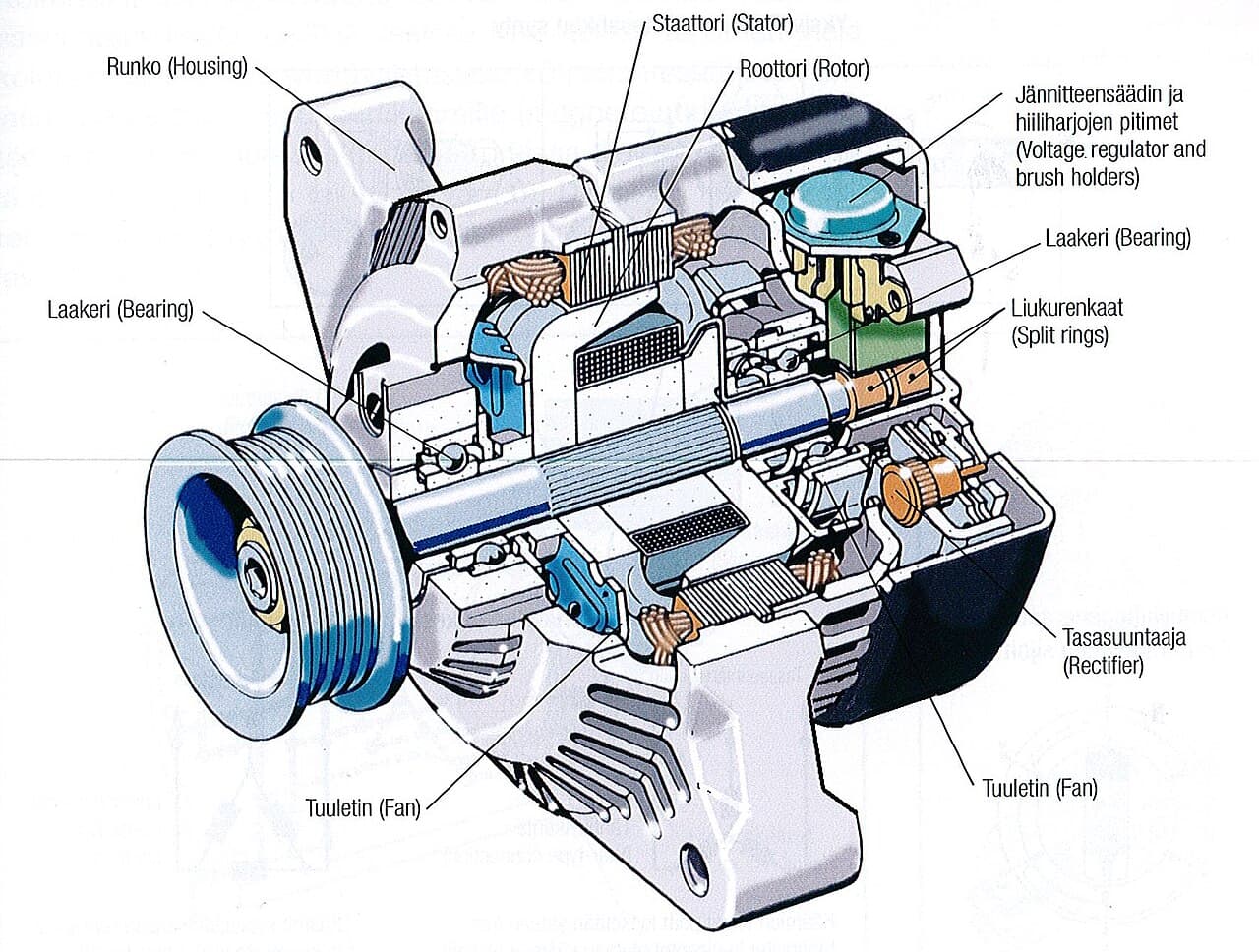
What shortens or lengthens a life
No published figure ties alternator life to the odometer, so treat these as general guidance rather than numbers.
- Heat and heavy electrical load. Alternators work harder in stop-and-go driving with the lights, wipers, defroster and audio all on, and they run in a hot engine bay.
- Oil and water. A leak from the engine dripping onto the alternator or belt can ruin bearings and make the belt slip.
- The belt. A loose or cracked belt slips, so the alternator turns slower than it should and charges less. If the light comes on while driving, Acura's owner's manual says to stop and check to see if the alternator belt is loose or broken.[2]
- A weak battery. A failing alternator leaves the battery flat, and a battery that no longer holds a charge can look like an alternator fault. Battery performance degrades in cold conditions and may prevent the engine from starting,[3] which is often the first time a marginal battery shows itself.
How to get the most from yours
Most of this is routine care. Follow the belt interval in your owner's manual and have the belt looked at when the car is in for service. Fix oil leaks when you see them. Replace an old battery before it strands you.
Do not ignore the warning signs. The charging system warning light comes on when there is a problem with the electrical charging system,[2] and dimming headlights, a whine from the front of the engine, or a battery that keeps going flat are the other usual signs. Getting the system tested at the first sign is usually cheaper than a tow later.
When it does fail
A failing alternator leaves the car running on the battery alone, and when that runs down the engine stops. Ask the shop to test the battery and the charging system, so you are not sold a part you do not need. See how to tell the alternator from the battery for the symptoms that separate them.
In Virginia, you can ask for a written estimate before work that may cost you more than $25.[4] Ask whether the part is new, remanufactured or used, what warranty comes with it, and whether the belt should be replaced at the same time. What the job costs depends on the car, and the written quote is the number that counts.
Stop and call a pro if
- The charging light comes on while you are driving. The car is running on the battery and will stop when it runs down. Go straight to a shop or have it towed.
- The car stalls or the lights dim in traffic. Pull over somewhere safe and call for help rather than restarting it repeatedly.
- There is a burning smell, smoke or a squealing belt that will not stop. Switch the engine off and have it towed; if the engine has been running, some engine components may be hot enough to burn you.[2]
- You are unsure whether it is the belt, battery or alternator. A charging-system test settles it.
Getting help in Virginia
Browse more automotive repair answers.
When you want a shop to test and quote it, describe the problem once and local shops will respond.
Common questions
- Is there a mileage at which I should replace the alternator?
- No. There is no standard mileage to replace it by. Most alternators are replaced when testing shows they have failed or are failing, not on a schedule. Your owner's manual does list the drive belt interval, which is the part to watch.
- What usually wears out inside an alternator?
- A University of Michigan case study of alternators says rotor parts typically have brush wear and bearing wear at their end of life. Brush wear can cause disconnection or failure of the voltage regulator, and bearing wear causes noise and vibration.
- Does a bad battery shorten alternator life?
- There is no established figure for how much it shortens alternator life. Replacing a battery that is clearly failing is sensible either way, because a dead battery strands you whatever the alternator is doing.
- Can I just replace the alternator before it fails?
- You can, but a part replaced early is a cost with no warning sign behind it. A better approach is to act on real signs, such as the charging light, noise or dimming lights, and have the system tested.
- Is a remanufactured alternator as good as a new one?
- The same Michigan study describes remanufacturing as a process that restores old products to perform like new. Ask the shop whether the part is new, remanufactured or used, and what the warranty is, and get it on the written estimate.
Sources
- [1] Economic and Environmental Assessment of Automotive Remanufacturing: Alternator Case Study, Center for Sustainable Systems, University of Michigan (ASME MSEC2008). Checked October 28, 2026.
- [2] Charging System Warning Light (owner's manual), American Honda Motor Co., Acura owner's manual. Checked October 28, 2026.
- [3] If the Battery Is Dead (HR-V 2024 owner's manual), American Honda Motor Co.. Checked October 28, 2026.
- [4] Va. Code § 59.1-207.3, Written estimate for repair work required upon request, Code of Virginia, Virginia General Assembly. Checked October 28, 2026.
Want a pro to handle it?
Describe the job once. Licensed local businesses send quotes, and you pay only when you book one.
Get a quote for Automotive