How often should shocks and struts be replaced?
There is no single mileage that fits every car. Wear depends on the vehicle, the roads and the load it carries, so replace them when they show signs of failing, not on a calendar. Have them checked at least once a year, such as at the Virginia safety inspection, and follow your owner's manual. Replace them in pairs on the same axle when a shop confirms wear.
Free to ask. Local shops send quotes, and you pay only when you book one.
By Kasra Taheri, Founder, LoclisPublished
Researched and drafted with AI, then checked claim by claim against the sources listed below before it was published. Prices and rules change; the dates beside each source say when it was last checked.
This is a job for a licensed pro in Virginia
This page explains what the work involves, the permits, what a licensed pro does and what drives the cost. It does not give step-by-step instructions, because this work needs a licence, a permit or both, and doing it wrong can injure someone. Before you hire, check the licence on Virginia's DPOR record.
There is no mileage or age at which shocks and struts must be replaced. They wear gradually, at a rate set by the vehicle, the roads, the load and how it is driven, so the practical rule is to have them inspected regularly and replace them when a shop finds real wear. A yearly look, such as at your Virginia safety inspection, plus attention to how the car rides, catches most problems.
Why there is no fixed interval
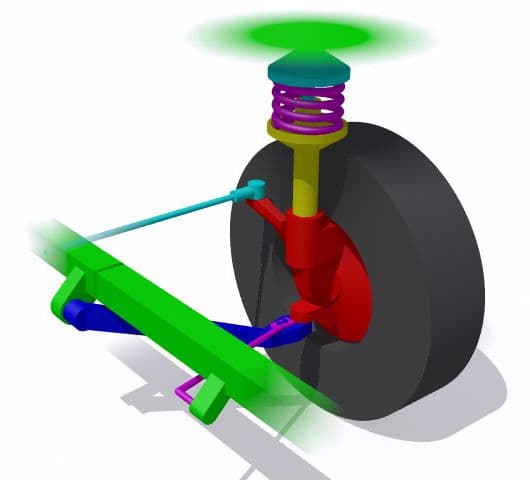
Shocks and struts are dampers that control spring bounce. Because they wear slowly, drivers rarely notice the loss. A car that is on rough roads, hauls heavy loads or tows will use them up faster than one that mostly runs on smooth highway. Your owner's manual is the first place to look for what the manufacturer lists to inspect, and it may differ between models. Virginia's inspection rules set no replacement mileage, so be cautious of any flat figure quoted as a rule.
When to check them
- Once a year. Ask for a suspension look at a regular service visit or at the safety inspection, when the car is already on a lift.
- When the ride changes. A bouncy ride, nose dive under braking, body lean or clunks over bumps is the cue. See the signs of bad shocks or struts.
- After a hard hit. A pothole, curb strike or crash can bend or loosen a damper without any obvious symptom.
- When the load changes. If you start towing or carrying heavy loads regularly, ask a shop whether your dampers are suited to it.
What Virginia's inspection does and does not tell you
The inspection rules are a floor, not a maintenance schedule. They reject shock absorbers or cross stabilizer links that are disconnected, broken, bent, loose, or do not function properly,[1] and the rules reject the vehicle when a spring is broken, sagging or misaligned.[1]
On leaks, the rules tell inspectors not to reject a shock absorber or MacPherson strut unless there is evidence of leakage that causes the device not to function properly.[1] A damper can pass and still be worn enough to make the car feel loose. If you notice a poor ride, do not wait for the inspection to say so.
Replace in pairs, and ask what was found
Shops generally replace dampers in pairs on the same axle, so that both sides control the wheels equally. That is sensible when both are worn, but it is fair to ask what each side showed. Ask for the evidence on the car, such as a leak, a bent rod or play, and whether related parts like mounts, boots and bushings are also tired. After replacing struts, many cars need an alignment, so ask whether it is in the quote.
Request a written estimate. In Virginia the shop cannot charge more than 10 percent over the written estimate, or 20 percent for a vehicle at least 25 model years old, unless you authorize the extra work or time.[2] For what moves the price, read how much suspension repair costs in Virginia, and for the same approach to another wear item, see how often brakes should be replaced.
When to call a licensed pro
For the replacement itself. Struts in particular hold the coil spring under load and are part of the steering geometry, so the work involves lifting the vehicle, releasing spring force and setting the car up afterward. Take it to a qualified repair shop, and stop driving it if the steering feels loose, the car pulls hard to one side, a wheel wobbles or you hear metal knocking from a corner. Your protection is the written estimate under Virginia's Automobile Repair Facilities Act, at law.lis.virginia.gov.
Loclis lists Virginia businesses by trade and area. Browse automotive repair services or read more automotive repair answers.
To get quotes for your own car, describe the job once.
Common questions
- Is there a mileage at which shocks and struts must be replaced?
- Virginia's inspection rules set none. Your owner's manual may list inspection points, and shops publish their own rules of thumb, but the right time is when the part shows wear: a leak with a bouncy ride, loose or broken mounts, or poor control over bumps.
- Should shocks and struts be replaced in pairs?
- Shops usually recommend it, because a new damper on one side and a worn one on the other can make the car handle unevenly. Ask the shop to show you the wear on each side and explain why for your vehicle.
- Can I wait until the Virginia inspection fails them?
- You can, but the inspection is a minimum, not a service schedule. The rules reject broken, bent, loose or disconnected shocks and struts, and do not reject for leakage unless it stops the part working, so a worn damper can pass while the ride is already poor.
- Do struts wear faster than shocks?
- Not by a rule. A strut is a damper that also carries the spring and holds the wheel in line, so it works under more load, but life depends on the car, roads and use. Judge each by condition, not by type.
- What should I ask for when a shop recommends replacement?
- Ask what it found on each part, whether the recommendation is for one side or the pair, and for a written estimate. In Virginia the shop cannot bill more than 10 percent above it without your approval.
Sources
- [1] 19VAC30-70-110, Steering and suspension, Virginia Administrative Code, Department of State Police. Checked October 28, 2026.
- [2] Va. Code § 59.1-207.3, Written estimate for repair work required upon request, Code of Virginia, Virginia General Assembly. Checked October 28, 2026.
Want a pro to handle it?
Describe the job once. Licensed local businesses send quotes, and you pay only when you book one.
Get a quote for Automotive