What does tearing down a shed involve?
Tearing down a shed means emptying it, having any power or gas disconnected, checking for a permit and calling Virginia 811, and checking old materials for asbestos, lead paint or treated wood. Then a crew takes the building apart, usually roof first, sorts metal from wood and trash, hauls it to a landfill or transfer station, and deals with the floor or slab left behind.
Free to ask. Local shops send quotes, and you pay only when you book one.
By Kasra Taheri, Founder, LoclisPublished
Researched and drafted with AI, then checked claim by claim against the sources listed below before it was published. Prices and rules change; the dates beside each source say when it was last checked.
This is a job for a licensed pro in Virginia
This page explains what the work involves, the permits, what a licensed pro does and what drives the cost. It does not give step-by-step instructions, because this work needs a licence, a permit or both, and doing it wrong can injure someone. Before you hire, check the licence on Virginia's DPOR record.
Tearing down a shed is a short job with a longer checklist in front of it. The building is emptied, any power or gas is disconnected, the permit question and the Virginia 811 locate are dealt with, and older materials are checked for asbestos, lead paint and treated wood. Then a crew takes the shed apart, sorts and hauls the debris, and leaves you with whatever floor or slab it stood on.
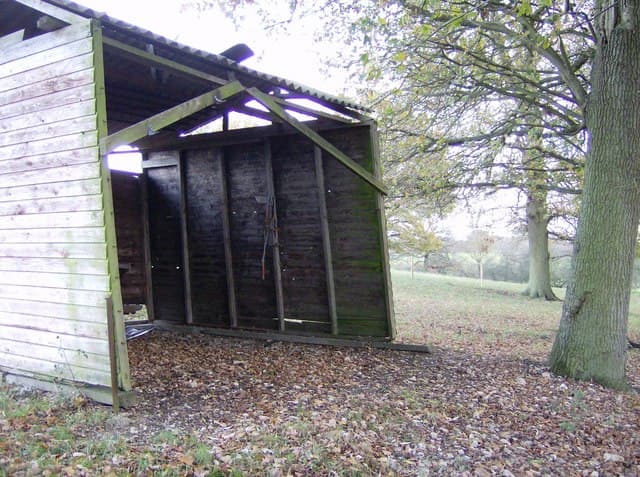
Before anything comes down
Empty it. Most quotes assume an empty building, and the contents are often the messiest part. Old fuel cans, pesticides and paint cannot go in the dumpster with the lumber. In the New River Valley, the Montgomery Regional Solid Waste Authority lists gas for disposal at one of its semi-annual events or at the New River Resource Authority's annual event,[10] so plan around those dates or ask the crew how it handles chemicals.
Disconnect the utilities. Many sheds have a light and an outlet fed from the house, and some have water or even gas. Columbia Gas of Virginia warns that it is not safe to demolish a building until both the electric and gas service is completely disconnected,[4] and it asks customers to call at least 30 days in advance to make an abandonment request.[4] Wiring is a job for a licensed electrician: Virginia's Board for Contractors regulates individual tradesmen in the electrical and gas fitting trades, and state certification of those trades is mandatory, not optional.[5]
Settle the permit. Virginia's Uniform Statewide Building Code lists the demolition of a building or structure among the work that needs a permit,[1] while it exempts one-story detached tool and storage sheds of 256 square feet or less from its permit requirement.[1] How your county or city applies that to tearing a small shed down varies, so call the building department. The details are in do you need a permit to tear down a shed in Virginia.
Call Virginia 811. No person may begin a demolition in Virginia without first submitting a locate request to the notification center,[2] and Virginia 811 asks for that request at least 3 working days in advance.[3] Buried power to the shed, a gas line, an irrigation line or a cable run often passes right under or beside it.
What the materials can hide
Old sheds were built from whatever was cheap at the time, and some of it needs care.
- Asbestos. Older roofing, siding panels and floor tiles can contain it. The EPA notes that you generally can't tell whether a material contains asbestos simply by looking at it, unless it is labeled,[6] and that materials containing asbestos may release fibers when they are disturbed, cut, sawed, drilled or scraped.[6] In Virginia, the building code requires a permit for removing or disturbing asbestos containing materials during demolition.[1] Suspect material is tested by an accredited inspector before the crew starts.
- Lead paint. The EPA says buildings from before 1978 are more likely to have lead-based paint,[7] and that workers involved in demolition can be exposed to lead dust that ends up on their skin, hair, clothing and equipment.[7]
- Treated wood. The Consumer Product Safety Commission says a residential wood structure built before 2004 that is not cedar or redwood was most likely built with wood pressure-treated with chromated copper arsenate (CCA), a preservative made of arsenic, chromium and copper.[8] Its guidance calls for working outdoors with goggles, gloves and a dust mask when sawing or handling CCA-treated wood,[8] and says CCA or other preservative-treated wood should not be burned, because of the toxic chemicals in the smoke and ash.[8]
- Rodents. A shed that has sat closed for years often has mice. The Virginia Department of Health says HPS is rarely reported in Virginia,[9] but the main way it spreads is breathing air contaminated with rodent urine, droppings or saliva.[9] VDH's precautions include opening a closed building to air out for at least 30 minutes before spending time inside, and wetting down dusty areas with droppings instead of sweeping or vacuuming them dry.[9]
Taking the building apart
Once the paperwork and checks are done, the teardown itself is usually the quickest part. A crew typically works from the top down: roofing and roof sheathing first, then siding and wall framing, then the floor and whatever it rests on. Metal kit sheds often come apart at their fasteners; plastic resin sheds break down into panels. A badly rotted shed may be pulled down in a controlled way with equipment instead, which is faster but makes sorting harder.
This is the part that injures people. Roof sections come down heavier than they look, rotted framing fails without warning, and old sheds are full of nails and broken glass. It is why the job is usually given to a crew with the equipment, insurance and a truck waiting.
Sorting and hauling
Debris is usually sorted on site. Metal roofing, a steel frame or a metal kit shed often goes for scrap; Chesterfield County's convenience centers, for example, have a scrap metal box with no recycling fee.[11] Wood, shingles and the rest go out as construction and demolition debris, charged by weight. When we checked on October 27, 2026, the Montgomery Regional Solid Waste Authority, which serves Blacksburg and Christiansburg, charged $53.00 a ton for construction material at its transfer station.[10] Chesterfield County's convenience centers take residential construction and demolition debris, but no asbestos or lead,[11] so tested material goes through a licensed abatement contractor.
For a larger job, the choice between the crew hauling as it goes and a rented roll-off is the same one covered in should the contractor haul debris or should you rent a dumpster.
What is left behind
When the walls are gone you still have the base: skids or a wood floor frame on blocks, a gravel pad, concrete piers or a poured slab. Each takes different work to remove, and digging out piers or breaking a slab is excavation as well as demolition. See how to clear the ground after a shed is torn down for what each option involves.
Who can do the work
Virginia's definition of a contractor covers anyone who, for a fee, undertakes the removal of any building or structure permanently annexed to real property,[12] and a Class C licence covers single jobs over $1,000 but less than $30,000.[12] A shed teardown with hauling often lands in that range, so ask for the licence number and check it with DPOR. Any wiring goes to a licensed electrician, and suspected asbestos to an accredited inspector and abatement contractor.
When to call a licensed pro
- The shed has electrical wiring, a water line or a gas line running to it.
- It was built before 1978, has old roofing or siding panels you cannot identify, or has peeling paint.
- It is bigger than a small storage shed, sits on a slab, or is close to a fence, a property line or the house.
- The structure is leaning, the roof is sagging, or the floor has rotted through.
- You want the debris hauled and the site left clean in one contract.
Browse more junk removal and moving answers, see shed and structure teardown businesses, or find junk removal businesses around Blacksburg and electricians around Blacksburg. To compare prices first, see what shed demolition costs in Virginia. When you are ready, describe the shed on Loclis with photos of the building, its base and the path to the street, and businesses quote on the same job.
Common questions
- How long does it take to tear down a shed?
- A small wooden or metal shed with an easy path to a truck is often a single day's work for a crew, including loading. Wiring that has to be disconnected, a concrete slab, suspected asbestos or a long carry to the street add time, and the 811 locate request has to be in at least 3 working days before the work starts.
- Do I have to empty the shed first?
- Usually, yes, or pay the crew to do it. Most quotes assume an empty building. Gasoline, pesticides, paint and other chemicals need separate disposal; in Montgomery County, for example, the regional solid waste authority accepts gas at scheduled collection events.
- Can I burn the old shed wood?
- Not if any of it is pressure-treated. The Consumer Product Safety Commission warns that CCA or other preservative-treated wood should not be burned, because of the toxic chemicals in the smoke and ash. Painted wood from an older shed may also carry lead paint. Most shed wood goes to a landfill or transfer station.
- Does the electric company need to be involved?
- If the shed has power, an electrician should disconnect the circuit and make the leftover wiring safe. If it has a gas line or meter, the gas utility needs to know well ahead; Columbia Gas of Virginia asks for 30 days' notice for an abandonment request.
- Who can I hire to tear down a shed?
- A junk removal or demolition business with a Virginia contractor's licence for jobs over $1,000, plus a licensed electrician for any wiring. Check the licence on DPOR's License Lookup before you sign, and get a written contract that includes cleanup and hauling.
Sources
- [1] 13VAC5-63-80. Section 108 Application for permit (Virginia Uniform Statewide Building Code), Virginia General Assembly, Legislative Information System. Checked October 27, 2026.
- [2] Code of Virginia § 56-265.17. Notification required prior to excavation or demolition, Virginia General Assembly, Legislative Information System. Checked October 27, 2026.
- [3] Homeowners, Virginia 811. Checked October 27, 2026.
- [4] Construction and Renovation, Columbia Gas of Virginia. Checked October 27, 2026.
- [5] Tradesmen Program, Virginia Department of Professional and Occupational Regulation. Checked October 27, 2026.
- [6] Protect Your Family from Exposures to Asbestos, U.S. Environmental Protection Agency. Checked October 27, 2026.
- [7] Reduce the Risk of Lead Exposure at Home, U.S. Environmental Protection Agency. Checked October 27, 2026.
- [8] CCA-Pressure Treated Wood: Guidance for Outdoor Wooden Structures, U.S. Consumer Product Safety Commission. Checked October 27, 2026.
- [9] Hantavirus Pulmonary Syndrome (HPS), Virginia Department of Health. Checked October 27, 2026.
- [10] Disposal Guide, Montgomery Regional Solid Waste Authority. Checked October 27, 2026.
- [11] Convenience Centers, Chesterfield County. Checked October 27, 2026.
- [12] Code of Virginia § 54.1-1100. Definitions, Virginia General Assembly, Legislative Information System. Checked October 27, 2026.
Want a pro to handle it?
Describe the job once. Licensed local businesses send quotes, and you pay only when you book one.
Get a quote from a local pro