How do I clear the ground after a shed is torn down?
Clearing the ground means removing whatever the shed stood on, such as skids, blocks, gravel, piers or a slab, then picking up nails and buried wood, filling and grading the spot, and replanting. Anything dug out needs a Virginia 811 locate first. Keep children and pets off soil under an old treated-wood shed, and plant grass in late summer to mid-fall for the best results.
Free to ask. Local shops send quotes, and you pay only when you book one.
By Kasra Taheri, Founder, LoclisPublished
Researched and drafted with AI, then checked claim by claim against the sources listed below before it was published. Prices and rules change; the dates beside each source say when it was last checked.
This is a job for a licensed pro in Virginia
This page explains what the work involves, the permits, what a licensed pro does and what drives the cost. It does not give step-by-step instructions, because this work needs a licence, a permit or both, and doing it wrong can injure someone. Before you hire, check the licence on Virginia's DPOR record.
Clearing the ground after a shed comes down is mostly about what the shed stood on. Skids on blocks or a gravel pad leave little behind; concrete piers or a poured slab are a small excavation job of their own. After the base is gone, the spot needs nails and buried wood picked up, low ground filled and graded, and something planted before it washes or fills with weeds. Anything that involves digging starts with a Virginia 811 locate request.
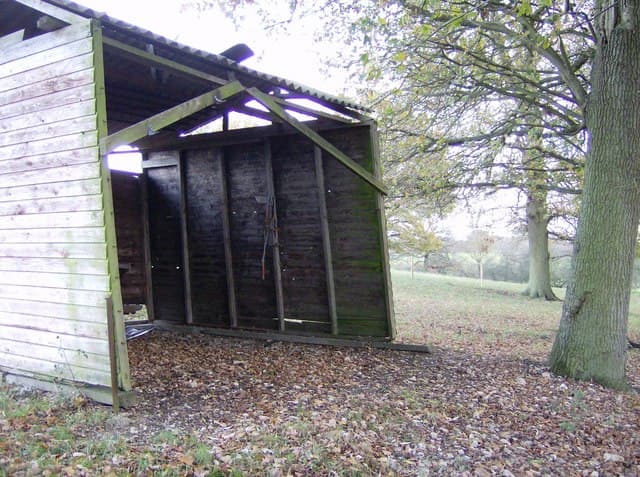
What the shed leaves behind
- Skids or a floor frame on blocks. The wood goes with the rest of the demolition debris. Concrete blocks or pavers can often be reused.
- A gravel pad. Some owners keep it as a base for a new shed, firewood or bins. Removing it means scraping and hauling stone.
- Concrete piers or posts set in the ground. These have to be dug out or cut off below grade.
- A poured slab. A sound slab can stay as a patio or pad. Taking it out means breaking concrete with heavy tools or equipment, hauling heavy loads, and filling the hole.
- Utility stubs. A buried cable, water line or conduit that fed the shed should already have been made safe by a licensed electrician or plumber before demolition. If it was not, stop and have that done before anyone digs.
Whether to keep the base is the first decision. If you are putting up a new shed, a level slab or gravel pad in good condition saves money. If you want lawn or a garden there, it has to go.
Call Virginia 811 before anything is dug out
Virginia law says no person may make or begin any excavation or demolition without first submitting a locate request to the notification center,[1] and the same law counts digging with shovels, picks and manual post hole diggers as excavation.[2] Virginia 811 says there is no allotted depth before you need to contact it, because many utilities are buried just a few inches below the surface,[3] and it asks for the request at least 3 working days in advance.[3] Lines to an old shed often run right under where it stood.
Treated wood, old paint and the soil
The soil under an old shed can carry what the shed was made of.
The Consumer Product Safety Commission notes that chemical residues can leach from CCA-treated wood,[4] the arsenic-based preservative that was a major source of treated wood for outdoor residential structures until 2004.[4] It advises not to let children or pets play in soil or other material under or near CCA-treated decks or structures,[4] and says CCA-treated wood should not be used for mulch or compost.[4] The EPA does not require the removal of the soil around existing CCA-treated structures,[5] so removing it is a judgment call, often made when the spot is becoming a vegetable bed or a play area.
Paint matters too. The EPA says yards can become contaminated when exterior lead-based paint from houses and other buildings flakes or peels and gets into the soil,[6] and lists the perimeter of buildings that used lead-based paint, the dripline, among the places lead is found in soil.[6] If the shed was painted before 1978 and the paint was peeling, a soil test before planting food crops is worth the small cost; your local Virginia Cooperative Extension office can point you to one.
Get the wood out of the ground
A good crew leaves no buried wood behind, and it is worth checking. Virginia Cooperative Extension warns that burying construction debris under a porch, stoop or slab causes large numbers of termites to congregate next to or under the structure,[7] and the Forest Products Laboratory notes that stumps, wood debris, stakes and wood concrete forms left under or near a building are often subject to decay and can become a source of decay for the building.[8] Broken skids, old form boards around a slab and rotted posts should leave with the rest of the debris, not go into the hole as fill.
Rodents that lived under the shed move on when it goes. The Virginia Department of Health recommends hauling away junk that can provide homes for rodents,[9] and keeping wood piles on platforms at least 12 inches off the ground and at least 100 feet from the house.[9] If you keep any salvaged lumber, that applies to it too.
Fill, grade and protect the soil
Where a slab or piers came out, the low spot is filled with soil and graded so water runs away from the house and the neighbour's yard rather than pooling. Bare soil washes in heavy rain, so the sooner it is covered with seed and straw, sod or mulch, the better.
Most shed sites are far too small for an erosion permit, but larger clearing is not. For example, Montgomery County requires a land disturbing permit when more than 10,000 square feet of land is disturbed,[10] and exempts minor land-disturbing activities such as home gardens and individual home landscaping.[10] If the shed removal is part of a bigger regrade, ask your county.
Replanting
Virginia Cooperative Extension says late summer to mid-fall is the best time to establish cool-season grasses such as tall fescue and Kentucky bluegrass,[11] and recommends testing the soil first, since many of Virginia's soils are very acid and probably need lime.[11] See the best time to overseed a lawn in Virginia and why a lawn has bare patches for the lawn side.
When to call a licensed pro
- The shed stood on a slab, concrete piers or a block foundation that has to be broken out.
- There is buried wiring, a water line or a gas line where the shed was, or you are not sure whether there is.
- The removal is part of regrading a larger area, or water will need to be redirected.
- You found buried debris, a buried tank or anything you cannot identify.
- The spot is becoming a vegetable garden or play area and the old shed was treated wood or had peeling paint.
Site work done for a fee is contracting: Virginia's definition covers the removal of any building or structure permanently annexed to real property or any other improvements to such real property.[12] Ask for the contractor's licence and get the scope in writing. For the teardown itself, see what tearing down a shed involves and what shed demolition costs in Virginia. Browse more junk removal and moving answers, or find junk removal businesses around Blacksburg. When you are ready, describe the shed and its base on Loclis, and businesses quote on the same job.
Common questions
- Should I keep the concrete slab from the old shed?
- Often, yes, if it is level and not badly cracked. A sound slab can carry a new shed, a patio set or a parking pad for a trailer, and leaving it avoids the cost of breaking and hauling concrete. Remove it if it is cracked, sinking, or in the way of what you want to plant.
- Can I plant a vegetable garden where the shed was?
- Think twice if the shed was old treated wood or painted before 1978. The Consumer Product Safety Commission advises keeping children and pets out of soil under or near CCA-treated structures, and the EPA says peeling exterior lead paint can contaminate soil. Ask your local Virginia Cooperative Extension office about soil testing first.
- Do I need to call 811 just to pull up a few blocks?
- If you are digging, yes. Virginia's law counts digging with hand tools such as shovels and picks as excavation, and Virginia 811 says there is no allotted depth before you need to call. Lifting blocks that sit on the surface without digging is a question to ask Virginia 811 directly.
- Why does it matter if wood scraps get buried?
- Buried wood feeds termites and decay. Virginia Cooperative Extension warns that construction debris buried under a slab or porch draws termites to the spot, and the Forest Products Laboratory notes buried stakes and scraps can become a source of decay for nearby buildings.
- When is the best time to reseed the bare spot?
- For cool-season lawns such as tall fescue and Kentucky bluegrass, Virginia Cooperative Extension says late summer to mid-fall is the best time. A soil test first tells you whether the spot needs lime or fertilizer.
Sources
- [1] Code of Virginia § 56-265.17. Notification required prior to excavation or demolition, Virginia General Assembly, Legislative Information System. Checked October 27, 2026.
- [2] Code of Virginia § 56-265.15. Definitions, Virginia General Assembly, Legislative Information System. Checked October 27, 2026.
- [3] Homeowners, Virginia 811. Checked October 27, 2026.
- [4] CCA-Pressure Treated Wood: Guidance for Outdoor Wooden Structures, U.S. Consumer Product Safety Commission. Checked October 27, 2026.
- [5] Chromated Arsenicals (CCA), U.S. Environmental Protection Agency. Checked October 27, 2026.
- [6] Reduce the Risk of Lead Exposure at Home, U.S. Environmental Protection Agency. Checked October 27, 2026.
- [7] Signs of Subterranean Termite Infestation (Publication 444-501), Virginia Cooperative Extension. Checked October 27, 2026.
- [8] Wood Handbook, Chapter 14: Biodeterioration of Wood, USDA Forest Service, Forest Products Laboratory. Checked October 27, 2026.
- [9] Hantavirus Pulmonary Syndrome (HPS), Virginia Department of Health. Checked October 27, 2026.
- [10] Construction & Land Development: Erosion and Sediment Control, Montgomery County, Virginia. Checked October 27, 2026.
- [11] Fall Lawn Care (Publication 430-520), Virginia Cooperative Extension. Checked October 27, 2026.
- [12] Code of Virginia § 54.1-1100. Definitions, Virginia General Assembly, Legislative Information System. Checked October 27, 2026.
Want a pro to handle it?
Describe the job once. Licensed local businesses send quotes, and you pay only when you book one.
Get a quote from a local pro