How are bats removed from a house?
Bats are removed by exclusion, not trapping. A permitted wildlife control operator finds every gap the bats use, fits one-way exits so they can leave at night but not return, waits until the roost is empty, then seals the openings. In Virginia the work has to avoid the summer months when flightless young are in the roost, and bats may not be poisoned or moved off the property.
Free to ask. Local shops send quotes, and you pay only when you book one.
By Kasra Taheri, Founder, LoclisUpdated
Researched and drafted with AI, then checked claim by claim against the sources listed below before it was published. Prices and rules change; the dates beside each source say when it was last checked.
This is a job for a licensed pro in Virginia
This page explains what the work involves, the permits, what a licensed pro does and what drives the cost. It does not give step-by-step instructions, because this work needs a licence, a permit or both, and doing it wrong can injure someone. Before you hire, check the licence on Virginia's DPOR record.
Bats are removed from a house by exclusion: the bats are let out and kept out, not caught. The Virginia Department of Wildlife Resources (DWR) puts it plainly: "The best and only good way to remove bats from a structure is to exclude the bats from the building."[1] A wildlife control operator finds every gap the colony uses, fits one-way exits, waits until the roost is empty, then seals the house. Timing matters as much as the method, because sealing a roost while young bats are inside traps them.
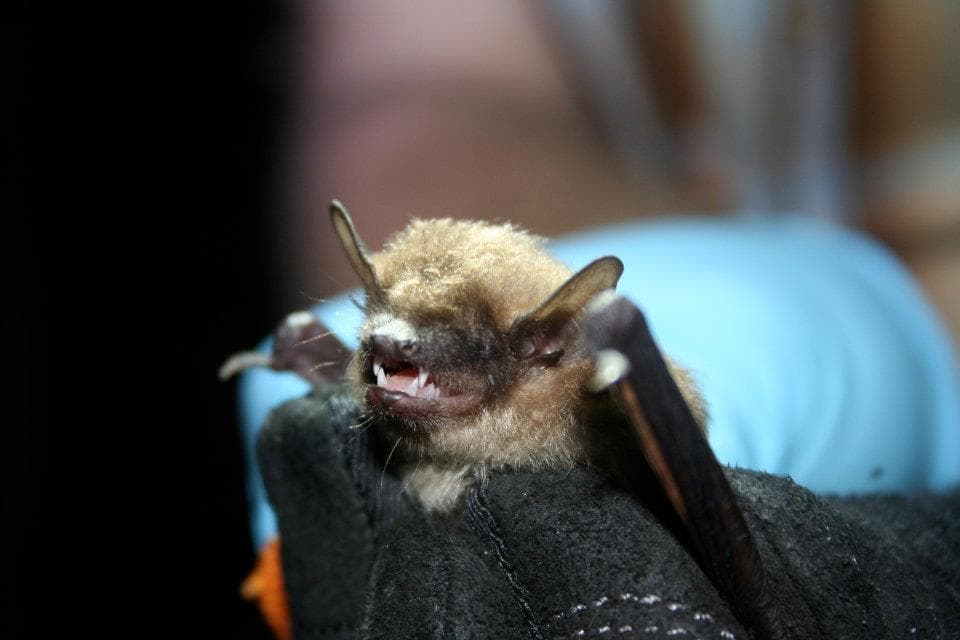
Why exclusion is the method
The two shortcuts people ask about are both illegal. DWR says it is illegal in Virginia to poison any animal, bats included, other than rats and mice,[1] and illegal to transport, release or relocate a bat anywhere other than the property it was caught on.[1] Several species are also protected outright. The Gray, Indiana and Virginia big-eared bats are federally endangered,[1] and the little brown bat, tri-colored bat and Rafinesque's big-eared bat are state endangered.[1]
The bats most often found in houses are common ones. The big brown bat, evening bat, little brown bat and Brazilian free-tailed bat are the four Virginia species most likely to live in a building,[1] and the little brown bat is one of the protected species, which is one more reason the job follows set rules.
What the work involves
A bat job usually runs over several visits, and it helps to know what each one is for.
- Inspection. The operator watches the house at dusk to see where the bats come out, which may take several nights to find every entry and exit point,[2] and checks the attic and walls for other gaps. A colony can use more than one.
- One-way exits. On the openings the bats use, the operator fits one-way exclusion devices that let bats leave but make it unlikely they can get back in.[2]
- The wait. The devices stay up until the roost is empty, typically 5 to 7 nights during warmer weather and longer during cold or inclement weather.[2]
- Sealing and repairs. Once the bats are gone, the operator takes the devices down and closes the remaining gaps. Larger openings, such as a gap under a ridge cap or a missing soffit panel, are a carpentry or roofing repair.
- Follow-up. Ask whether a later check that no bats are getting back in is part of the price.
Some homeowners also follow DWR's suggestion of putting up a bat house on the property to encourage roosting away from the house.[1] It gives the evicted colony somewhere nearby to go.
When it can be done
Exclusion is a spring and autumn job. VDH says bat exclusion should be performed before April and after August, and avoided during hibernation,[2] and never during any period when bats do not leave their roost on a regular nightly basis.[2]
The rules for operators are just as firm. DWR's permit conditions define the bat maternity season as May 1 to August 15, inclusive,[3] and say bats may not be excluded or removed from a structure in that season except when no young bats are present or there is a threat to human health or safety.[3] For the little brown and tri-colored bats, the state regulation adds that between May 15 and August 31 there is no exclusion of bats from maternity colonies, except for human health concerns.[4]
If you find bats in July, the usual answer is an inspection now and the exclusion once the young can fly.
The cleanup afterwards
Exclusion gets the bats out. It does not clean the attic. DWR warns that bat droppings can harbor histoplasmosis spores and should be cleaned up by a professional,[1] and VDH recommends a company that specializes in removal of hazardous waste[5] for areas with droppings. A large colony can leave soiled insulation that has to be removed and replaced, which is priced separately. If you are not sure bats are the problem, read how to know if you have bats in the attic or what animal is living in the attic.
If a bat is in the living space
A bat inside the house is a health question first. DWR's permit conditions say being in the same room with a bat counts as a potential rabies exposure when exposure cannot be ruled out, as with an infant, a small child or a sleeping adult.[3] VDH's guidance is to contain the bat and contact the local health department or animal control, which may include testing the bat for rabies.[2] Call them before anyone releases it.
When to call a licensed pro
Hire a wildlife control operator who holds DWR's Commercial Nuisance Animal Permit and knows bats. The species matters. The state regulation allows incidental take of the little brown bat and the tri-colored bat when animals need to be removed from a lived-in building,[4] but only with set conservation measures, one of which is a department-permitted nuisance wildlife control operator with department-recognized certification in techniques associated with removal of bats.[4] DWR also advises: "Before implementing any control technique, ensure that your problem bat is not one of these three endangered species."[1] Telling the species apart is part of what you pay a pro for.
DWR's permit materials add that permit holders who offer bat management or exclusion services after January 1, 2025 must, with limited exceptions, complete an additional bat-specific training course and pass its exam with at least 80%.[3] That training rule does not apply to exclusion done outside the maternity season when no bats are present in the structure.[3] Ask any company for its Commercial Nuisance Animal Permit and, for work in season or with bats still inside, its bat training certificate. DWR runs a trapper finder tool that lists licensed trappers and Commercial Nuisance Animal Permit holders near you.[7]
The sealing and repair work can also fall under contractor licensing. In the Code of Virginia, Class C contractors are those whose single contract or project is over $1,000 but less than $30,000.[6] If the quote includes significant repairs to soffits, trim or vents, ask whether the company holds a Virginia contractor licence and look it up: how to check a contractor's licence in Virginia. For prices, see what bat removal costs in Virginia, and for the legal side, whether you can legally remove bats yourself.
Loclis lists businesses for bird and bat exclusion and pest control in Blacksburg, and all pest control answers are in one place.
Describe the bat problem once and local businesses quote it.
Common questions
- Can bats be trapped and released somewhere else?
- No. The Virginia Department of Wildlife Resources says it is illegal to transport, release or relocate a bat anywhere other than the property it was caught on. Bats in a building are removed by exclusion: they leave on their own through one-way exits and the gaps are then sealed.
- How long does bat exclusion take?
- Plan on more than one visit. The Virginia Department of Health's guidance has the one-way exclusion tubes left in place until all bats are gone, typically 5 to 7 nights during warmer weather and longer during cold or inclement weather, before the last openings are sealed.
- Why won't a company remove bats in June or July?
- That is when flightless young are in the roost. DWR's permit conditions define the bat maternity season as May 1 to August 15 and bar exclusion in that window unless no young are present or there is a threat to human health or safety. Sealing a roost then would trap the pups inside.
- Can bats just be sprayed or poisoned?
- No. DWR says it is illegal in Virginia to poison any animal other than rats and mice, and that covers bats. Exclusion is the method the state recognises.
- What happens to the droppings left in the attic?
- They stay until someone cleans them up, and that is a separate job. Bat droppings can carry the fungus that causes histoplasmosis, and the Virginia Department of Health recommends a company that specializes in hazardous waste removal for cleaning areas with droppings.
- A bat flew through my bedroom while I slept. Does that change anything?
- Yes. Call your local health department first. DWR's permit conditions treat being in the same room as a bat as a possible rabies exposure when it cannot be ruled out, such as with a sleeping adult, and the health department may want the bat tested.
Sources
- [1] Problems with Bats, Virginia Department of Wildlife Resources. Checked October 26, 2026.
- [2] Methods for Bat Exclusion and Capture (Virginia Guidelines for Rabies Prevention and Control), Virginia Department of Health. Checked October 26, 2026.
- [3] Commercial Nuisance Animal Permit: Information Materials and Permit Conditions, Virginia Department of Wildlife Resources. Checked October 26, 2026.
- [4] 4VAC15-20-130. Endangered and threatened species; adoption of federal list; additional species enumerated, Virginia Administrative Code. Checked October 26, 2026.
- [5] Histoplasmosis, Virginia Department of Health. Checked October 26, 2026.
- [6] Code of Virginia § 54.1-1100. Definitions, Code of Virginia. Checked October 26, 2026.
- [7] Find a Licensed Trapper or Wildlife Control Specialist, Virginia Department of Wildlife Resources. Checked October 26, 2026.
Want a pro to handle it?
Describe the job once. Licensed local businesses send quotes, and you pay only when you book one.
Get a quote from a local pro