How does a hot water boiler heating system work?
A hot water boiler heats water with gas, propane, oil or electricity, and a pump circulates it through pipes to radiators, baseboards or radiant floors, which give the heat off into your rooms. The cooler water returns to the boiler to be reheated. An expansion tank, a relief valve and the boiler's controls keep the sealed loop at a safe pressure and temperature.
Free to ask. Local shops send quotes, and you pay only when you book one.
By Kasra Taheri, Founder, LoclisPublished
Researched and drafted with AI, then checked claim by claim against the sources listed below before it was published. Prices and rules change; the dates beside each source say when it was last checked.
This is a job for a licensed pro in Virginia
This page explains what the work involves, the permits, what a licensed pro does and what drives the cost. It does not give step-by-step instructions, because this work needs a licence, a permit or both, and doing it wrong can injure someone. Before you hire, check the licence on Virginia's DPOR record.
A hot water boiler is a closed loop. In Navien's description, a boiler heats water, the water is circulated through a piping system in the building, an emitter transfers the heat from the water into the building, and the cooler water returns to the boiler to be reheated.[1] A boiler can run on natural gas, liquid propane, fuel oil or electricity.[1] Nothing is blown through ducts: the heat moves in water, and the rooms warm from the radiators, baseboards or floors.
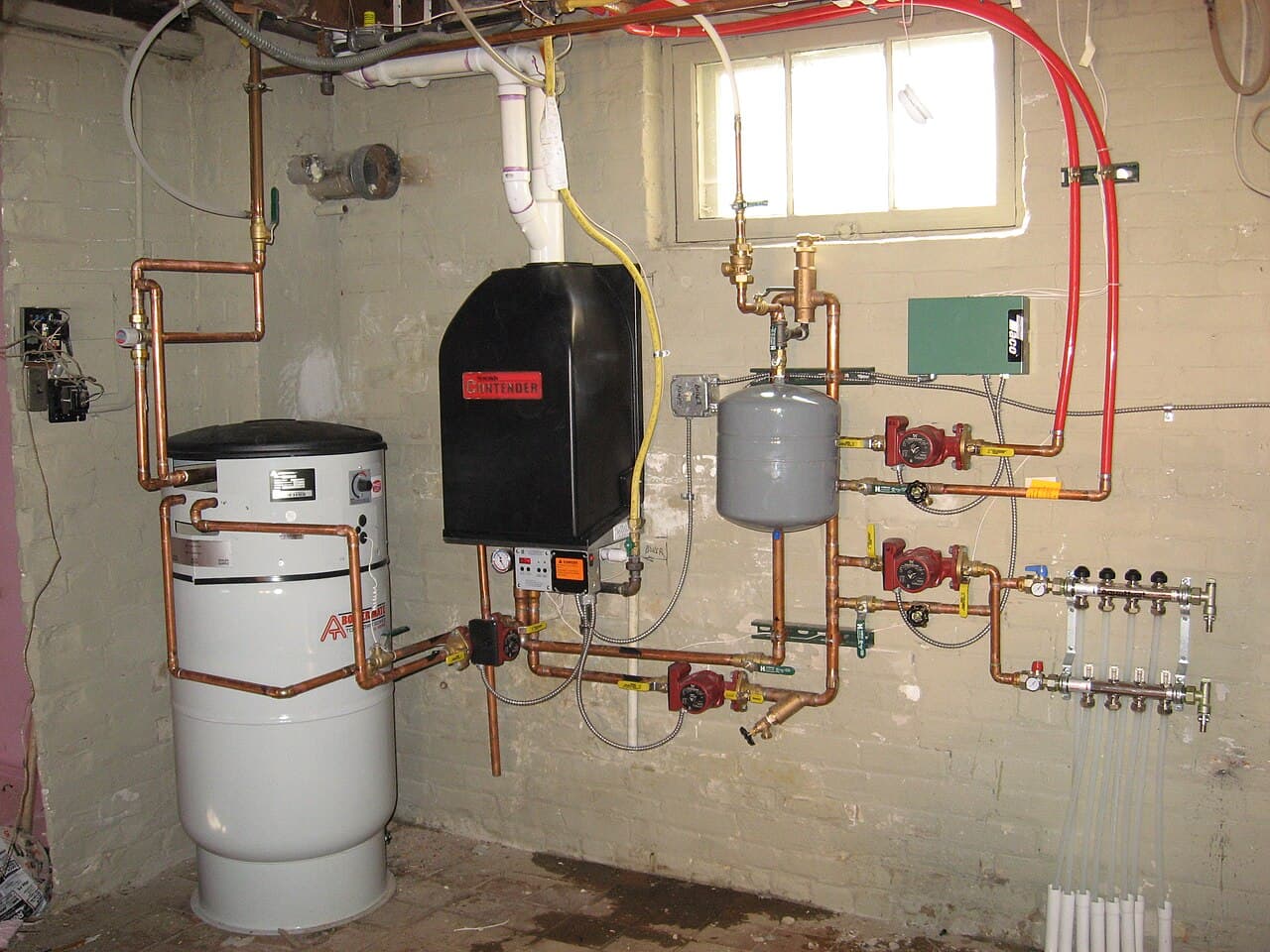
The parts of the loop
Whatever the brand, every boiler has a few key parts: a heat exchanger, a burner, a circulator (a pump) and some type of control system.[1] The heat exchanger is where the flame's heat passes into the water. The circulator moves the water. The controls decide when the burner fires and how hot the water gets.
Out in the house, the hot water gives up its heat through emitters. Navien lists radiators, baseboards or radiant floor heating[2] as the usual choices. Older homes often have cast-iron radiators; newer ones are more likely to have finned baseboard along the walls or tubing under the floor. Larger systems are split into zones, each with its own thermostat and its own pump or valve, so the bedrooms and the living room can run at different temperatures.
Many boilers also make the household's hot water. Some heat a separate indirect tank through a coil, as in the photo above. A combi boiler provides hydronic home heating and hot water from one wall-hung unit.[3]
What happens when the thermostat calls for heat
The cycle is simple. When the house cools off, a control tells the boiler to start. The pump turns on to circulate water through the boiler and the house, and the burner lights to heat the water.[1] The control holds the outgoing water at the temperature the system needs, and once the rooms have warmed up, it turns the boiler off.[1]
How hot is the water? Weil-McLain says the average setting for a forced hot water system is 180°F, lower for in-floor heating, and that it can be raised as high as 210°F in severe weather.[5] Radiant floors run cooler because the whole floor is the radiator.

Pressure, air and the safety parts
A hot water system is sealed and runs under pressure, so a few parts exist only to keep that pressure in a safe range.
The expansion tank. In Navien's words, "Expansion tanks provide space for water to move in and out as the heating system water expands due to temperature increase or contracts as the water cools."[4] Without one, every heating cycle would push the pressure up.
The relief valve. This is the last line of defence if pressure or temperature climbs too high: it opens and dumps water through a discharge pipe. Navien's manual warns that corrosion can leave a relief valve inoperative, and failure to re-inspect the boiler relief valve as directed could result in unsafe pressure buildup, which can result in severe personal injury, death, or substantial property damage.[4] A relief valve that drips is a symptom to have diagnosed, not a part to plug. See why a boiler loses pressure.
Air removal. Air in a boiler system can cause overheating or stop the pumps from circulating water.[1] Navien says every boiler system needs an air eliminator in its piping to remove air as the water passes through.[1] Gurgling pipes or radiators that stay cold at the top usually point to trapped air.
Freeze protection. Where a loop could freeze, Weil-McLain recommends that a heating professional use antifreeze designed for hydronic systems and formulated with inhibited propylene glycol, and says not to use automotive antifreeze.[5]
Condensing and non-condensing boilers
There are two broad designs, and they install differently. Condensing boilers entered the market in the 1990s.[2]
- Non-condensing (conventional). Usually a heavier floor-standing unit. A non-condensing boiler's exhaust is extremely hot and must be vented through a chimney or flue.[2]
- Condensing (high efficiency). Usually smaller and wall-mounted. A condensing boiler captures heat from the exhaust gas before it leaves, which lowers the exhaust temperature and creates condensation inside the unit that needs to be drained.[2] Its cooler exhaust can be vented in PVC or polypropylene, and it needs a drain line for the acidic condensate.[2]
Efficiency is measured as AFUE, the share of the fuel that ends up as heat. Navien notes that traditional boilers have an AFUE of up to 80%.[2] ENERGY STAR certified gas boilers are rated 90% AFUE or greater and certified oil boilers 87% or greater.[6] Navien gives both types a service life of around 15 to 20 years,[2] depending on installation, use and maintenance.
Boiler or furnace?
A furnace heats air and blows it through ducts. A boiler heats water, and the radiators or floors warm the room more slowly and evenly, without a blower pushing air around. The trade-off is that a boiler does nothing for cooling: a house heated only by hot water and with no ductwork needs a separate way to cool, such as window units or ductless mini-splits.
Safety: gas and carbon monoxide
A gas, propane or oil boiler burns fuel, so its venting matters. The EPA lists worn or poorly adjusted and maintained boilers and furnaces[7] among the sources of carbon monoxide indoors. Navien's manual says the installer is required to confirm that at least one carbon monoxide alarm is installed in the living space before the boiler is put into operation.[4]
If you smell gas near the boiler, Navien's instructions are clear: do not try to light any appliance, do not touch any electrical switch or use any phone in the building, and call your gas supplier from a neighbor's phone.[4] If you cannot reach the gas supplier, call the fire department.[4]
When to call a licensed pro
Understanding the system helps you describe a problem; the repair itself belongs with a pro. Virginia's tradesman regulations define "HVAC work" as work that includes the installation, alteration, repair, or maintenance of "steam and hot water heating systems, boilers".[8] Under the Code of Virginia, no individual may work as a tradesman unless licensed,[10] and a tradesman is anyone who works for the general public for compensation in the plumbing or HVAC trades,[9] so anyone you pay to work on your boiler must hold a licence. Even the manufacturers keep homeowners out of the cabinet: Navien says only a limited amount of troubleshooting can be done with a homeowner, because the product involves water, electricity and gas.[1]
Call a licensed HVAC or plumbing business when:
- there is no heat, or some radiators stay cold while others are hot;
- the pressure gauge reads higher or lower than it normally does, or the relief valve drips;
- you see water under the boiler or around a radiator valve;
- the boiler shows an error code, bangs or short cycles;
- a CO alarm sounds, or you smell gas (leave first, then call).
Check a business on DPOR's License Lookup[11] before it starts. For who holds which licence, read who can service a gas boiler in Virginia, and for upkeep, how often a boiler should be serviced.
Finding help in Virginia
Loclis lists DPOR-licensed HVAC businesses with their licence number and class. Browse boilers and radiant heat, look up HVAC businesses in Blacksburg, or read more heating and cooling answers.
Describe your boiler and the problem once and licensed local businesses send quotes.
Common questions
- Is a hot water boiler the same as a water heater?
- No. A water heater makes hot water for taps and showers. A heating boiler heats water that circulates in a closed loop through radiators, baseboards or floor tubing and back again. Some boilers also heat household water, either through a separate indirect tank or, in a combi boiler, inside the same unit.
- What temperature does a boiler heat the water to?
- Weil-McLain says the average setting for a forced hot water system is 180°F, lower for in-floor radiant heat, and that it can go as high as 210°F in severe weather. Your installer sets the right temperature for your emitters and boiler type.
- Why does my boiler have a tank on the pipes?
- That is usually the expansion tank. Water expands as it heats, and the tank gives it room to move in and out so the pressure in the sealed loop does not climb too high. A tank that stops working is one common reason a relief valve starts dripping.
- How long does a boiler last?
- Navien puts the service life of both condensing and non-condensing boilers at around 15 to 20 years, depending on how well the boiler was installed, how hard it works and how well it is maintained.
- Can a boiler give off carbon monoxide?
- Yes, a fuel-burning boiler can. The EPA lists worn or poorly adjusted and maintained boilers and furnaces among the sources of carbon monoxide indoors. Keep working CO alarms in the living space and have the boiler and its venting checked by a professional every year.
Sources
- [5] Boiler FAQs & Common Questions, Weil-McLain. Checked October 26, 2026.
- [6] Boilers, ENERGY STAR, U.S. Environmental Protection Agency. Checked October 26, 2026.
- [7] Carbon Monoxide's Impact on Indoor Air Quality, U.S. Environmental Protection Agency. Checked October 26, 2026.
- [8] 18VAC50-30-10, Definitions (Individual License and Certification Regulations), Board for Contractors, Virginia Administrative Code. Checked October 26, 2026.
- [9] Va. Code § 54.1-1128, Definitions, Code of Virginia, Virginia General Assembly. Checked October 26, 2026.
- [10] Va. Code § 54.1-1129, Necessity for licensure, Code of Virginia, Virginia General Assembly. Checked October 26, 2026.
- [11] License Lookup, Virginia Department of Professional and Occupational Regulation. Checked October 26, 2026.
Want a pro to handle it?
Describe the job once. Licensed local businesses send quotes, and you pay only when you book one.
Get a quote for HVAC Repair