Who can service a gas boiler in Virginia?
A licensed HVAC or plumbing tradesman, working for a licensed contractor. Virginia's rules list boilers under both HVAC work and plumbing work, a gas-fitter-only licence does not cover boilers, and new or altered gas piping is gas fitting work. Check the technician's and the company's licences on DPOR's License Lookup before anyone opens the boiler.
Free to ask. Local shops send quotes, and you pay only when you book one.
By Kasra Taheri, Founder, LoclisPublished
Researched and drafted with AI, then checked claim by claim against the sources listed below before it was published. Prices and rules change; the dates beside each source say when it was last checked.
This is a job for a licensed pro in Virginia
This page explains what the work involves, the permits, what a licensed pro does and what drives the cost. It does not give step-by-step instructions, because this work needs a licence, a permit or both, and doing it wrong can injure someone. Before you hire, check the licence on Virginia's DPOR record.
In Virginia, a gas boiler is serviced by a licensed tradesman in HVAC or plumbing, working for a business that holds the matching contractor licence. Virginia's tradesman regulations define "HVAC work" as work that includes the installation, alteration, repair, or maintenance of "steam and hot water heating systems, boilers".[1] The same section also lists "Boilers" and "Hydronic heating systems" among the systems covered by plumbing work.[1] So a properly licensed HVAC company or plumbing company can both be the right call; a handyman cannot.
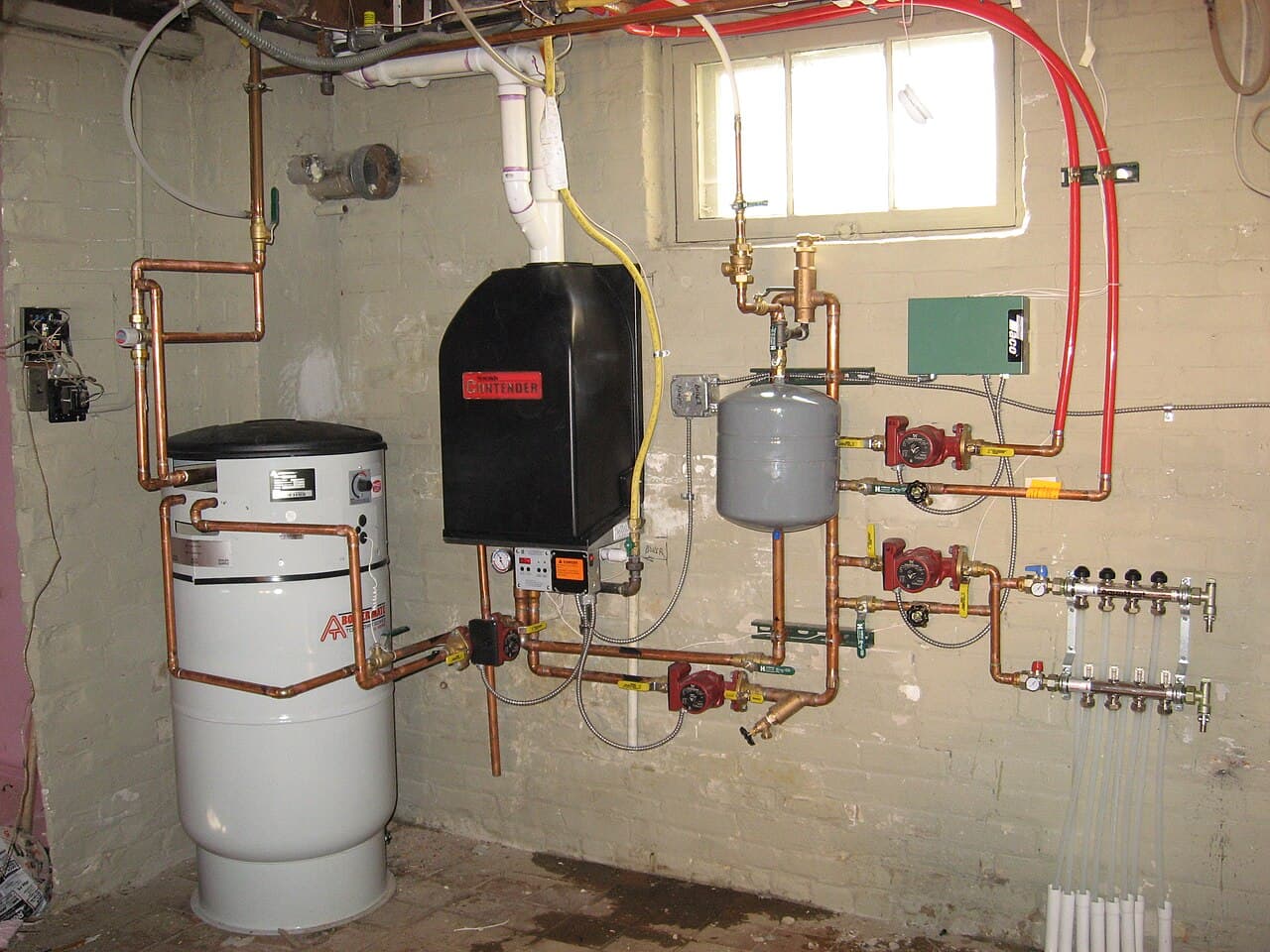
The technician: an HVAC or plumbing tradesman
Under the Code of Virginia, no individual may work as a tradesman unless licensed, and the Code defines a tradesman as someone who works for the public for pay in the electrical, plumbing or HVAC trades.[2][3] There is one allowance: someone working under the supervision of a tradesman licensed in that specialty does not need a licence of their own.[2] That is how apprentices learn, and it is why the licensed person should be the one responsible for your job.
Tradesman licences come at journeyman and master levels.[7] Since April 1, 2025, DPOR has also issued Residential HVAC Mechanic and Residential Plumbing licenses, which allow work in residential structures only.[7] Any of these can be right for a house; what matters is that the designation is HVAC or plumbing and the licence is current.
Gas fitters and the gas piping
A gas boiler sits where two trades meet: the boiler and its water side, and the gas piping that feeds it. Virginia draws the line carefully.
- Gas-fitter-only licences do not cover the boiler. The Code's definition of a liquefied petroleum gas fitter excludes "hot water heaters, boilers and central heating systems which require a heating, ventilation and air conditioning or plumbing certification".[3] The natural gas fitter provider licence likewise excludes new gas piping for boilers and central heating systems.[3]
- Gas piping is gas fitting work. The regulations describe a gas fitter as a tradesman who performs gas fitting-related work "usually within the HVAC or plumbing trades," including gas piping, vents and appliances.[1] A gas fitting designation can sit on the same tradesman licence as HVAC or plumbing, and DPOR requires continuing education for each designation a licence carries.[7]
The same split shows up in the company licences. Under the Board for Contractors' rules, HVAC contractors (HVA) are licensed for heating systems and boilers, and plumbing contractors (PLB) for boilers and hydronic systems, but both classifications exclude gas piping.[4] The gas fitting contracting (GFC) specialty covers the installation, repair, improvement, or removal of gas piping and appliances.[5] Meanwhile the liquefied petroleum gas (LPG) specialty excludes boilers that require an HVA or PLB license, and the natural gas fitting provider (NGF) specialty excludes new gas piping for them.[5]
In practice: a routine service call or a repair on the boiler is HVA or PLB work. If the job adds, moves or replaces gas piping, as a boiler replacement may, the company or a subcontractor also needs gas fitting credentials.
The company: a contractor licence
Virginia's contractor licence classes start with Class C, for a single contract worth over $1,000 but less than $30,000, and the Code adds that the Board requires a master tradesman license as a condition of licensure for HVAC and plumbing contractors.[6] On a quote for a boiler replacement, look for the company's licence number and an HVA or PLB classification, with GFC if gas piping is involved.
What the manufacturers say
Boiler makers agree with the law. Navien's manual for its NHB-H condensing boilers states: "Installation and service must be performed by a qualified installer, service agency or the gas supplier."[12] The owner's list in that manual is short and mostly a matter of looking: keeping the boiler area free of flammable materials, watching the pressure gauge and looking over the vent piping.[12] The rest goes to a qualified technician.
Permits and inspections
Two Virginia rules are worth knowing before a boiler is replaced.
No state boiler certificate for a house. Article 1 of Virginia's Boiler and Pressure Vessel Safety Act does not apply to boilers used in or on the property of private residences or apartment houses of less than four apartments.[9]
A building permit for a replacement. The Uniform Statewide Building Code requires a permit before work on mechanical systems, fuel supply systems or equipment regulated by the code,[10] and for emergency equipment replacement the application must be submitted by the end of the first working day after the work starts.[10] The code's permit exemption for replacing mechanical appliances in homes applies only for mechanical equipment that is not fueled by gas or oil,[10] so a gas boiler replacement is permitted work. The licensed contractor usually pulls the permit; ask whose name is on it.
Getting it in writing
For residential work, the Board for Contractors requires a written contract with, among other things, the total cost, the amounts and schedule for progress payments, and the contractor's name, address, license number, class of license and classifications or specialty services.[11] Routine maintenance or service contracts are excluded from that written-contract rule,[11] but asking for a written work order and price before a repair is still sensible.
When to call a licensed pro
Call a licensed HVAC or plumbing business, rather than trying a fix, when the boiler will not fire, the pressure gauge reads outside its normal range, the relief valve drips, water appears under the boiler, it shows an error code, or it is due for its yearly service. If you smell gas, Navien's instructions are not to light any appliance, not to touch any electrical switch or use any phone in the building, and to call your gas supplier from a neighbor's phone, or the fire department if you cannot reach the supplier.[12] Treat a sounding carbon monoxide alarm as an emergency too.
Before anyone starts, look up both the technician and the company on DPOR's License Lookup.[8] Check that the licence is active and that the designation or classification fits the work.
For what the yearly visit should include, read how often a boiler should be serviced. If you are pricing a replacement, see what a new boiler costs in Virginia, and for the licensing picture across heating and cooling, does an HVAC technician need a licence in Virginia.
Finding a licensed boiler technician
Loclis lists DPOR-licensed HVAC businesses with their licence number and class, and plumbing, HVAC, electrical and gas work on Loclis needs a licence at any job size. Look up HVAC businesses in Blacksburg, browse boilers and radiant heat, or read more heating and cooling answers.
Describe your boiler and what it is doing once and licensed local businesses send quotes.
Common questions
- Can a plumber service my gas boiler, or does it have to be an HVAC company?
- Either can be properly licensed for it. Virginia's regulations list boilers under both HVAC work and plumbing work, and the HVA and PLB contractor classifications both cover boilers. Neither classification includes gas piping, so new or altered gas lines need gas fitting credentials as well.
- Can the gas company service my boiler?
- Navien's manual says installation and service must be done by a qualified installer, a service agency or the gas supplier. Whether your gas utility offers appliance service is up to the utility, so ask, and if it sends a contractor, check that business's licence on DPOR's License Lookup.
- Does a home boiler need a state inspection certificate in Virginia?
- Not under the state boiler safety law. Article 1 of Virginia's Boiler and Pressure Vessel Safety Act does not apply to boilers in private residences or apartment houses of less than four apartments. A boiler replacement still needs a building permit and a local inspection under the Uniform Statewide Building Code.
- Can I service my own boiler?
- The tradesman licence rules apply to people working for the public for pay, but that does not make the work safe to do yourself, and a gas or oil boiler replacement still needs a permit. Navien's owner maintenance schedule for its boilers is mostly visual checks, such as watching the pressure gauge and looking over the vent piping, and it leaves the annual inspection and service to a qualified technician.
- What licence should I look for on a boiler company's quote?
- The company's DPOR contractor licence number with an HVA or PLB classification, plus GFC if the job includes gas piping. Virginia's Class C contractor licence covers jobs over $1,000, and the Board for Contractors' rules require the licence number, class and classifications in a residential written contract.
Sources
- [1] 18VAC50-30-10, Definitions (Individual License and Certification Regulations), Board for Contractors, Virginia Administrative Code. Checked October 26, 2026.
- [2] Va. Code § 54.1-1129, Necessity for licensure, Code of Virginia, Virginia General Assembly. Checked October 26, 2026.
- [3] Va. Code § 54.1-1128, Definitions, Code of Virginia, Virginia General Assembly. Checked October 26, 2026.
- [4] 18VAC50-22-20, Definitions of license classifications, Board for Contractors Regulations, Virginia Administrative Code. Checked October 26, 2026.
- [5] 18VAC50-22-30, Definitions of specialty services, Board for Contractors Regulations, Virginia Administrative Code. Checked October 26, 2026.
- [6] Va. Code § 54.1-1100, Definitions, Code of Virginia, Virginia General Assembly. Checked October 26, 2026.
- [7] Tradesmen, Virginia Department of Professional and Occupational Regulation. Checked October 26, 2026.
- [8] License Lookup, Virginia Department of Professional and Occupational Regulation. Checked October 26, 2026.
- [9] Va. Code § 40.1-51.8, Exemptions (Boiler and Pressure Vessel Safety Act), Code of Virginia, Virginia General Assembly. Checked October 26, 2026.
- [10] 13VAC5-63-80, Section 108 Application for permit, Virginia Uniform Statewide Building Code, Virginia Administrative Code. Checked October 26, 2026.
- [11] 18VAC50-22-260, Filing of charges; prohibited acts, Board for Contractors Regulations, Virginia Administrative Code. Checked October 26, 2026.
Want a pro to handle it?
Describe the job once. Licensed local businesses send quotes, and you pay only when you book one.
Get a quote for HVAC Repair