How much does a new boiler cost in Virginia?
There is no published Virginia price list for a new boiler; your number comes from written quotes after a contractor has seen the house. The price moves with the boiler type, its size from a heat-loss calculation, the number of zones, venting and gas piping changes, how you heat household water, and the permit. The federal tax credit for gas and oil boilers ended with 2025.
Free to ask. Local shops send quotes, and you pay only when you book one.
By Kasra Taheri, Founder, LoclisPublished
Researched and drafted with AI, then checked claim by claim against the sources listed below before it was published. Prices and rules change; the dates beside each source say when it was last checked.
This is a job for a licensed pro in Virginia
This page explains what the work involves, the permits, what a licensed pro does and what drives the cost. It does not give step-by-step instructions, because this work needs a licence, a permit or both, and doing it wrong can injure someone. Before you hire, check the licence on Virginia's DPOR record.
There is no published Virginia price list for a new boiler. Weil-McLain, for one, relies on independent heating professionals to install, maintain and troubleshoot its boilers,[2] and each of those businesses prices the job for the house in front of it. The real number comes from written quotes after a licensed contractor has looked at your house. What you can know in advance is what moves the price, and what a quote should spell out so you can compare two of them.
What drives the price
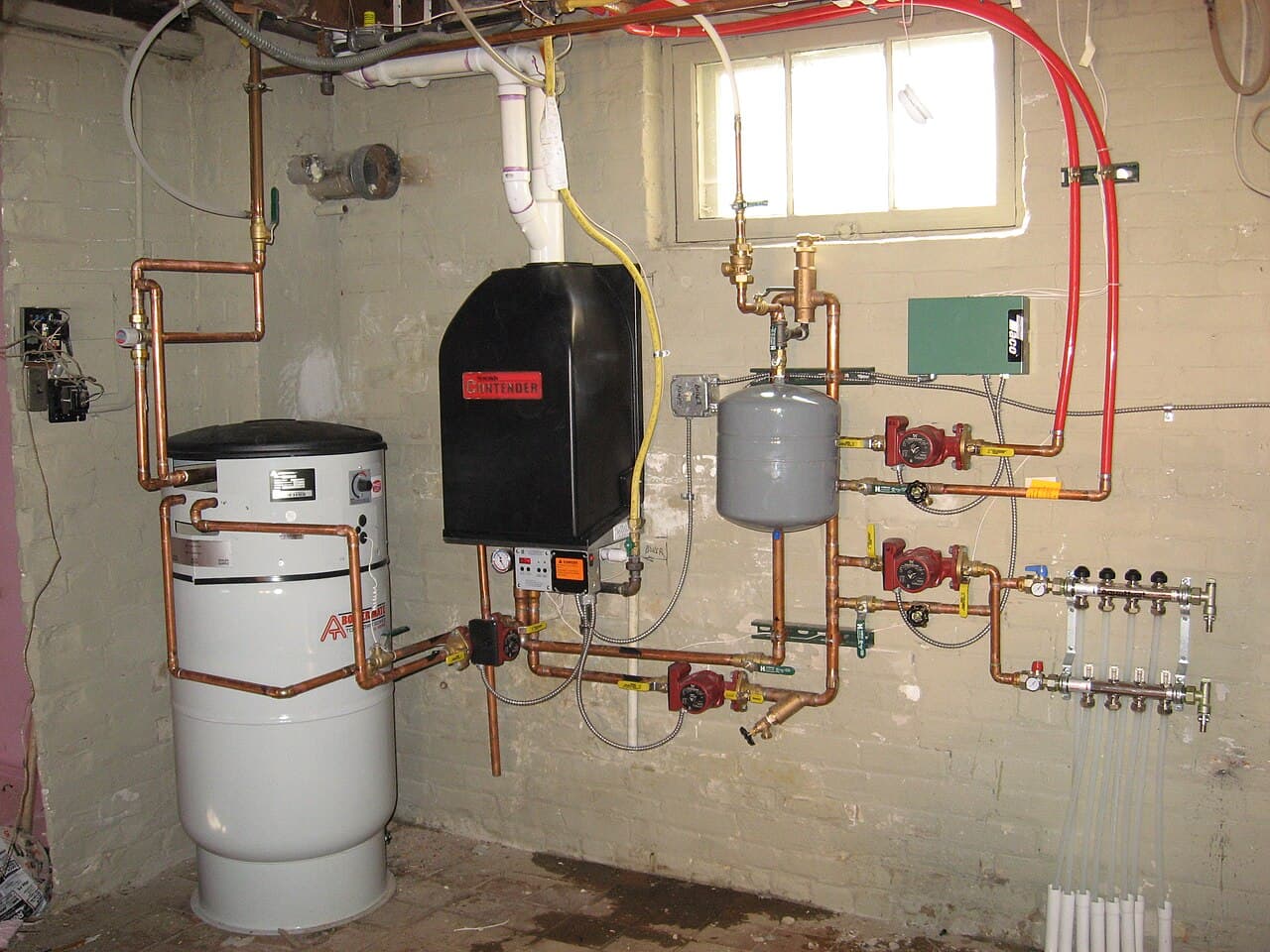
Navien sums up the installation side: installation costs can vary based on the home and boiler size, number of zones, and how much work needs to be done for gas piping and venting.[1] Taking those one at a time:
Condensing or conventional. The two types install differently. A non-condensing boiler must be vented through a proper chimney or flue because its exhaust is extremely hot.[1] A condensing boiler can be vented in PVC or polypropylene, but it needs a drain line for its acidic condensate.[1] Swapping an old cast-iron boiler for a condensing one therefore often adds new vent piping, a condensate drain and sometimes repiping near the boiler. Replacing like with like on an existing chimney can be simpler, but ask the contractor to confirm the chimney is suitable.
Size. A boiler should match the house, not the old boiler's label. Weil-McLain's advice: "Your local heating professional should perform a heat-loss estimate based upon the size and construction of your home before recommending a boiler size and model."[2] ENERGY STAR adds that a contractor should size the system based on the size of the house, its insulation and its windows.[4] An oversized boiler costs more to buy and can short cycle once it is in.
Zones and the rest of the system. Each heating zone has its own thermostat and a pump or valve. A quote may also include a new expansion tank, circulators, air separator or controls. If the radiators or baseboard stay, the cost is mostly in the boiler room; adding radiant floors or new emitters is a bigger job.
Household hot water. Some boilers heat a separate indirect tank. Others, called combi boilers, heat household water as well as the house, so there is no separate water heater. Whether that saves money depends on how much hot water the house uses and what is being replaced.
Fuel and gas piping. Moving the boiler, changing fuel or upsizing the gas line adds gas fitting work. An oil-to-gas conversion also involves the oil tank and the gas utility's service.
The permit. The Uniform Statewide Building Code requires a permit for work on mechanical systems and fuel supply systems,[5] and its exemption for replacing mechanical appliances in homes applies only for equipment that is not fueled by gas or oil.[5] Fees are local. As one example, Spotsylvania County's mechanical permit packet, updated in August 2025, prices a residential trade permit at $100 per trade plus a 2% building surcharge and a $45 processing fee, $147.00 in all,[6] and adds a 2.70% convenience fee when the permit is paid by debit or credit card.[6] Your county or city will charge its own amount.
Efficiency and running costs
The purchase price is only part of the cost. Navien notes that traditional boilers have an AFUE of up to 80%, so up to 20% of the fuel is lost, while its condensing gas boilers reach up to 95% AFUE.[1] ENERGY STAR certified gas boilers are rated 90% AFUE or greater and oil boilers 87% or greater.[3]
Navien gives both condensing and non-condensing boilers a service life of around 15 to 20 years,[1] so a boiler near that age with repeated repairs is usually the point to start getting replacement quotes, before it fails in January. To see how the parts fit together, read how a hot water boiler heating system works.
Tax credits and rebates
The federal credit many articles still mention is over. The IRS says the Energy Efficient Home Improvement Credit covered improvements made through December 31, 2025,[7] and it had listed natural gas, propane, or oil furnaces and hot water boilers among the qualifying equipment.[7]
Virginia Energy runs two Home Energy Rebate programs,[8] and one of them, the High Efficiency Appliance Rebates, does not cover a fuel-burning boiler. Virginia Energy states: "Under current DOE program guidance, High Efficiency Appliance Rebates cannot be used to help pay for replacement of a non-electric appliance."[8] It also says Virginia Energy cannot provide an estimated date on when Home Energy Rebates will be available,[8] and warns against contractors who promise eligibility for the rebates before the program launches.[8] Utility programmes change from year to year, so ask your gas and electric companies before you sign.
What to ask for in a written quote
ENERGY STAR's advice when comparing bids is to be sure to compare cost, energy efficiency and warranties,[4] and it cautions that the lowest price may not be the best deal if it is not the most efficient, because your energy costs will be higher.[4]
A quote you can compare line by line names:
- the boiler's brand, model, input and output ratings and AFUE, and how the contractor sized it;
- whether it is condensing, and the venting and condensate drain work that comes with it;
- any gas piping, expansion tank, pump, zone valve or control changes, priced separately;
- how household hot water will be made, and the cost of any indirect tank or combi unit;
- the permit, the inspection and removal of the old boiler;
- the manufacturer's warranty, the contractor's labour warranty, and who registers the equipment.
For residential jobs, Virginia's Board for Contractors requires the written contract to state, among other things, the amounts and schedule for progress payments, including a specific statement on the amount of the down payment,[9] and a statement that the contractor will comply with all local requirements for building permits and inspections.[9] Be wary of a large deposit before the equipment is ordered.
When to call a licensed pro
A contractor you pay to replace a boiler must be licensed. Under the Code of Virginia, no individual may work as a tradesman unless licensed,[11] and a tradesman is anyone who works for the general public for compensation in the plumbing or HVAC trades.[10] The job also needs a permit, as described above, and it covers gas or oil piping, water piping, wiring and venting, so it belongs with a licensed business. Check each business on DPOR's License Lookup[12] before you compare its price; a lower quote from an unlicensed installer is not the same job. For the licences that apply, see who can service a gas boiler in Virginia.
Get two or three quotes while the old boiler still runs, so you are not pricing a replacement in an emergency. Keeping the current one serviced buys time; see how often a boiler should be serviced.
Getting quotes in Virginia
Loclis lists DPOR-licensed HVAC businesses with their licence number and class. Browse boilers and radiant heat, look up HVAC businesses in Blacksburg, or read more heating and cooling answers.
Describe your boiler and house once and licensed local businesses send written quotes.
Common questions
- Why don't you give a price range for a new boiler?
- Because the installed price depends on your house more than on the boiler. The boiler type and size, whether the venting or chimney has to change, the gas piping, the number of zones, how hard the old unit is to remove and the permit all move the total. Two or three itemized written quotes for the same scope are the reliable way to get your number.
- Is a condensing boiler worth the extra cost?
- It usually burns less fuel. Navien says traditional boilers have an AFUE of up to 80%, while its condensing models reach up to 95%. Over a boiler's long life, that difference shows up on every fuel bill. A condensing boiler also needs a condensate drain and usually new vent piping, so ask each contractor to price both options.
- Can I still get a tax credit for a new gas boiler?
- Not for one installed now. The IRS says the Energy Efficient Home Improvement Credit covered improvements made through December 31, 2025. Ask your gas or electric utility about any current programme before you sign.
- Do Virginia's High Efficiency Appliance Rebates cover boilers?
- Not gas, propane or oil boilers. Virginia Energy says that under current federal guidance those rebates cannot pay for replacing a non-electric appliance, and it cannot yet say when the Home Energy Rebates will be available.
- How much is the permit for a boiler replacement?
- Each county or city sets its own fee. As one example, Spotsylvania County's packet, updated in August 2025, prices a residential trade permit at $147.00, with a 2.70% fee for card payments. Ask whether the quote includes the permit.
Sources
- [2] Boiler FAQs & Common Questions, Weil-McLain. Checked October 26, 2026.
- [3] Boilers, ENERGY STAR, U.S. Environmental Protection Agency. Checked October 26, 2026.
- [4] 10 Tips for Hiring a Heating and Cooling Contractor, ENERGY STAR, U.S. Environmental Protection Agency. Checked October 26, 2026.
- [5] 13VAC5-63-80, Section 108 Application for permit, Virginia Uniform Statewide Building Code, Virginia Administrative Code. Checked October 26, 2026.
- [6] Mechanical (HVAC Only) Application Packet, Spotsylvania County, Virginia. Checked October 26, 2026.
- [7] Energy Efficient Home Improvement Credit, Internal Revenue Service. Checked October 26, 2026.
- [8] Consumer Energy Rebates Frequently Asked Questions, Virginia Department of Energy. Checked October 26, 2026.
- [9] 18VAC50-22-260, Filing of charges; prohibited acts, Board for Contractors Regulations, Virginia Administrative Code. Checked October 26, 2026.
- [10] Va. Code § 54.1-1128, Definitions, Code of Virginia, Virginia General Assembly. Checked October 26, 2026.
- [11] Va. Code § 54.1-1129, Necessity for licensure, Code of Virginia, Virginia General Assembly. Checked October 26, 2026.
- [12] License Lookup, Virginia Department of Professional and Occupational Regulation. Checked October 26, 2026.
Want a pro to handle it?
Describe the job once. Licensed local businesses send quotes, and you pay only when you book one.
Get a quote for HVAC Repair