Why is my boiler losing pressure?
A hot water boiler that keeps losing pressure is usually losing water. The common causes are a leak in the piping, a radiator valve or the boiler itself, a relief valve that opens because a failed or undersized expansion tank lets pressure spike when the water heats, or a leaking air vent. Note the gauge readings and any water you see, and have a licensed technician find the cause.
Free to ask. Local shops send quotes, and you pay only when you book one.
By Kasra Taheri, Founder, LoclisPublished
Researched and drafted with AI, then checked claim by claim against the sources listed below before it was published. Prices and rules change; the dates beside each source say when it was last checked.
This is a job for a licensed pro in Virginia
This page explains what the work involves, the permits, what a licensed pro does and what drives the cost. It does not give step-by-step instructions, because this work needs a licence, a permit or both, and doing it wrong can injure someone. Before you hire, check the licence on Virginia's DPOR record.
A hot water heating system is a sealed loop, so a boiler that keeps losing pressure is usually losing water, or getting rid of air it should not have had. The water is going somewhere: through a leak, out of the relief valve, or out of an air vent. Finding which one is the technician's job, but knowing the usual suspects helps you describe what you are seeing.
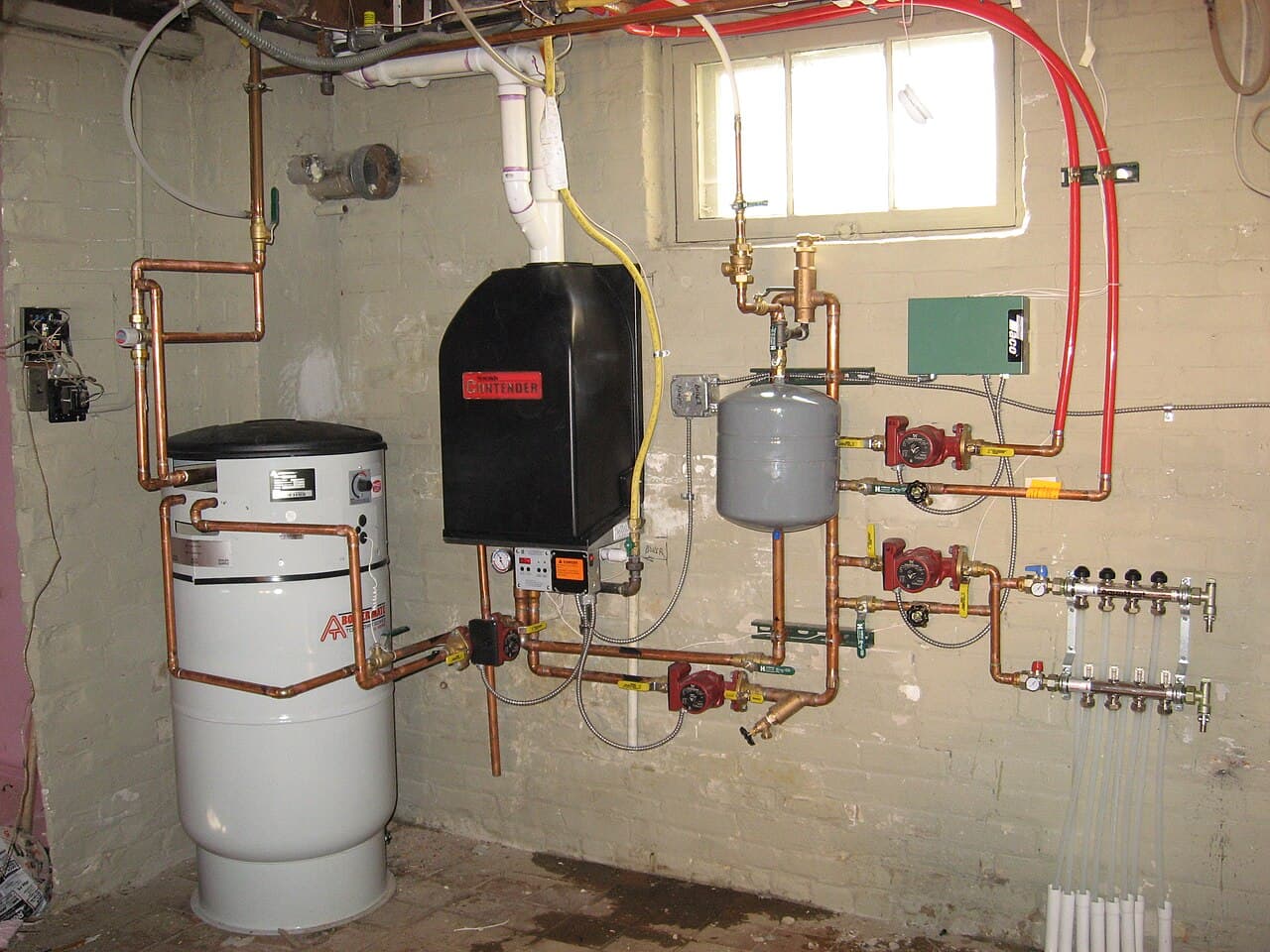
How pressure works in a boiler system
Water expands when it heats. The expansion tank, usually a small tank on the pipes near the boiler, absorbs it. As Navien puts it, "Expansion tanks provide space for water to move in and out as the heating system water expands due to temperature increase or contracts as the water cools."[1] So the gauge normally reads somewhat higher when the system is hot than when it is cold. A slow, steady fall over days or weeks, or a sharp swing every heating cycle, is the sign of a problem.
The usual causes
1. A leak in the system. The most common cause. Water can escape at a radiator or baseboard valve, a fitting, a pump flange, a pipe joint, or the boiler's own heat exchanger. Small leaks often evaporate off hot pipes before they drip, leaving only a white crust or rust stain. A leak can also be out of sight, under a floor or inside a wall. Weil-McLain's advice for a leaking boiler is to contact your installer or a professional heating contractor,[3] and it notes that if the leaking part is under warranty, a heating professional may submit a warranty claim on your behalf.[3]
2. A relief valve that keeps opening. The relief valve opens to dump water when the pressure gets too high. If it opens every time the boiler heats up, the system loses a little water each cycle and the cold pressure creeps down. Navien's service instructions say that when a relief valve weeps, the technician should make sure the cause is the valve and not over-pressurization of the system due to expansion tank waterlogging or undersizing.[1] They add: "Excessive pressure rise indicates expansion tank sizing or performance problem."[1] A tank that has lost its air charge or is too small for the system is a classic hidden cause of pressure loss.
3. A relief valve that is failing. Sometimes the valve itself is the problem: debris or mineral deposits keep it from closing fully. In that case a relief valve that weeps or will not seat properly is replaced,[1] by a technician who has first ruled out high system pressure.
4. Air vents and air in the system. Boilers have automatic air vents to let air out. A vent that sticks open lets water out too. At service, automatic air vents and air separators are inspected, and any leaking vents are replaced.[1] Trapped air causes its own trouble: air in a boiler system can cause overheating or stop the pumps from circulating water.[2] Pressure often dips for a while after a system has been drained, refilled or worked on, as the last of the air works its way out.

Why a slow leak still matters
It is tempting to keep topping the system up. Navien warns against living with it: "Continual fresh makeup water will reduce boiler life."[1] Its manual explains that minerals can build up in the heat exchanger, reduce heat transfer, overheat it and cause it to fail, and that leaking water may also cause severe property damage.[1] Many systems refill themselves automatically, so the gauge may look steady while fresh water quietly flows in to replace what is leaking out.
What the gauge readings mean
The right pressure depends on the boiler and on how tall the house is, and the installer sets it. For its NHB-H boilers, Navien says the cold fill pressure must be a minimum of 6 psi,[1] and at service the technician watches the pressure as the boiler heats up to make sure it does not rise too high.[1] Some boilers display the pressure and raise a code when it is out of range; Navien's NHB-H uses E302 for low water pressure and E352 for high water pressure.[1]
What you can usefully do is observe and write down:
- the gauge reading with the system cold (first thing in the morning) and hot (after it has run a while), over a few days;
- any error code on the boiler's display;
- any water, crust or rust under the boiler, at radiator and baseboard valves, on pipes or on ceilings below them;
- whether there is water at the end of the relief valve's discharge pipe, or a wet spot under it.
Navien's owner schedule includes checking the pressure and temperature gauge daily for signs of higher than normal pressure.[1] Those notes let a technician go straight to the likely cause.
Stop using the boiler and call now if
- the pressure is at or near zero; Navien's warning is "Ensure that the boiler is filled with water before turning it on."[1]
- the gauge is climbing toward the relief valve's rating, or the valve is discharging; Navien warns that corrosion can leave a relief valve inoperative, and failure to re-inspect the boiler relief valve as directed could result in unsafe pressure buildup, which can result in severe personal injury, death, or substantial property damage[1]
- water is reaching the boiler's controls or any wiring;
- the boiler or its controls have been flooded: Navien says do not use the boiler if any part of it has been under water, and call a qualified service technician.[1]
Keep clear of the relief valve's discharge pipe. Navien notes that when the valve opens it discharges hot water, and it should be piped so the discharge goes to a safe place to avoid scalding.[1] Never cap or plug it.
When to call a licensed pro
Pressure problems are diagnosed with the system open: testing the expansion tank, checking the relief valve, tracing leaks and checking the fill valve. Navien says only a limited amount of troubleshooting can be done with a homeowner, because the product involves water, electricity and gas.[2] Virginia's tradesman regulations define "HVAC work" as work that includes the installation, alteration, repair, or maintenance of "steam and hot water heating systems, boilers",[4] and under the Code of Virginia no individual may work as a tradesman unless licensed.[5]
Check a business on DPOR's License Lookup[6] and see who can service a gas boiler in Virginia. A yearly service catches many of these faults early; read how often a boiler should be serviced, and for the parts involved, how a hot water boiler heating system works.
Finding a boiler technician
Loclis lists DPOR-licensed HVAC businesses with their licence number and class. Look up HVAC businesses in Blacksburg, browse boiler repair, or read more heating and cooling answers.
Describe the pressure readings and what you have seen once and licensed local businesses send quotes.
Common questions
- Is it normal for boiler pressure to go up and down?
- Some movement is normal: water expands as it heats, so the gauge reads higher when the system is hot than when it is cold. What is not normal is a pressure that keeps falling over days, or one that climbs high every time the boiler runs. Navien says an excessive pressure rise indicates an expansion tank sizing or performance problem.
- What pressure should my boiler be at?
- It depends on the boiler and the height of the house, and your installer sets it. For its NHB-H boilers, Navien says the cold fill pressure must be a minimum of 6 psi. Check your own boiler's manual or ask the technician to note the normal cold and hot readings on the boiler.
- Why is water coming out of the pipe on the side of my boiler?
- That pipe is usually the relief valve's discharge line. Water there means the valve is opening, either because system pressure is too high, often from a waterlogged or undersized expansion tank, or because the valve itself is failing. Both need a technician; never cap or plug that pipe.
- Can I keep refilling the boiler instead of fixing the leak?
- It is a bad trade. Navien warns that continual fresh makeup water will reduce boiler life, because each refill brings in minerals that build up in the heat exchanger and can make it fail. Topping up hides the symptom while the leak gets worse.
- Will the boiler warranty cover a leak?
- Sometimes. Weil-McLain says that if the leaking part is under warranty, a heating professional may submit a warranty claim on your behalf. Have the boiler's model and serial number ready when you call.
Sources
- [3] Boiler FAQs & Common Questions, Weil-McLain. Checked October 26, 2026.
- [4] 18VAC50-30-10, Definitions (Individual License and Certification Regulations), Board for Contractors, Virginia Administrative Code. Checked October 26, 2026.
- [5] Va. Code § 54.1-1129, Necessity for licensure, Code of Virginia, Virginia General Assembly. Checked October 26, 2026.
- [6] License Lookup, Virginia Department of Professional and Occupational Regulation. Checked October 26, 2026.
Want a pro to handle it?
Describe the job once. Licensed local businesses send quotes, and you pay only when you book one.
Get a quote for HVAC Repair