How often should a boiler be serviced?
Once a year, ideally in early fall before the heating season. Navien says all residential boilers should be inspected and serviced annually by a professional, and the EPA and U.S. Fire Administration both call for a yearly professional inspection of heating equipment. Between visits, keep the area clear, watch the pressure gauge and vent pipe, and call sooner if anything changes.
Free to ask. Local shops send quotes, and you pay only when you book one.
By Kasra Taheri, Founder, LoclisPublished
Researched and drafted with AI, then checked claim by claim against the sources listed below before it was published. Prices and rules change; the dates beside each source say when it was last checked.
This is a job for a licensed pro in Virginia
This page explains what the work involves, the permits, what a licensed pro does and what drives the cost. It does not give step-by-step instructions, because this work needs a licence, a permit or both, and doing it wrong can injure someone. Before you hire, check the licence on Virginia's DPOR record.
Have a boiler serviced once a year, before the heating season starts. Navien puts it plainly: "All residential boilers should be inspected and serviced annually by a professional."[1] It adds that condensing and non-condensing boilers alike should have the heat exchanger flushed once a year or as determined by combustion efficiency.[1] Its owner's manual says a qualified technician should inspect the boiler at the beginning of every heating season and when there is a problem.[2]
The federal safety agencies say the same about heating equipment in general. The EPA advises that you have a trained professional inspect, clean and tune up central heating systems, including flues and chimneys, every year.[5] The U.S. Fire Administration says to have heating equipment and chimneys cleaned and inspected each year by a professional.[6]
When to book it
ENERGY STAR's advice is to check the heating system in the fall, because contractors get busy once winter comes.[4] In most of Virginia that means booking in September or October, so a problem found at the service visit can be fixed before you need the heat. If your boiler also makes your hot water, it runs all year and the timing matters less than not skipping a year.
What a yearly boiler service covers
A proper service is more than a look and a signature. ENERGY STAR's checklist for fuel-burning heating has the technician check all gas (or oil) connections, gas pressure, burner combustion and the heat exchanger.[4] The reason: improperly operating gas or oil connections are a fire hazard and can contribute to health problems, and a dirty burner or cracked heat exchanger makes the equipment run less safely and efficiently.[4]
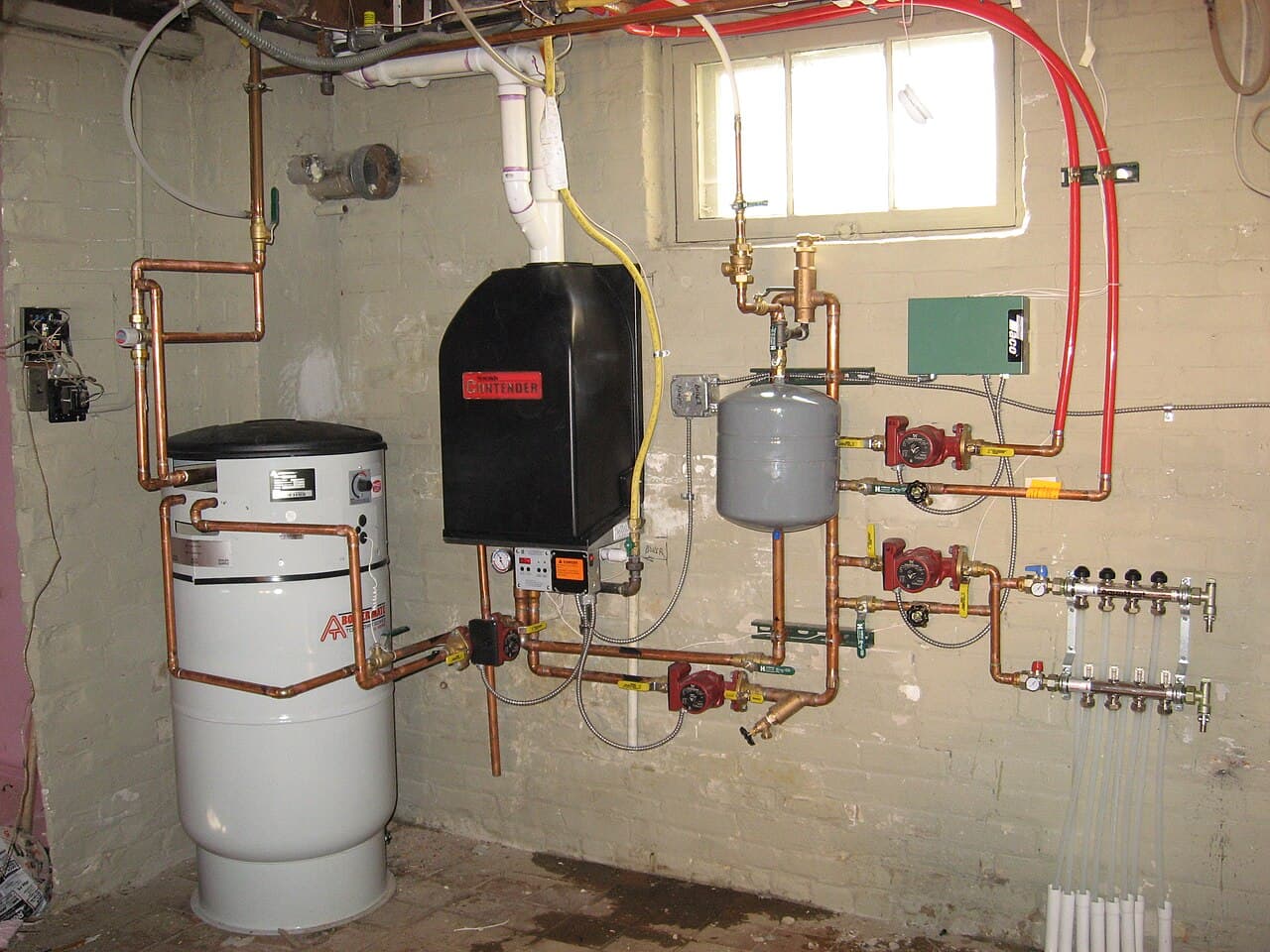
Navien's annual start-up list for its NHB-H condensing boilers shows what that means for a boiler. It includes dealing with any problems the owner has reported; inspecting and cleaning the inside of the cabinet; cleaning the condensate trap and refilling it with fresh water; checking for water, gas, flue and condensate leaks; confirming the flue and air pipes are sound and sealed; checking the system water pressure, piping and expansion tank; checking the control settings, ignition, flame sensor and wiring; and inspecting the flame.[2] If combustion or performance show a need, the technician also flushes the heat exchanger and cleans the air intake filter.[2]
Other items come up depending on the boiler:
- Water quality. Navien says boiler water quality should be verified and heat exchangers flushed as necessary.[3] Its units have screens on the water connections and an air screen below the air intake that keep debris out.[3]
- The relief valve. Navien's manual says relief valves should be inspected at least once every three years by a licensed plumbing contractor or authorized inspection agency,[2] and that inspection of the valve's internal parts must be done by a plumbing contractor or authorized inspection agency, not by the owner.[2]
- Combustion readings. On a gas or oil boiler, ask whether the technician measures combustion with an analyser and writes the readings down, so next year's visit has something to compare against.
Navien also notes that the frequency of this maintenance varies with the installation, location, application and operation of the unit,[3] so a boiler in a dusty basement or on hard water may need more attention than once a year.
Ask for a written service report each time: what was checked, the pressure and combustion readings, and anything the technician recommends. It is your record for the warranty and for the next technician.
What you can watch between visits
Navien's owner schedule for its NHB-H boilers is a set of things to look at, not to take apart:
- Daily: the boiler area is free of combustible and flammable materials, and the pressure and temperature gauge shows no sign of higher-than-normal pressure.[2]
- Monthly: the vent piping shows no leaks or blockage, the burner flame looks normal through the window, and the condensate trap and PVC fittings look sound.[2]
- Every six months: the gas and water piping shows no leaks.[2]
Leaks matter more than they look. Navien warns: "Continual fresh makeup water will reduce boiler life."[2] Every time the system tops itself up with fresh water it brings in new minerals, and minerals can build up, overheat the heat exchanger and cause it to fail.[2] If you live with hard water, Navien adds that a scale prevention system can extend a boiler's service life by preventing lime and calcium deposits.[1] If your pressure keeps dropping, read why a boiler loses pressure.
Why skipping a year is a false saving
The EPA lists worn or poorly adjusted and maintained boilers and furnaces[5] among the sources of carbon monoxide in homes. A yearly visit is when a cracked heat exchanger, a blocked condensate line or a corroded vent joint gets caught. Keep working CO alarms too: as the EPA notes, the CPSC recommends that every home have carbon monoxide alarms on each level outside each sleeping area.[5]
Many HVAC companies sell yearly service agreements that schedule the visit for you. Whether one pays off depends on what it includes; see are HVAC maintenance plans worth it. For the rest of the house, read how to keep a heating system from failing in winter.
When to call a licensed pro
The yearly service itself is a job for a licensed technician. Weil-McLain highly recommends using a heating professional to change any parts or perform any kind of maintenance service,[7] and Virginia's tradesman regulations define "HVAC work" as work that includes the installation, alteration, repair, or maintenance of "steam and hot water heating systems, boilers".[8] Under the Code of Virginia, no individual may work as a tradesman unless licensed.[9]
Book a visit sooner than the annual one if the pressure gauge moves outside its usual range, the relief valve drips, you see water or rust under the boiler, it shows an error code, or rooms stop heating evenly. If you smell gas, Navien's manual says not to light any appliance, not to touch any electrical switch or use any phone in the building, and to call your gas supplier from a neighbor's phone.[2] Treat a sounding CO alarm as an emergency too.
Check any business on DPOR's License Lookup[10] before booking, and see who can service a gas boiler in Virginia for which licences apply.
Booking a boiler service
Loclis lists DPOR-licensed HVAC businesses with their licence number and class. Browse boilers and radiant heat, look up HVAC businesses in Blacksburg, or read more heating and cooling answers.
Ask for a boiler service once and licensed local businesses send quotes.
Common questions
- Does a new boiler need servicing every year too?
- Yes. Navien's advice is that all residential boilers should be inspected and serviced annually by a professional, and its manual asks for a qualified technician at the start of every heating season. Keep the service records with the boiler's paperwork.
- What time of year should I book boiler service?
- Early fall. ENERGY STAR advises checking the heating system in the fall because contractors get busy once winter comes. In Virginia that usually means September or October, before the first cold snap.
- Do condensing and non-condensing boilers need different maintenance?
- Both need a yearly professional service. A condensing boiler adds a condensate trap and drain that the technician cleans and checks, and plastic vent piping to inspect. Navien says both types should have the heat exchanger flushed once a year or as determined by combustion efficiency.
- Should the boiler be shut off in summer?
- Navien's manual says to shut the boiler down outside the heating season unless it also makes your household hot water. Ask your technician to show you the correct shutdown and start-up for your model at the annual visit.
- How often should the relief valve be checked?
- Navien's manual calls for relief valves to be inspected at least once every three years by a licensed plumbing contractor or an authorized inspection agency, and notes that internal inspection is not an owner's job. Ask for it as part of the yearly service when it is due.
Sources
- [4] Maintenance Checklist, ENERGY STAR, U.S. Environmental Protection Agency. Checked October 26, 2026.
- [5] Carbon Monoxide's Impact on Indoor Air Quality, U.S. Environmental Protection Agency. Checked October 26, 2026.
- [6] Heating Fire Safety, U.S. Fire Administration, FEMA. Checked October 26, 2026.
- [7] Boiler FAQs & Common Questions, Weil-McLain. Checked October 26, 2026.
- [8] 18VAC50-30-10, Definitions (Individual License and Certification Regulations), Board for Contractors, Virginia Administrative Code. Checked October 26, 2026.
- [9] Va. Code § 54.1-1129, Necessity for licensure, Code of Virginia, Virginia General Assembly. Checked October 26, 2026.
- [10] License Lookup, Virginia Department of Professional and Occupational Regulation. Checked October 26, 2026.
Want a pro to handle it?
Describe the job once. Licensed local businesses send quotes, and you pay only when you book one.
Get a quote for HVAC Repair