How does a tankless water heater work?
A tankless water heater has no tank to keep hot. When you open a hot tap, a flow sensor switches on a gas burner or electric element, and the water is heated as it passes through a heat exchanger, then leaves at the set temperature. It stops when the tap closes. It is sized by gallons per minute, not tank gallons.
Free to ask. Local shops send quotes, and you pay only when you book one.
By Kasra Taheri, Founder, LoclisPublished
Researched and drafted with AI, then checked claim by claim against the sources listed below before it was published. Prices and rules change; the dates beside each source say when it was last checked.
This is a job for a licensed pro in Virginia
This page explains what the work involves, the permits, what a licensed pro does and what drives the cost. It does not give step-by-step instructions, because this work needs a licence, a permit or both, and doing it wrong can injure someone. Before you hire, check the licence on Virginia's DPOR record.
A tankless water heater heats water only while it is flowing. There is no tank of hot water waiting in the basement. Open a hot tap and the heater fires; close it and the heater stops. The trade-off is that it can heat only so many gallons a minute, so it is sized to your busiest moment rather than by tank gallons.
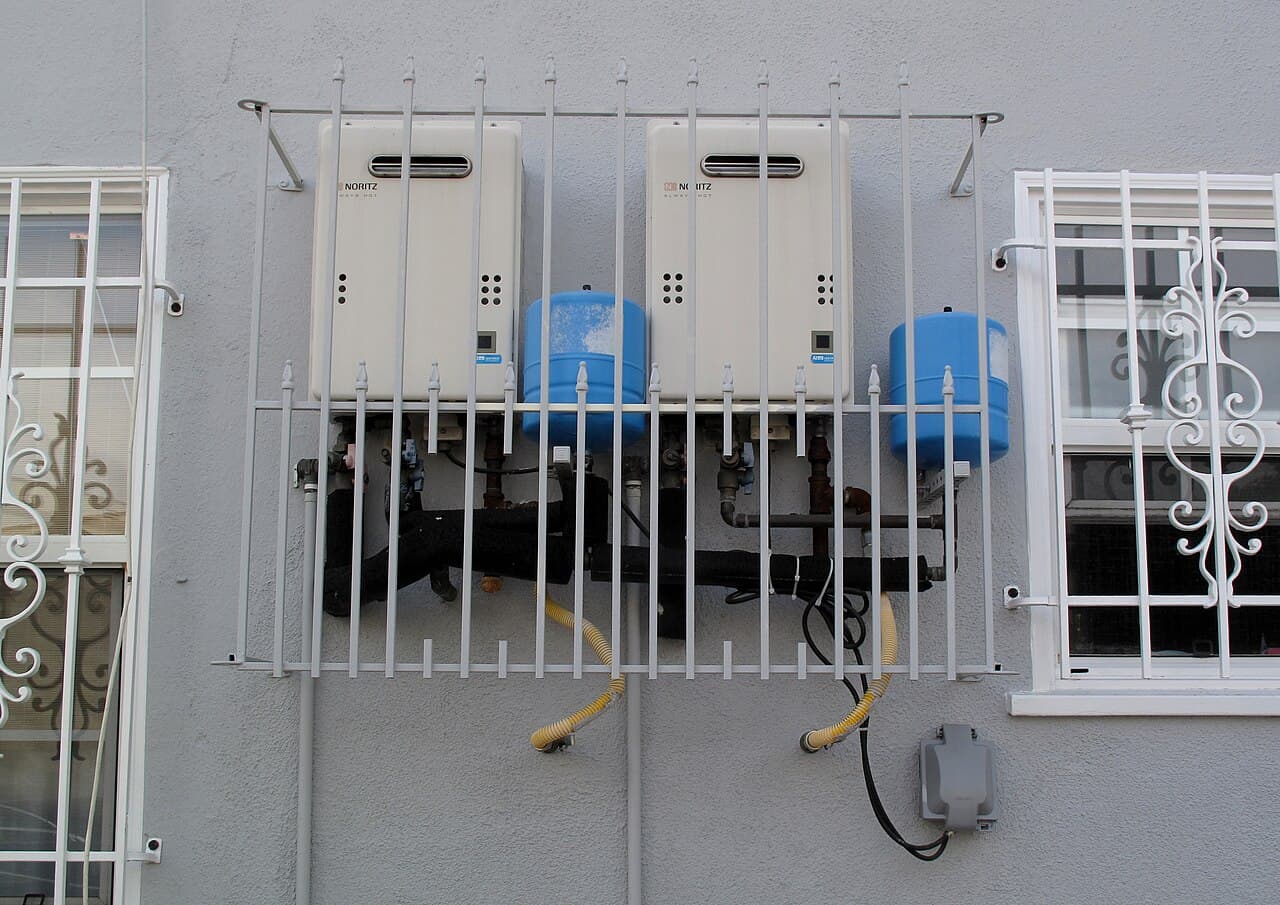
What happens when you open a hot tap
ENERGY STAR describes the sequence for a gas unit: "When a hot water tap is turned on in the home, cold water is drawn into the water heater. A flow sensor activates the gas burner, which warms the heat exchanger."[1] From there the water circles the heat exchanger and leaves at the temperature the heater is set to, while combustion gases go out through a dedicated, sealed vent.[1] The Department of Energy's Building America guide adds the other half: when the flow stops, the heater shuts off.[5]
An electric model works the same way with a heating element in place of the burner.[3]
Why it uses less energy than a tank
A tank heater keeps its whole tank hot around the clock, and heat leaks out between uses. Most of a tank heater's day is spent just keeping stored water hot. That standby time can account for 96% of a storage heater's operating time each day.[3]
How much a tankless heater saves depends on how much hot water you use. The Department of Energy's Energy Saver guide says that for homes that use 41 gallons or less of hot water a day, gas on-demand heaters can be 24% to 34% more energy efficient than conventional storage tank heaters, and 8% to 14% more efficient in homes that use around 86 gallons a day.[4] Our answer on whether a tankless heater is worth it weighs that against the higher installed cost.
Gallons per minute, not tank gallons
Where a tank is sized by how much it holds, tankless models are rated by how many gallons of hot water they produce per minute (GPM).[2] To size one, a plumber adds up the hot water your household runs at the same time. ENERGY STAR's average figures are 2.5 GPM for a shower or bathtub, 3.3 GPM for a clothes washer, 2.2 GPM for a kitchen or bathroom sink and 1.3 GPM for a dishwasher.[2]
The second number is the temperature rise: how many degrees the heater has to add to the incoming water. A heater set to 120°F with 50°F water coming in has a temperature rise of 70°F.[6] The colder the water coming in, the fewer gallons a minute the same heater can deliver at that setting. ENERGY STAR notes that output capacity partly depends on the groundwater temperature, so colder climates generally need higher-capacity heaters.[3] In Virginia that usually means sizing for winter, when the water coming in from the main or the well is coldest.
That is the real limit on "endless" hot water. The Building America guide gives the example: if people try to take two showers, start laundry and wash dishes at once, the hot water may not be as hot as they want.[5] If you tend to use hot water in several places at the same time, you may need two or more tankless water heaters to keep up.[4]
The minimum flow that switches it on
A tankless heater needs enough water moving through it to know a tap is open. Noritz says: "Most units have a minimum flow rate activation of .5 gallons per minute (gpm)."[7] Rinnai's gas models need at least 0.4 to 0.6 gallons per minute through the hot side to ignite and 0.26 gallons per minute to keep running.[8] A trickle of hot water at a bathroom sink may not be enough, and that threshold explains most cases of water going cold in the middle of a shower.
Gas and electric models
Heating water on the fly takes a lot of power at once. The Building America guide compares them: "Typical burners for residential tank-type water heaters are often 30,000 – 50,000 Btu/h while tankless water heaters typically have burner capacities of 120,000 – 200,000 Btu/h."[5] That is why the gas supply matters: a tankless heater might need a ¾-inch branch gas line where many tank heaters need only ½-inch piping.[5] Even natural gas units need a 120-volt outlet for their controls, sensors and electric spark ignition,[5] so they stop in a power outage.
Gas units come in two kinds. ENERGY STAR explains the more efficient one: "An ENERGY STAR certified gas tankless water heater uses a secondary heat exchanger to use 9 percent less energy than a conventional gas tankless water heater."[1] Pulling that extra heat out cools the exhaust until it condenses, so these condensing models need venting through a vertical PVC pipe and a condensate drain.[1]
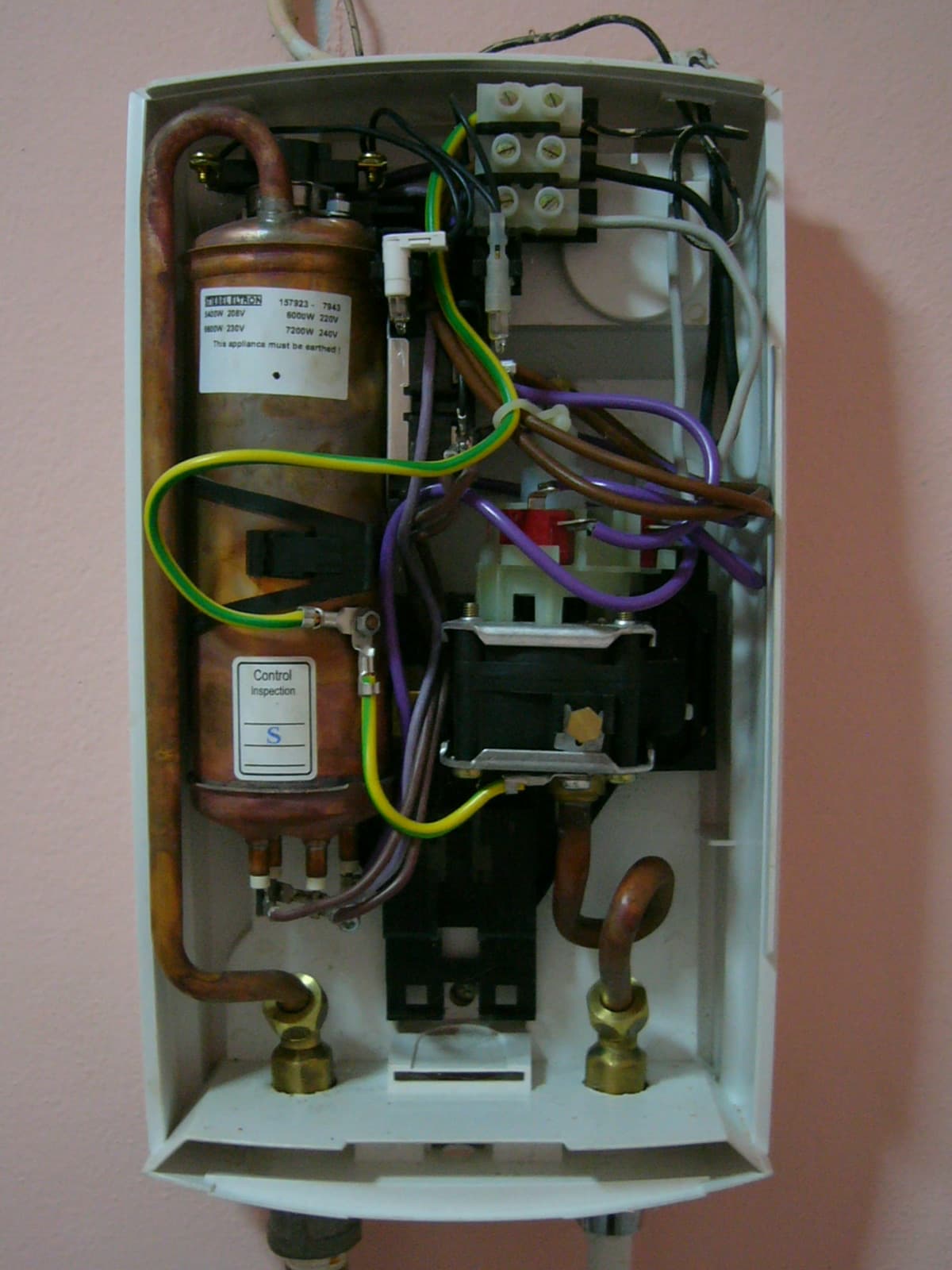
Electric tankless heaters skip the gas line and the vent, but the Building America guide notes that electric versions provide less hot water flow than gas-fired units and can create high peak loads for electric utilities.[5] The Energy Saver guide adds that electric storage tank and electric tankless water heaters are not ENERGY STAR eligible because they are already highly efficient.[4] For a fixture far from the main heater, a small point-of-use unit like the one above can be installed near the fixture.[3]
What a tankless heater does not change
It does not make hot water arrive instantly. ENERGY STAR's bulletin explains that a large amount of hot water can sit in the pipe between the heater and a distant fixture, cool down, and run down the drain while you wait.[3] Some systems add a recirculation pump to keep the line warm, but the Building America guide points out a catch: a recirculation pump that shuts off once the pipes are hot also shuts the burner down, so a small slug of cold water can pass through before the burner relights.[5]
It also does not escape hard water. With no tank, minerals do not settle in a pile; they coat the inside of the heat exchanger instead. In hard-water areas, scale can build up in the heat exchanger, reducing capacity and efficiency, and in extreme cases it can cause the heater to fail completely.[5] See how often a tankless heater should be descaled.
When to call a licensed pro
Installing or servicing a tankless heater means work on a gas line, a sealed combustion vent, a water connection and an electrical supply, all on one appliance. A replacement can need a larger gas line, a new vent through the wall, a condensate drain and an outlet the old tank never had.
In Virginia, that work is licensed, and installing one needs a permit. Virginia's building code requires a permit before work on equipment the code regulates and on fuel supply systems, and its exemption for replacing appliances in houses does not cover equipment fueled by gas or oil.[9] Under the Code of Virginia, no individual may work as a tradesman without a licence, and a tradesman is anyone doing electrical, plumbing or heating, ventilation and air conditioning work for the public for pay.[11][10] Ask any installer for its licence number and check it on DPOR's record before work starts.
Columbia Gas of Virginia tells its customers: "If you smell gas, think you have a gas leak, have carbon monoxide symptoms or have some other emergency situation, go outside and call 911 and then call us,"[12] meaning the gas company. Our answer on what to do if you smell gas covers the rest.
Find a licensed installer
Loclis lists DPOR-licensed businesses with their licence number and class. Browse plumbing services, look up plumbers in Blacksburg, or read more plumbing answers, including what a tankless installation costs.
Describe your tankless water heater job and licensed local plumbers quote it.
Common questions
- Does a tankless water heater really give endless hot water?
- It never runs out the way a tank does, because it heats water as it flows. But it can only heat so many gallons a minute. Run two showers, the washer and the dishwasher at once and the water may come out cooler than you want. Sizing to your busiest moment is what makes it feel endless.
- What does GPM mean on a tankless water heater?
- Gallons per minute: how much hot water the heater can deliver at a given temperature rise. ENERGY STAR's average figures are about 2.5 GPM for a shower and 3.3 GPM for a clothes washer, so add up what your household runs at the same time.
- Why does a gas tankless heater need electricity?
- Its controls, flow sensor, fan and electric spark ignition run on a 120-volt supply. In a power outage it stops making hot water unless it is on a battery backup.
- What is the difference between condensing and non-condensing tankless heaters?
- A condensing model has a second heat exchanger that pulls more heat out of the exhaust, so it uses less gas. ENERGY STAR says certified models use 9 percent less energy than a conventional gas tankless heater. Condensing units vent through PVC and need a drain for the acidic condensate.
- Is an electric tankless heater the same as a gas one?
- It works the same way, with an element in place of a burner, but it delivers less flow than a gas unit and puts a large load on the electrical supply. Any new circuit for it is electrical work, which is licensed in Virginia.
- Why does hot water still take a while to reach my faucet?
- The heater starts quickly, but the water already sitting in the pipe between the heater and the faucet has cooled and has to run out first. Distance and pipe size set the wait, not the heater.
Sources
- [1] How It Works — Whole-Home Gas Tankless Water Heaters, ENERGY STAR, U.S. Environmental Protection Agency. Checked October 26, 2026.
- [2] Whole Home Tankless Gas Water Heaters, ENERGY STAR, U.S. Environmental Protection Agency. Checked October 26, 2026.
- [3] Technical Bulletin: Demand Water Heaters, ENERGY STAR, U.S. Environmental Protection Agency. Checked October 26, 2026.
- [4] Energy Saver Guide: Tips on Saving Money and Energy in Your Home (2022), U.S. Department of Energy. Checked October 26, 2026.
- [5] Gas-Fired Tankless Water Heaters, Building America Solution Center, Pacific Northwest National Laboratory (U.S. Department of Energy). Checked October 26, 2026.
- [6] What does the term "temperature rise" mean?, Noritz America. Checked October 26, 2026.
- [7] I recently had my tankless unit installed, why don't I get hot water at all my fixtures?, Noritz America. Checked October 26, 2026.
- [8] FAQ, Rinnai America Corporation. Checked October 26, 2026.
- [9] 13VAC5-63-80, Virginia Uniform Statewide Building Code, Section 108 Application for permit, Virginia Administrative Code, Legislative Information System. Checked October 26, 2026.
- [10] Va. Code § 54.1-1128, Definitions, Code of Virginia, Virginia General Assembly. Checked October 26, 2026.
- [11] Va. Code § 54.1-1129, Necessity for licensure, Code of Virginia, Virginia General Assembly. Checked October 26, 2026.
- [12] Natural Gas Safety, Columbia Gas of Virginia. Checked October 26, 2026.
Want a pro to handle it?
Describe the job once. Licensed local businesses send quotes, and you pay only when you book one.
Get a quote for Plumbing Repair