Why does my tankless water heater go cold in the middle of a shower?
Most often the flow through the heater dropped below the minimum it needs to keep firing, for example because the shower mixes in a lot of cold water, the showerhead is very low-flow, or a screen is clogged. Other causes are too many fixtures at once, a cold burst from a recirculation pump, scale in the heat exchanger, or not enough gas.
Free to ask. Local shops send quotes, and you pay only when you book one.
By Kasra Taheri, Founder, LoclisPublished
Researched and drafted with AI, then checked claim by claim against the sources listed below before it was published. Prices and rules change; the dates beside each source say when it was last checked.
This is a job for a licensed pro in Virginia
This page explains what the work involves, the permits, what a licensed pro does and what drives the cost. It does not give step-by-step instructions, because this work needs a licence, a permit or both, and doing it wrong can injure someone. Before you hire, check the licence on Virginia's DPOR record.
The usual reason is that the water moving through the heater dropped below the minimum it needs to keep the burner lit. Noritz puts it simply: "This type of problem is typically caused by low water flow."[1] That can happen when the shower is set to warm rather than hot, the showerhead is very low-flow, or a screen somewhere is clogged. The other causes are too many fixtures at once, a cold burst from a recirculation pump, scale in the heat exchanger, and a gas supply that cannot keep up.
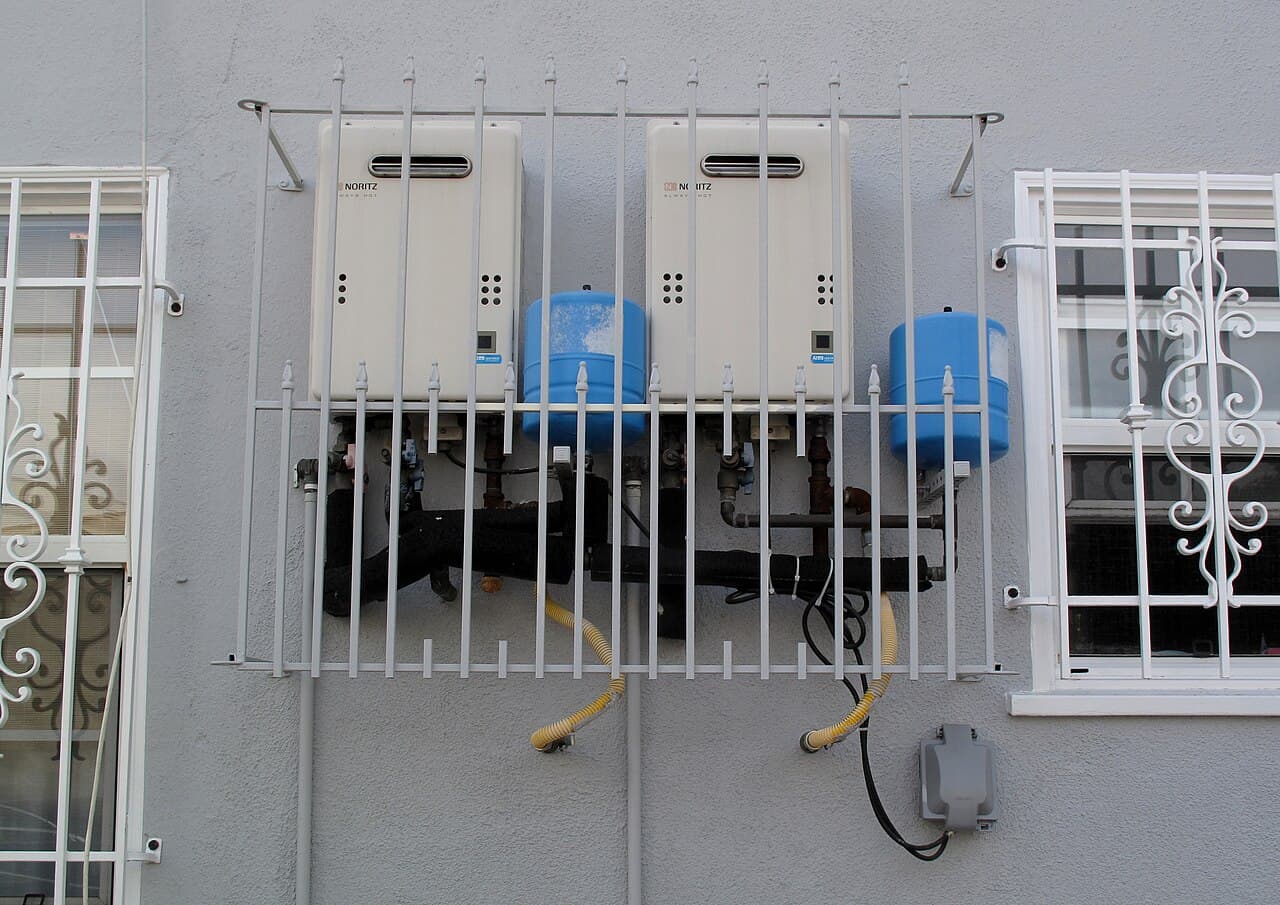
1. The flow dropped below the heater's minimum
A tankless heater fires when it senses water moving and stops when the flow falls too low. Noritz says: "Noritz tankless water heaters have a minimum flow requirement (0.5 gpm for most models.)"[1] Rinnai's gas models need at least 0.4 to 0.6 gallons per minute through the hot side to ignite and 0.26 gallons per minute to keep running,[3] and Rinnai explains: "If the flow rate falls below these levels, the energy-efficient Rinnai unit will turn off because it senses that hot water isn't needed."[3]
The shower itself is often the cause. When you turn the handle toward warm, you send less water through the hot side. With a low-flow showerhead, that hot-side flow can slip under the minimum, and the heater shuts off mid-shower. Signs that this is your problem: it happens at one shower but not others, it happens when you set the water cooler, and the water comes back hot when you turn the handle to full hot.
Three things decide how much water reaches the heater at a given shower setting, and they are what a plumber looks at first:
- The heater's set temperature. The hotter the heater's setting, the more cold water the shower mixes in and the less passes through the heater. It sounds backwards, but Rinnai suggests lowering the heater's temperature setting by a couple of degrees, which changes the hot and cold mix so more water passes through the heater,[3] and Noritz suggests trying 120°F.[1]
- The shower valve. Rinnai notes that many single-handle faucets have limit stops that affect the hot and cold mix and may need adjusting.[3] A limit stop that holds the handle back from full hot can keep the hot-side flow low.
- The fixture. Noritz notes that scale buildup or other debris in a faucet can reduce the flow, and so can shutoff valves under the sink that are not fully open.[2] Rinnai's list of remedies includes cleaning or removing the aerators on showerheads or fixtures, or replacing low-flow showerheads or fixtures.[3]
If every fixture is affected, the restriction may be at the heater: the inlet water filter on the heater's cold water inlet can collect sediment that cuts the flow.[3] That screen is inside the heater's water connections, so have a technician clean it.
2. Too much hot water at once, especially in winter
A tankless heater can make only so many gallons a minute. The Department of Energy's Building America guide gives the example: if people try to take two showers, start laundry and wash dishes at once, the hot water may not be as hot as they want.[4] If the shower turns lukewarm when the washer or dishwasher starts, and recovers when it stops, the heater is at its limit.
Winter makes it worse. ENERGY STAR notes that output capacity partly depends on the groundwater temperature, so colder climates generally need higher-capacity heaters.[5] A unit that kept up in September can fall short in January. The fix is either staggering hot water use or a plumber's check of whether the heater is undersized; our answer on how a tankless heater works explains the sizing.
3. A cold burst from a recirculation pump
If the water runs hot, turns cold for a few seconds, then comes back hot, and the house has an on-demand recirculation system, the recirculation may be the cause rather than a failure. The pump shuts off once the line is hot, the burner shuts down with it, and when the tap opens, the Building America guide explains, "there is the potential for a small amount of cold water to pass through the water heater before the burner re-ignites."[4] The guide calls this the "cold-water sandwich effect."[4]
The most common way to deal with it is a small electric storage tank kept at the hot water temperature, added by a plumber.[4] "This added tank can be as small as 5 or 10 gallons."[4]
4. Scale in the heat exchanger
Hard water leaves scale inside the heater, where it narrows the passages and insulates the heat exchanger. Rheem says: "If your tankless unit struggles to deliver consistent hot water, or if your tank model takes longer to reheat, sediment buildup or scaling may be restricting heat transfer or water flow."[6] Noritz adds that scale buildup forces the burner to work at a higher temperature, and heaters with scale detection will show an error message that service is required.[7] If your heater has not been descaled in a few years and your water is hard, scale is worth suspecting. See how often a tankless heater should be descaled.
5. Not enough gas, power or air
A gas tankless heater draws far more gas than a tank, and an undersized gas line can starve it when other gas appliances run. Rinnai says every Rinnai tankless heater has technology that safely stops operation if it detects inadequate gas flow.[3] If the shower goes cold when the furnace or a gas range comes on, mention that to the technician. Noritz's checklist includes verifying that gas, water and power are all reaching the heater,[1] since the heater needs electricity for its controls.[4]
On gas models, venting is the problem not to wait on. A. O. Smith says gas tankless heaters need proper exhaust ventilation to safely expel combustion gases, and warns: "Poor ventilation creates dangerous conditions and requires immediate professional attention."[8]
When to call a licensed pro
Call a plumber when the shower keeps going cold, when every fixture goes cold, when the heater shows an error code (write it down), or when you suspect scale or the gas supply. Inspecting the inlet filter, flushing the heat exchanger, testing gas pressure and checking the vent are service work inside a gas appliance. Noritz says of its own maintenance procedures: "The procedures shown in this video should be performed by a trained service professional as it deals with gas, water and electricity within confined spaces."[9]
In Virginia, no individual may work as a tradesman without a licence, and a tradesman is anyone doing electrical, plumbing or heating, ventilation and air conditioning work for the public for pay.[12][11] Check the plumber's licence before the visit.
Treat it as an emergency if a cold shower comes with a gas smell, a suspected gas leak or carbon monoxide symptoms. Columbia Gas of Virginia's instruction is: "If you smell gas, think you have a gas leak, have carbon monoxide symptoms or have some other emergency situation, go outside and call 911 and then call us,"[10] meaning the gas company. See what to do if you smell gas.
Get it looked at
Look up plumbers in Blacksburg, browse plumbing services, or read more plumbing answers.
Request a tankless water heater service call and licensed local plumbers quote it.
Common questions
- Why does my tankless water heater shut off when I turn the shower to warm instead of hot?
- Turning the handle toward cold sends less water through the heater. If the hot side drops below the heater's minimum flow, 0.5 gallons per minute on most Noritz models, the burner shuts off and the shower goes cold. Rinnai and Noritz both name a slightly lower set temperature as one remedy, because the shower then draws more hot water. A plumber can check that along with the shower valve and the fixture.
- Why do I get a burst of cold water a few seconds into my shower?
- In a home with an on-demand recirculation system, it may be the cold-water sandwich: the pump and the burner shut off once the line is hot, so a small amount of cold water can pass through before the burner relights. The most common remedy is a small electric storage tank, which can be as small as 5 or 10 gallons. Other causes need a plumber to diagnose.
- Can a low-flow showerhead cause a tankless heater to go cold?
- Yes, if its flow on the hot side falls below the heater's minimum. Rinnai lists cleaning or removing aerators and replacing low-flow showerheads or fixtures among its fixes, and Noritz says a fixture's flow rate rating should be greater than 0.5 gallons per minute. A plumber can compare the two.
- Why does it only go cold in winter?
- The water coming in is colder, so the heater has to raise it more and can deliver fewer gallons a minute. A unit that kept up in summer may fall short with two fixtures running in January. A plumber can check whether it is undersized for your winter demand.
- Should I flush my tankless heater myself if it keeps going cold?
- Noritz says its maintenance procedures should be done by a trained service professional because they deal with gas, water and electricity in confined spaces, and Rinnai says flushing should be completed by a professional installer. Note any error code on the controller and give it to the technician.
- When is a cold shower a safety problem?
- When it comes with a gas smell, a suspected gas leak or carbon monoxide symptoms. For those, Columbia Gas of Virginia's advice is to go outside and call 911, and then call the gas company.
Sources
- [1] My heater shuts off while I am in the shower or using the sink in the kitchen, why?, Noritz America. Checked October 26, 2026.
- [2] I recently had my tankless unit installed, why don't I get hot water at all my fixtures?, Noritz America. Checked October 26, 2026.
- [3] FAQ, Rinnai America Corporation. Checked October 26, 2026.
- [4] Gas-Fired Tankless Water Heaters, Building America Solution Center, Pacific Northwest National Laboratory (U.S. Department of Energy). Checked October 26, 2026.
- [5] Technical Bulletin: Demand Water Heaters, ENERGY STAR, U.S. Environmental Protection Agency. Checked October 26, 2026.
- [6] How to Keep Your Tank and Tankless Water Heaters Running at Peak Performance, Rheem Manufacturing Company. Checked October 26, 2026.
- [7] Tankless Myths 1: Tankless Needs An Annual Maintenance?, Noritz America. Checked October 26, 2026.
- [8] How Long Do Tankless Water Heaters Last?, A. O. Smith. Checked October 26, 2026.
- [9] What maintenance is recommended?, Noritz America. Checked October 26, 2026.
- [10] Safety, Columbia Gas of Virginia. Checked October 26, 2026.
- [11] Va. Code § 54.1-1128, Definitions, Code of Virginia, Virginia General Assembly. Checked October 26, 2026.
- [12] Va. Code § 54.1-1129, Necessity for licensure, Code of Virginia, Virginia General Assembly. Checked October 26, 2026.
Want a pro to handle it?
Describe the job once. Licensed local businesses send quotes, and you pay only when you book one.
Get a quote for Plumbing Repair