What should I do if I smell gas in my house?
Leave right away and get everyone out. Do not switch lights or appliances on or off, use a phone, light anything or start a car in the garage on the way out. Once you are a safe distance away, call 911 and your gas company's emergency line, and stay out until responders say it is safe. Then have a licensed pro repair any leak on your side of the meter.
Free to ask. Local shops send quotes, and you pay only when you book one.
By Kasra Taheri, Founder, LoclisPublished
Researched and drafted with AI, then checked claim by claim against the sources listed below before it was published. Prices and rules change; the dates beside each source say when it was last checked.
This is a job for a licensed pro in Virginia
This page explains what the work involves, the permits, what a licensed pro does and what drives the cost. It does not give step-by-step instructions, because this work needs a licence, a permit or both, and doing it wrong can injure someone. Before you hire, check the licence on Virginia's DPOR record.
If you smell gas in your house, get everyone out now, without switching anything on or off, and call 911 and your gas company's emergency line once you are well away from the building. Do not look for the leak or try to fix it. Stay out until responders tell you it is safe, and then have a licensed pro repair anything on your side of the meter.
Right now
Do not make a spark. Columbia Gas of Virginia's instructions are direct: "Don't smoke or light a match. Don't open the windows. Don’t use anything that could cause a spark, like a phone, light switch, appliance or flashlight. Don’t start your car or use your garage door to leave."[1] Virginia Natural Gas adds landlines, electronic devices and vehicles to the list of things that can spark.[2] Leave a light on if it is on and off if it is off.
Get out. "If you're inside, get out immediately."[1] Take people and pets with you, and warn anyone else in the house on the way out.
Leave the leak alone. "Do not try to identify the source or stop the leak yourself."[2] Hunting for it keeps you in the building.
Call from outside. From a safe location, away from the building, call 911 and the gas company's emergency number, then wait for crews to arrive.[1] Two of Virginia's gas companies publish these lines:
- Columbia Gas of Virginia: 1-800-544-5606, 24 hours a day.[1]
- Virginia Natural Gas: 877.572.3342, its 24-hour emergency number.[2]
If another company supplies your gas or propane, look for its emergency number on your bill or its website before you need it, and keep it somewhere easy to find. Do not hold back over cost: Columbia Gas says it will send someone to check the source of the odor free of charge, whether there is a leak or not.[1]
Stay out. Virginia Natural Gas tells customers to stay away until emergency personnel or the gas company say it is safe to return.[2]
Signs it might be gas
Natural gas is naturally colorless and odorless, so gas companies add an odorant called mercaptan that smells like rotten eggs or sulfur.[1] A leak can also make a hissing, blowing, whistling or roaring sound,[1] and outdoors a buried leak can show up as blowing dirt, bubbling water or dead vegetation.[1]
Do not rely on your nose alone. Virginia Natural Gas warns that some people cannot smell the odorant because of a diminished sense of smell or because other odors mask it.[2] Its rule is simple: "You should act any time you detect even a small amount of this odor in the air."[2]
If you use propane
Propane is treated the same way. Columbia Gas tells its propane customers to leave the area immediately, then, from a safe location away from the building, call 911 and its emergency number and wait for crews to arrive.[3] If another company fills your tank, use that company's emergency number. One difference matters while you leave: propane is heavier than air, so a leak may collect in low spaces and near the floor.[3] Do not go down to a basement to look.
Gas smell or carbon monoxide
They are different dangers. Carbon monoxide is an odorless, tasteless, non-corrosive gas created when fuels (such as gasoline, wood, natural gas, propane or oil) burn incompletely.[4] You will not smell it. Columbia Gas lists flu-like symptoms including headaches, dizziness, nausea, vomiting, irregular breathing or feeling ill.[4] If a carbon monoxide alarm sounds or anyone has those symptoms, leave for fresh air and call 911.[4] Columbia Gas recommends a carbon monoxide detector on every level of your home and in every room where someone sleeps.[4]
After the emergency
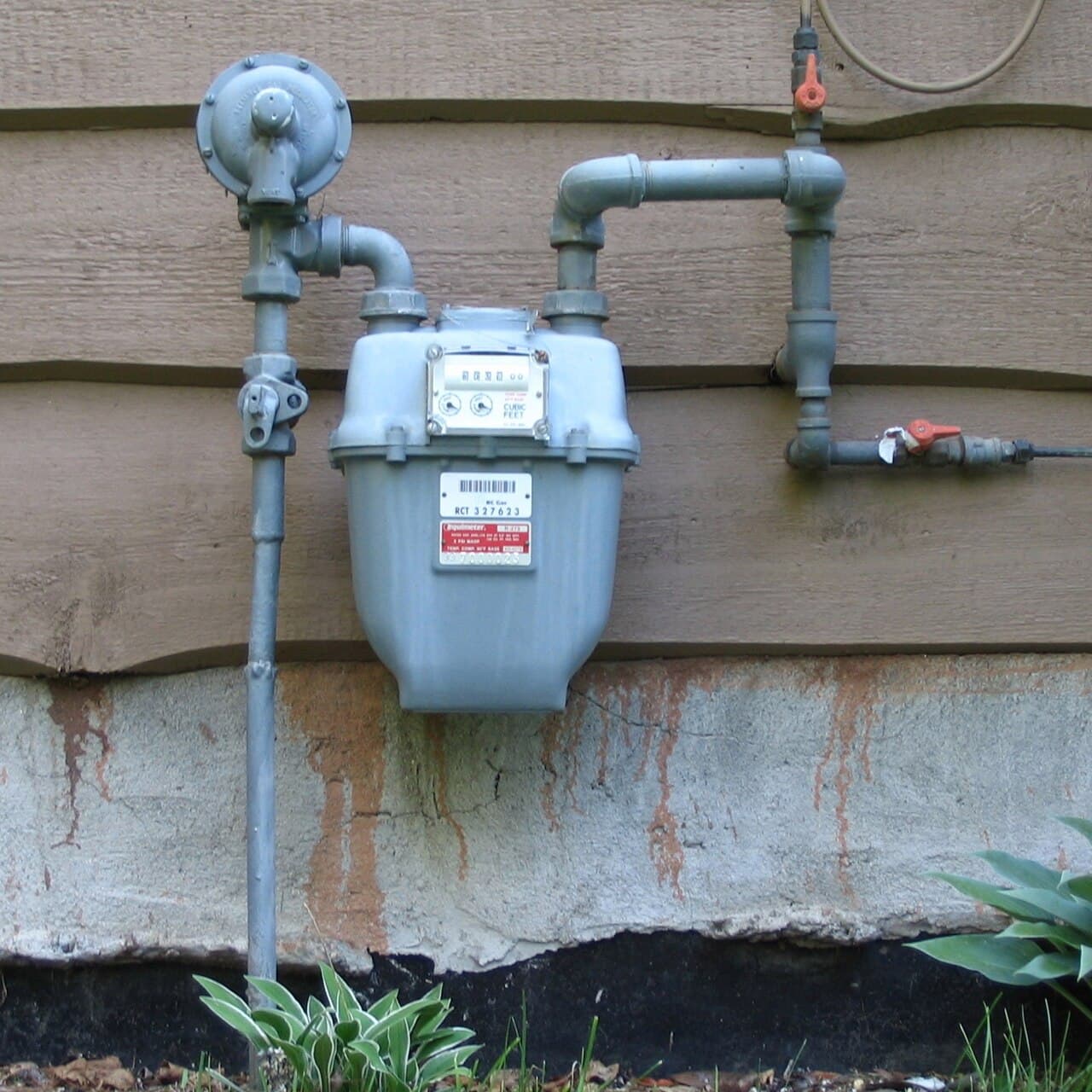
The gas company finds and makes safe what it can, and it is responsible up to the meter. You own the gas lines from your meter to your gas appliances,[5] so a leak in the house piping or at an appliance is yours to have fixed. Columbia Gas says an unsafe condition should be repaired immediately or the gas left off until the repair is made and a safety inspection is completed.[5]
On the owner's side, the source can be an old appliance connector or a line left open after an appliance was removed. Some older uncoated brass appliance connectors can separate from their end pieces and cause a serious leak,[7] and Virginia Natural Gas warns that moving an appliance to check its connector can break an old one, since they can break if moved even slightly.[7] If you find an uncapped gas line, do not touch it; call a qualified professional.[6]
When to call a licensed pro
As soon as the gas company has made the house safe, or right away if it has shut off gas to an appliance or the whole house. Virginia's building code allows urgent work to start first: applications for emergency construction, alterations or equipment replacement can be filed by the end of the first working day after the work starts.[8] Under the Code of Virginia, a natural gas fitter provider is licensed for the incidental repair, testing, or removal of natural gas piping,[9] and no individual may do that work without a licence.[10] A plumbing or HVAC firm with a gas fitting licence can also do it. Our answer on who can install or repair a gas line in Virginia explains what to look for, and how often gas lines should be inspected covers keeping it from happening again.
If the problem turns out to be an appliance, such as a furnace that will not stay lit, see whether it is safe to relight a pilot light yourself. Loclis lists DPOR-licensed businesses with licence number and class: see plumbers in Blacksburg or more plumbing answers.
Once the gas company says it is safe, describe the leak or repair once and licensed local businesses quote the fix.
Common questions
- Should I open the windows if I smell gas?
- No. Columbia Gas of Virginia lists opening the windows among the things not to do. Spend those seconds getting everyone out, and let the gas company air out and make the house safe.
- Should I turn off the gas at the meter?
- Do not try to stop the leak yourself. Virginia Natural Gas says to leave and not try to find or stop the leak, and the gas company's crew decides what has to be shut off. Your job is to get out and call.
- Can I call the gas company from inside the house?
- No. A phone can make a spark. Leave first, then call 911 and the gas company's emergency number from a safe distance away from the building.
- Does the gas company charge to check a gas smell?
- Columbia Gas of Virginia says it checks the source of a gas odor free of charge, whether or not there is a leak. Ask your own gas company, but do not let cost stop you from calling.
- Who pays to fix a gas leak in my house?
- The gas company is responsible up to and including the meter. A leak in the piping or connectors after the meter is the owner's to repair, using a licensed gas fitter or plumber.
- I smell gas faintly sometimes but it goes away. Is that normal?
- Treat it as a possible leak. Virginia Natural Gas says to act any time you notice even a small amount of the odor. Leave and call, and let the gas company decide whether there is a leak.
Sources
- [1] What to do if you smell natural gas, Columbia Gas of Virginia. Checked October 26, 2026.
- [2] Leaks, Odors & Safety Tips, Virginia Natural Gas. Checked October 26, 2026.
- [3] Important propane safety information, Columbia Gas of Virginia. Checked October 26, 2026.
- [4] Know the dangers of carbon monoxide, Columbia Gas of Virginia. Checked October 26, 2026.
- [5] Know your gas lines and their locations, Columbia Gas of Virginia. Checked October 26, 2026.
- [6] How to maintain your natural gas appliances, Columbia Gas of Virginia. Checked October 26, 2026.
- [7] Appliance Connectors, Virginia Natural Gas. Checked October 26, 2026.
- [8] 13VAC5-63-80, Virginia Uniform Statewide Building Code, Section 108 Application for permit, Virginia Administrative Code, Legislative Information System. Checked October 26, 2026.
- [9] Va. Code § 54.1-1128, Definitions, Code of Virginia, Virginia General Assembly. Checked October 26, 2026.
- [10] Va. Code § 54.1-1129, Necessity for licensure, Code of Virginia, Virginia General Assembly. Checked October 26, 2026.
Want a pro to handle it?
Describe the job once. Licensed local businesses send quotes, and you pay only when you book one.
Get a quote for Plumbing Repair