How does a whole-house surge protector work?
A whole-house surge protector is a device wired at the main breaker panel that gives a sudden voltage spike on the incoming power line a short path to ground, so it does not spread through the house's circuits. It does not cover surges arriving on cable, phone or antenna lines, so plug-in protectors at sensitive electronics still matter. Installing one is licensed electrical work in Virginia.
Free to ask. Local shops send quotes, and you pay only when you book one.
By Kasra Taheri, Founder, LoclisPublished
Researched and drafted with AI, then checked claim by claim against the sources listed below before it was published. Prices and rules change; the dates beside each source say when it was last checked.
This is a job for a licensed pro in Virginia
This page explains what the work involves, the permits, what a licensed pro does and what drives the cost. It does not give step-by-step instructions, because this work needs a licence, a permit or both, and doing it wrong can injure someone. Before you hire, check the licence on Virginia's DPOR record.
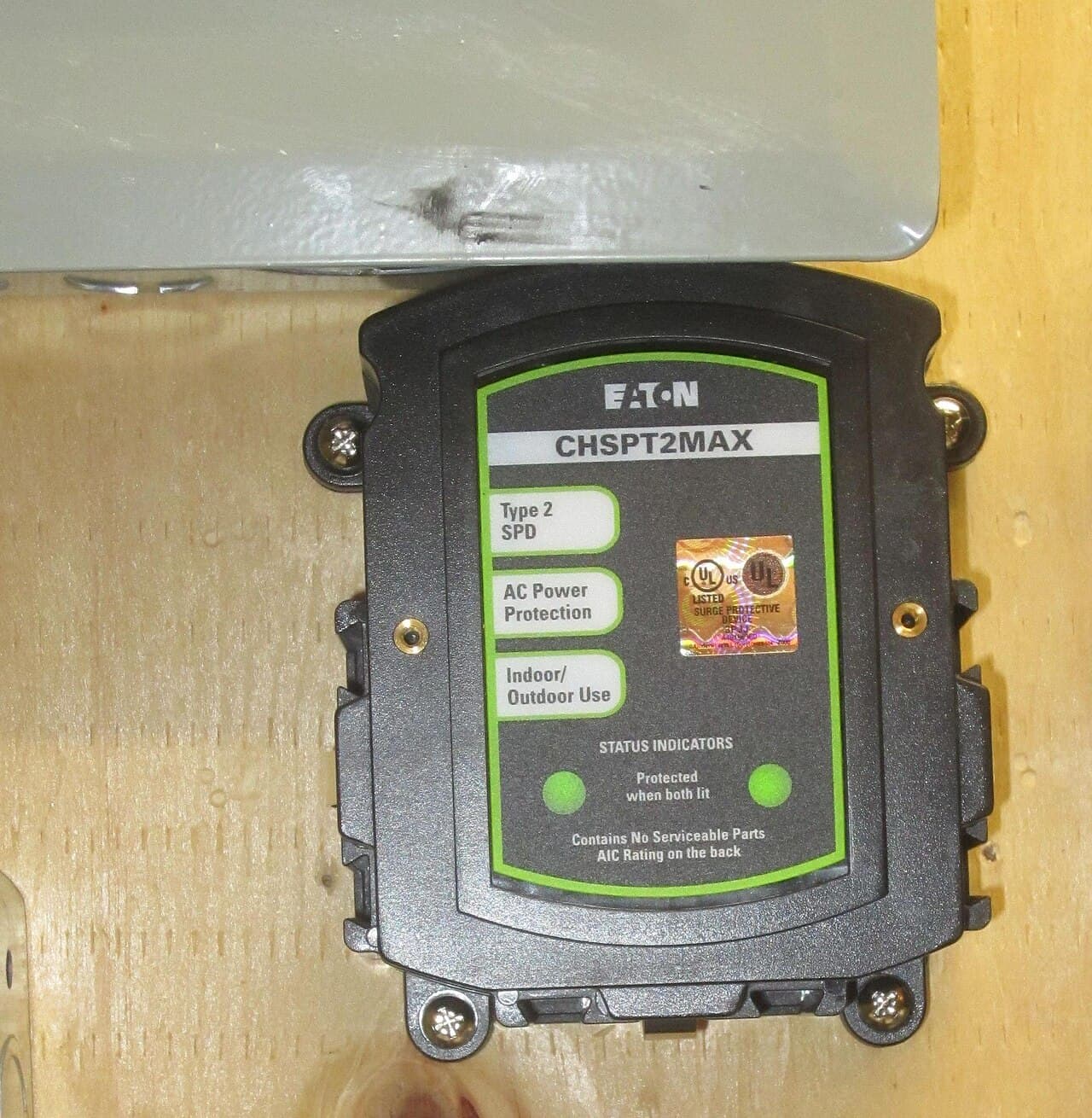
A whole-house surge protector, which electricians call a surge-protective device or SPD, is wired to the main breaker panel and gives a sudden voltage spike on the incoming power line a short path to ground. The spike is shunted away at the edge of the house instead of travelling through every circuit to your appliances. It is one layer of protection, not the whole answer: it does nothing about surges that come in on the cable, phone or antenna line, so plug-in protectors at your most sensitive electronics still matter.
What a surge is
Household power is meant to be a steady 120 volts. NIST's homeowner guide explains that lightning, short circuits, a pole knocked down by a car or some other accident can make the voltage jump to hundreds, even thousands of volts.[1] A surge lasts only a few millionths of a second, but that is enough to destroy or upset an appliance.[1]
Lightning is the famous cause, not the only one. NIST notes that switching surges happen when electrical loads are turned on or off inside the home, and during the power company's normal operations.[1] Leviton, a maker of these devices, says utility work and air conditioners or washers and dryers cycling on and off cause small surges inside a home every day, and that these may not cause obvious damage but can shorten the life of equipment over time.[3]
What the device does with it
The name "surge protector" oversells it slightly. NIST points out that they neither suppress nor arrest a surge; they divert it to ground, where it can do no harm.[1] In simple terms, the unit stays out of the way at normal voltage and conducts only during the spike, so the excess energy goes to ground instead of into your appliances.
Two things follow from that:
- Grounding is everything. NIST warns that the best surge protector can be useless if grounding is not done properly.[1] If the home's grounding and bonding are poor, the surge has nowhere good to go.
- Short wires work better. NIST advises that the protector should sit close to the service panel, within about one foot, or its voltage-limiting effect is degraded.[1] One manufacturer's installation notes put it simply: long leads hurt performance.[4] That is why the unit is usually mounted right beside or inside the panel, as in the photo above.
Type 1, Type 2 and Type 3
Surge devices are sorted by where they connect. Per Leviton's code summary, Type 1 devices are intended for installation between the secondary side of the service transformer and the line side of the service equipment, and protect against external surges caused by lightning or utility capacitor bank switching.[2] Type 2 devices go on the load side of the service equipment and protect against residual lightning energy, motor-driven surges and other surges generated inside the house.[2] Type 3 devices are point-of-use surge receptacles for computers, televisions and other expensive electronics.[3]
For a home's service, Leviton summarizes that Article 230.67 of the 2020 National Electrical Code requires a Type 1 or Type 2 device for all services supplying dwelling units, installed integral to or immediately adjacent to the service equipment, including where service equipment is replaced.[2] NIST describes the common in-panel arrangement, with the protector connected on the load side of a pair of dedicated spare breakers in the panel.[1]
Reading the label
NIST explains that joules are a simplified measure of the surge energy a protector can absorb without damage to itself, and maximum surge current may give better information than the joule figure.[1] It also advises to make sure the product has been tested by a product safety testing organization such as UL, ETL or CSA.[1] As an example of what you will see, one manufacturer's whole-house units are listed to UL 1449 as Type 2 devices and come in surge capacities of 60,000, 100,000 and 140,000 amperes.[4]
The device wears with use, so it has indicator lights. On that same product line, their green lights go out, a red service light flashes and an alarm beeps when the unit needs replacing.[4] Other brands use different signals; the instruction card tells you which. Our answer on how long a surge protector lasts covers the wear in more detail.
What it does not do
NIST's guide is frank about the limits. It says a protector at the service entrance is enough for appliances connected only to power, but not for appliances also connected to a telephone, cable or satellite line.[1] With those, a surge on one of those systems can damage the appliance through a difference in voltage between the two systems, even when each system has its own protector.[1] The fix is a plug-in protector that routes both the power and the coax or phone line through the same box.
That does not make the panel device pointless. An important function of the service-entrance protector is to divert large surges on the power line before they enter the house,[1] which makes the plug-in protectors' job easier.
Nor is it lightning protection for the building. Lightning rods protect the structure of the house and help avoid fires, but they do not prevent surges in the wiring.[1] And the National Weather Service is blunt: Typical surge protectors will not protect equipment from a lightning strike.[5] If something was damaged despite a protector, see why electronics get damaged in a storm even with a surge protector.
Where Virginia's code stands
Fairfax County's technical bulletin on the 2021 Virginia Uniform Statewide Building Code says a surge-protective device is required at the service panel under Section E3606.5 of the 2021 code, and that the requirement also applies to replacement service equipment.[6] In practice that means a new home, or a panel or service replacement, includes one. For a panel that is staying put, Virginia's maintenance code says no provision of it requires alterations to existing equipment unless conditions meet its definition of an unsafe structure,[7] so adding a unit is your choice. Our answers on whether you need one and what it costs in Virginia help with that decision.
When to call a licensed pro
A whole-house unit connects inside or right beside the panel, on live service equipment. Virginia defines an electrician as a tradesman who does the construction, repair, maintenance, alteration or removal of electrical systems regulated under the building code,[9] and no individual may work as a tradesman unless licensed.[10] CPSC tells homeowners not to remove the service-panel cover, because that is a job for a qualified electrician.[8] Ask the electrician which type and rating suits your panel, where it will mount, whether your grounding and bonding need attention first, and whether your locality wants a permit.
Find an electrician
Browse Loclis surge protection services, look up electricians in Blacksburg, or read more electrical answers.
Describe your surge protector job and licensed local electricians quote it.
Common questions
- Does a whole-house surge protector replace my power strips?
- No. It handles large surges on the power line before they reach your circuits, but it does not protect a television or computer from a surge that arrives on the cable, phone or antenna line. Keep a plug-in protector with matching coax or phone jacks at those devices.
- Will it protect my house if lightning hits it?
- Do not count on it. The National Weather Service says typical surge protectors will not protect equipment from a lightning strike. A whole-house device reduces the damage from the much more common surges that travel in on the lines from farther away.
- What is the difference between Type 1 and Type 2?
- Where they connect. A Type 1 device can go on the line side of the service equipment, ahead of the main breaker, and is aimed at external surges such as lightning. A Type 2 device goes on the load side, usually on a breaker in the panel. The 2020 National Electrical Code accepts either for a home's service.
- How do I know it is still working?
- Look at its indicator lights. Many units have one or more; on the Siemens units described here, the green lights go out and a red light flashes when the unit needs replacing. The meaning varies by brand, so keep the instruction card.
- Is a whole-house surge protector required in Virginia?
- Fairfax County's summary of the 2021 Virginia code says a surge-protective device is required at the service panel, including on replacement service equipment. That means new homes and panel or service replacements. If your panel is staying, adding one is your choice.
Sources
- [1] Surges Happen! How to Protect the Appliances in Your Home (NIST Special Publication 960-6, May 2001), National Institute of Standards and Technology. Checked October 27, 2026.
- [2] 2020, 2023 and 2026 National Electrical Code Updates: 230.67 Surge Protection, Leviton Manufacturing Co.. Checked October 27, 2026.
- [3] Whole Home Surge Protection, Leviton Manufacturing Co.. Checked October 27, 2026.
- [4] FirstSurge Whole House Surge Protection data sheet and installation notes, Siemens Canada Limited. Checked October 27, 2026.
- [5] Lightning Indoors, National Weather Service. Checked October 27, 2026.
- [6] Technical Bulletin 24-02: Summary of Code Changes in the 2021 Virginia Uniform Statewide Building Code, Fairfax County Land Development Services. Checked October 27, 2026.
- [7] 13VAC5-63-470, Virginia Maintenance Code, Section 103 Application of code, Virginia Administrative Code, Legislative Information System. Checked October 27, 2026.
- [8] CPSC Guide to Home Wiring Hazards (Publication 518), U.S. Consumer Product Safety Commission. Checked October 27, 2026.
- [9] 18VAC50-30-10, Tradesman Rules and Regulations, Definitions, Virginia Administrative Code, Legislative Information System. Checked October 27, 2026.
- [10] Code of Virginia § 54.1-1129, Tradesman license required, Code of Virginia, Legislative Information System. Checked October 27, 2026.
Want a pro to handle it?
Describe the job once. Licensed local businesses send quotes, and you pay only when you book one.
Get a quote for Electrical Repair