How long does a surge protector last?
There is no fixed number of years. A surge protector wears out as it absorbs surges and high voltage, so one unit may last many years and another may be spent after a single bad storm. Its indicator lights are the real gauge: when the protection light goes out or the unit alarms, replace a plug-in unit and have an electrician replace a panel unit.
Free to ask. Local shops send quotes, and you pay only when you book one.
By Kasra Taheri, Founder, LoclisPublished
Researched and drafted with AI, then checked claim by claim against the sources listed below before it was published. Prices and rules change; the dates beside each source say when it was last checked.
This is a job for a licensed pro in Virginia
This page explains what the work involves, the permits, what a licensed pro does and what drives the cost. It does not give step-by-step instructions, because this work needs a licence, a permit or both, and doing it wrong can injure someone. Before you hire, check the licence on Virginia's DPOR record.
A surge protector does not have a set lifespan in years. It lasts until its protective parts are used up, and that depends on how many surges, and how much high voltage, it has had to absorb. One protector can last a long time in a quiet house; another can be spent after one bad storm. The reliable way to know is the protector's own indicator lights, so the real maintenance job is knowing what they mean and checking them.
Why surge protectors wear out
NIST's homeowner guide puts it plainly: many, if not all, electronic components will age and have a limited life.[1] It says well-designed surge protectors might reach the end of their life early if exposed to some exceptionally high and rare stress.[1]
Surges are not the main killer, though. NIST reports the view among specialists that most of the rare catastrophic failures of surge protectors are caused by excessively high line voltage that can occur when there is a fault on the power system,[1] and that failure from a very large surge is less likely than failure from high line voltage.[1] For whole-house units, wiring matters too: Siemens's installation notes say neutral-to-ground bonding not done to the NEC will fail surge devices, and calls it the leading cause of their failures.[3]
What the ratings tell you about life
A bigger rating gives more margin, not a set number of years. NIST explains that joules are a simplified measure of the surge energy a protector can dissipate without damage to itself, and the higher the value, the more energy it can handle,[1] and that typical values range from about 100 joules to 1,000 joules or more.[1] It also notes that somewhat higher clamping voltages, such as 400 volts or more, can still protect electronics while making the protector itself less susceptible to damage from swells.[1]
Know what the lights mean
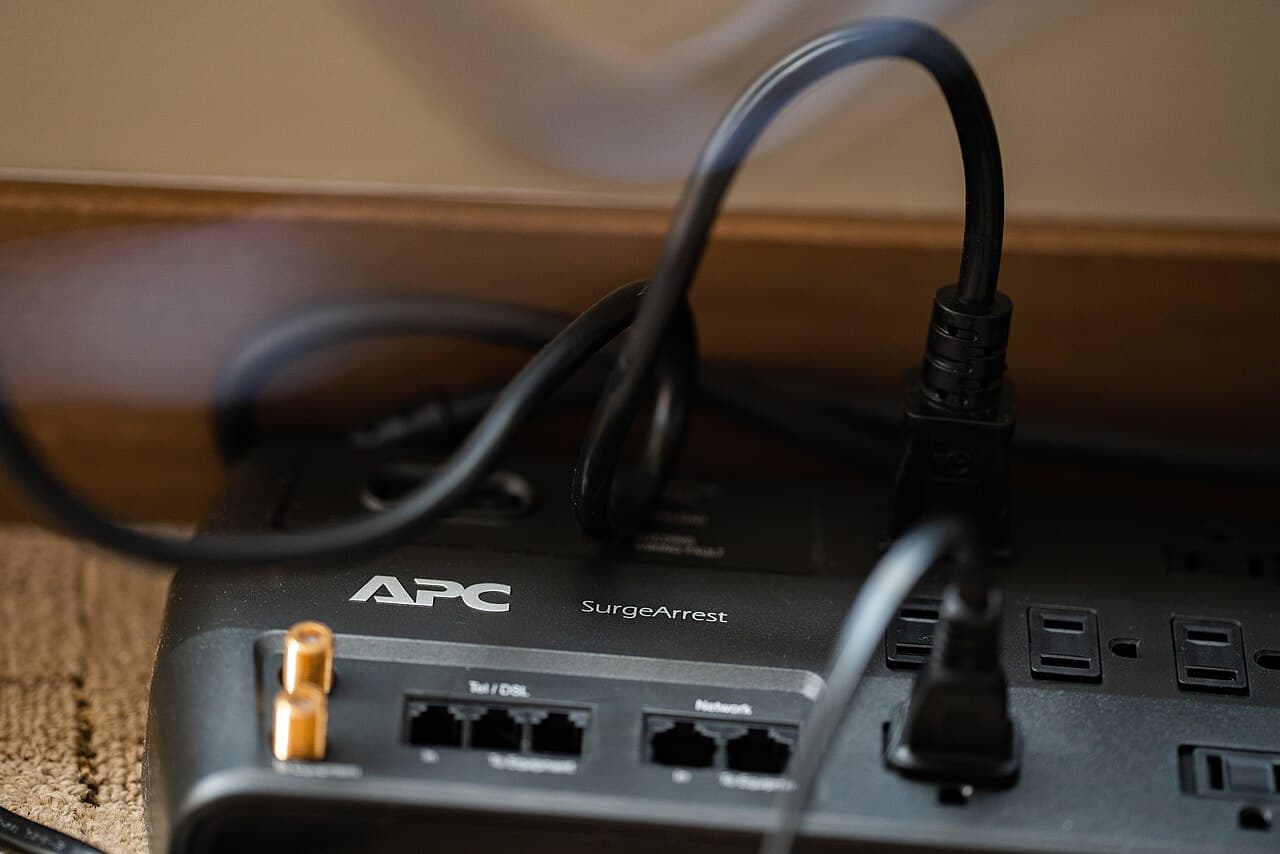
On one APC model, the user guide says: "If the LED is not illuminated the surge suppression circuitry has been compromised."[2]
What the protector does at the end of its life varies. That APC guide says: "This device will disconnect the surge protective component at the end of its useful life. It will not continue to supply power to connected equipment."[2] Other designs behave differently. NIST explains that some protectors cut off power when their protective element fails, while others disconnect the failed element and keep powering your equipment.[1] With the second kind, the TV keeps working and nothing tells you the protection is gone except the light. NIST's own question is the right one: if the protector keeps power on, how often will you look under or behind your desk to check that the protection light is still on.[1]
NIST adds that indicator lights are not standardized, so save any card that explains them.[1] Some devices make it easier. Leviton says its surge receptacles have an audible alarm, so you are notified when you need to replace the surge outlet.[4]
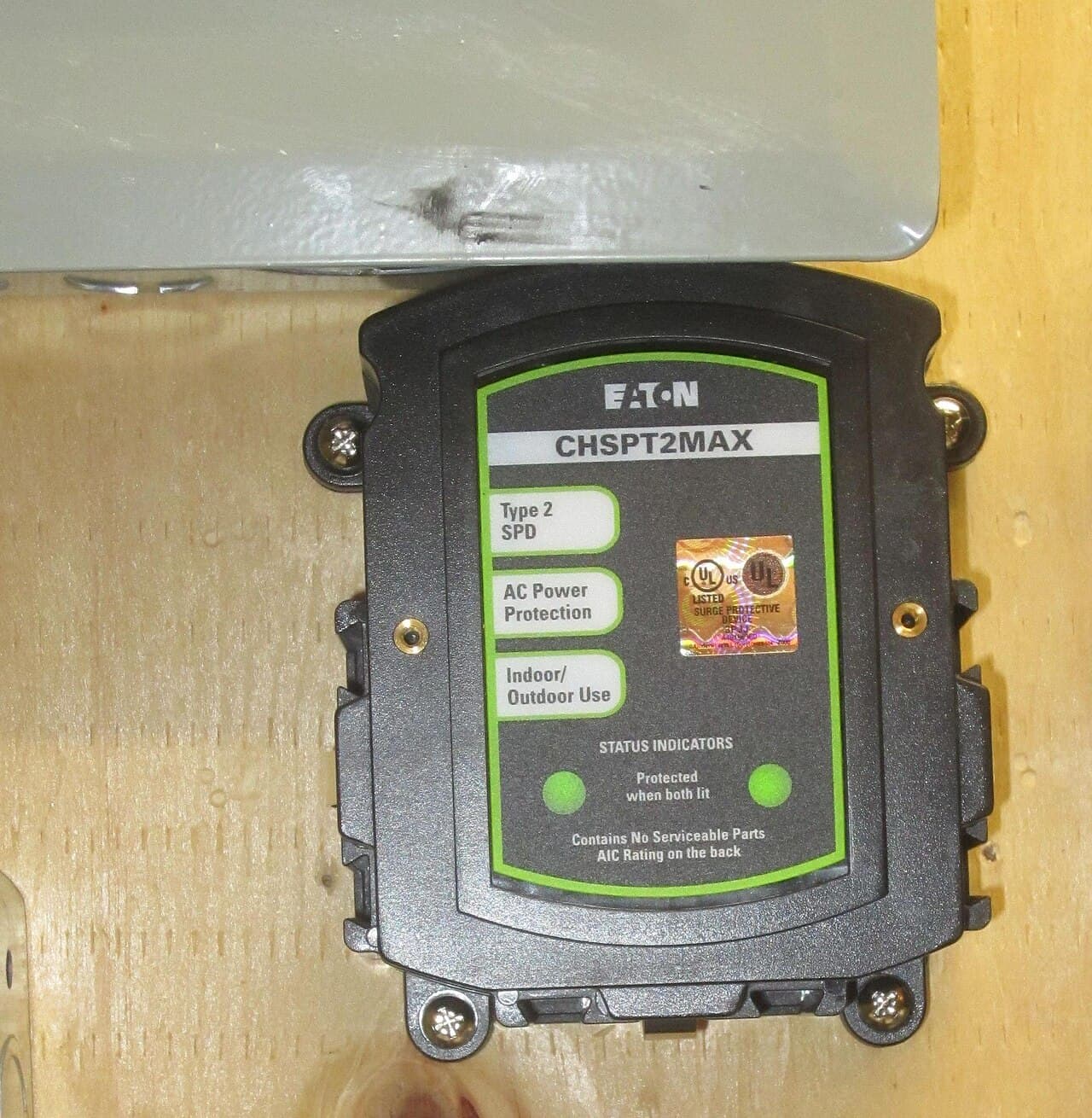
Whole-house units signal too. Siemens says its whole-house units let you know when they are worn out: the green lights go out, a red service light flashes and an alarm beeps.[3] On those units, the same red light flashing and beeping with the green lights still on warns of a compromised neutral-to-ground bond,[3] which is a wiring problem, not a worn-out protector. The unit in the photo above is labelled as protecting only when both of its green lights are lit.
Simple habits that make them last
- Check the lights on every protector now and then, and after any severe storm or power company fault.
- Watch for wiring warnings. On the APC model, a Ground OK light that goes out means the unit has detected a wiring fault,[2] and the guide says to stop using it and have a qualified electrician correct the building wiring.
- Use it as designed. APC's guide says: "Do not plug extension cords into the SurgeArrest."[2] It also says not to install it where there is excessive heat or humidity.[2]
- Keep the paperwork. APC warrants that model against defects for the lifetime of the original purchaser, limited to repairing or replacing the product,[2] and Siemens advertises a 10 year product and connected equipment warranty on its whole-house units, subject to its terms.[3] Receipts and the card explaining the lights belong in the same drawer.
- Retire strips with no light. An old strip with no protection indicator gives you no way to tell whether it still protects.
When to call a licensed pro
A plug-in protector whose light is out is simply replaced. A whole-house unit is different: it is connected at the service panel, and CPSC tells homeowners not to remove the service-panel cover, because that is a job for a qualified electrician.[5] Virginia defines an electrician as a tradesman who does the construction, repair, maintenance, alteration or removal of electrical systems regulated under the building code,[6] and no individual may work as a tradesman unless licensed.[7] Call one when a panel unit's lights go out or it alarms, when a protector reports a wiring or grounding fault, or after a storm that damaged equipment. Our answers on how a whole-house surge protector works and why electronics get damaged even with a surge protector explain what the electrician will look at.
Get it checked
Browse Loclis surge protection services, look up electricians in Blacksburg, or read more electrical answers.
Describe your surge protector job and licensed local electricians quote it.
Common questions
- Should I replace my surge protector every few years anyway?
- Age alone is not the test the manufacturers give; the indicator is. That said, an old strip with no protection light at all gives you no way to know, and replacing it is usually a small cost next to the electronics it guards.
- My power strip still works. Does that mean it still protects?
- Not necessarily. Some designs keep passing power after the protective part has failed. Check the protection light. If it is out, the strip may now be nothing more than an outlet extender.
- Does a big storm use up a surge protector?
- It can. A large surge or a long period of high voltage can wear out or end a protector's life. Check the lights on every protector, and on a panel unit, after a severe storm or a power company fault.
- How long does a whole-house unit last?
- Like a plug-in unit, it lasts until its protective parts are spent, which depends on what it absorbs. Its lights or alarm tell you when. Siemens backs its units with a 10-year product and connected equipment warranty, subject to its terms.
- Who replaces a whole-house surge protector?
- A licensed electrician. It is connected to breakers inside or beside the service panel, and CPSC advises homeowners not to remove the panel cover.
Sources
- [1] Surges Happen! How to Protect the Appliances in Your Home (NIST Special Publication 960-6, May 2001), National Institute of Standards and Technology. Checked October 27, 2026.
- [2] Essential SurgeArrest P3U3B user guide (07/2014), APC by Schneider Electric (manual hosted by Lowe's). Checked October 27, 2026.
- [3] FirstSurge Whole House Surge Protection data sheet and installation notes, Siemens Canada Limited. Checked October 27, 2026.
- [4] Whole Home Surge Protection, Leviton Manufacturing Co.. Checked October 27, 2026.
- [5] CPSC Guide to Home Wiring Hazards (Publication 518), U.S. Consumer Product Safety Commission. Checked October 27, 2026.
- [6] 18VAC50-30-10, Tradesman Rules and Regulations, Definitions, Virginia Administrative Code, Legislative Information System. Checked October 27, 2026.
- [7] Code of Virginia § 54.1-1129, Tradesman license required, Code of Virginia, Legislative Information System. Checked October 27, 2026.
Want a pro to handle it?
Describe the job once. Licensed local businesses send quotes, and you pay only when you book one.
Get a quote for Electrical Repair