Why did my electronics get damaged in a storm even with a surge protector?
Usually because the surge took a path the protector does not cover, such as the cable, phone or antenna line, or because the strike was too close for any typical protector. A protector that was already worn out, poor grounding, or a device plugged in on another circuit are the other common reasons. A licensed electrician can check the grounding and the panel.
Free to ask. Local shops send quotes, and you pay only when you book one.
By Kasra Taheri, Founder, LoclisPublished
Researched and drafted with AI, then checked claim by claim against the sources listed below before it was published. Prices and rules change; the dates beside each source say when it was last checked.
This is a job for a licensed pro in Virginia
This page explains what the work involves, the permits, what a licensed pro does and what drives the cost. It does not give step-by-step instructions, because this work needs a licence, a permit or both, and doing it wrong can injure someone. Before you hire, check the licence on Virginia's DPOR record.
Most of the time, electronics are damaged despite a surge protector because the surge did not come through the path the protector guards, or because the event was bigger than any typical protector can handle. A spent protector, weak grounding, or a device plugged in on another circuit explain most of the rest. Working out which one happened tells you what to fix before the next storm.
The surge came in on another wire
A power strip only watches the power cord. The National Weather Service explains that lightning can enter a structure by a direct strike, through wires or pipes that extend outside it, or through the ground,[2] and once inside it can travel through the electrical, phone, plumbing, and radio and television reception systems.[2]
NIST's homeowner guide makes the same point about appliances: each of the power, telephone, cable and antenna connections offers a path for a surge to come in, something that might be overlooked when the cause of damage is explained as a power surge.[1]
Devices with two connections are hit hardest. NIST says a surge coming in on either system can damage the appliance because of the difference in voltage between the two, and that this can happen even when there are surge protectors on each system.[1] It adds that insurance company statistics put video systems and computers with a modem connection at the top of the list of appliances most often damaged during a lightning storm.[1] A TV on cable, a modem and router, or a computer on a wired network are the usual casualties.
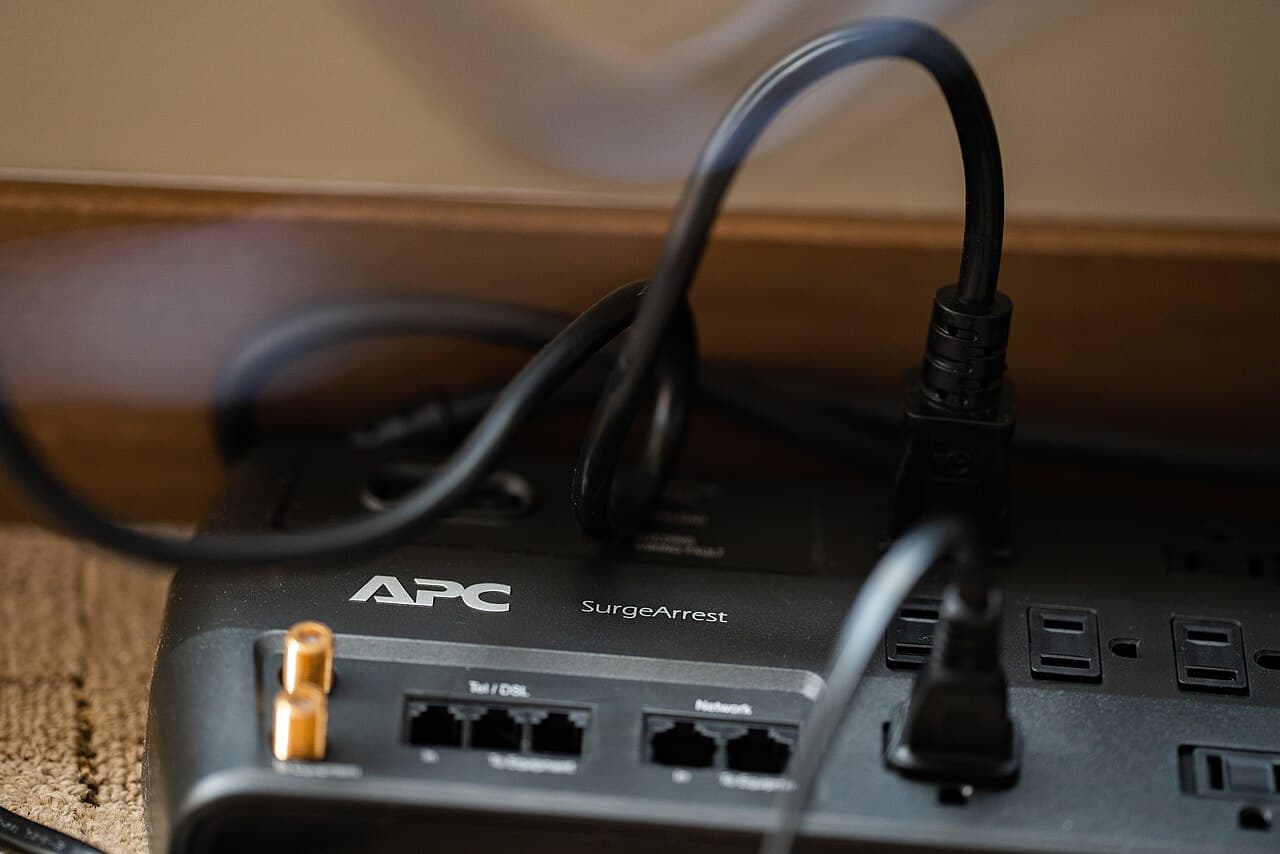
The fix NIST describes is a combined protector that carries both the power and the phone or cable line through the same box,[1] like the one in the photo above, with coax and phone jacks beside the outlets.
The strike was too close
There is a limit to what any protector can do. The National Weather Service says: "Lightning generates electric surges that can damage electronic equipment some distance from the actual strike. Typical surge protectors will not protect equipment from a lightning strike."[2] NIST notes that even appliances with simple mechanical controls might be damaged in extreme cases, such as a direct strike to the building or one very close to the utility.[1] If a tree, the house or the pole outside was hit, damage despite protection is not a sign the protector was faulty.
The protector was already spent
Surge protectors wear out as they absorb surges, and some fail quietly. NIST explains that some protectors cut off power when their protective element fails, while others disconnect the failed element and keep powering your equipment.[1] With the second kind, everything keeps working with no protection left. On one APC model the user guide is plain: "If the LED is not illuminated the surge suppression circuitry has been compromised."[3] Check the light on every strip, especially old ones behind furniture. Our answer on how long a surge protector lasts covers the signs.
The grounding or bonding is poor
NIST reminds readers that your surge protector works by diverting surges to ground, and the best surge protector can be useless if grounding is not done properly.[1] One common problem is the separate services not being tied together: NIST says cable TV service that is not bonded to the power service ground is a clear violation of the National Electrical Code, but not so rare, and the result can be severe damage.[1] For whole-house units, Siemens's installation notes say neutral-to-ground bonding not done to the NEC is the leading cause of surge device failures.[4] These are things only an electrician should open up and check.
The device was on another circuit, or an ungrounded outlet
A protector in one room does little for another. NIST says a plug-in protector may help other receptacles on the same branch circuit, but that benefit is much less on other branch circuits.[1] Each sensitive device needs its own.
The outlet matters too. NIST warns that some combined protectors might not work very well if plugged into a two-slot receptacle with a cheater plug,[1] and APC's guide tells users to plug the unit into a 3 wire, 120 volt, grounded outlet.[3] In an older Virginia house with two-prong outlets, that may be the whole story; see what replacing two-prong outlets involves.
It was not really a surge
Storms also bring downed lines and utility faults. NIST notes that most of the rare catastrophic failures of surge protectors are caused by excessively high line voltage that can occur when there is a fault on the power system.[1] A longer rise in voltage is what NIST calls a swell, and it can damage appliances if it is a very large or very long swell.[1] If many things failed at once and lights brightened or flickered, tell your power company as well as an electrician.
What to do after the storm
Wait it out first. The weather service warns: "Do not unplug equipment during a thunderstorm as there is a risk you could be struck."[2]
Afterwards, look at every protector's lights. On the APC model, a Ground OK light that goes out signals a wiring fault, such as a missing ground, a hot-neutral polarity reversal or an overloaded neutral circuit, and the user should stop using the unit and have a qualified electrician correct the building wiring.[3] Keep damaged equipment, the protector and receipts in case a connected equipment warranty applies.
When to call a licensed pro
Call right away if the panel or any outlet shows the warning signs CPSC lists: sizzling or buzzing sounds, parts that are hot to the touch or discolored from heat, and an odor of hot insulation.[5] Call too if several devices failed at once, a protector reports a wiring fault, or you want a whole-house unit added. Virginia defines an electrician as a tradesman who does the construction, repair, maintenance, alteration or removal of electrical systems regulated under the building code,[6] and no individual may work as a tradesman unless licensed.[7] Ask the electrician to check the grounding and bonding of the power, cable and phone services, and whether a panel device makes sense; our answer on whether you need a whole-house surge protector helps with that.
Get help
Browse Loclis surge protection services, look up electricians in Blacksburg, or read more electrical answers.
Describe what failed and licensed local electricians quote the repair.
Common questions
- My TV died but the surge protector still works. How?
- The surge most likely came in on the cable or antenna line, not the power cord. A power-only protector does nothing on that path, and the voltage difference between the two lines can damage the TV even when the power side is protected. Use a protector that carries the coax as well as the power.
- Should I unplug things when a storm is coming?
- Not while it is overhead. The National Weather Service says not to unplug equipment during a thunderstorm because you could be struck. Stay off corded phones and away from electrical equipment while the storm is overhead.
- Is my surge protector ruined after a big storm?
- Check its protection light. If it is out or shows a fault, the protective part may be spent, and some designs keep passing power without protection. Replace a plug-in unit whose protection indicator is out; have an electrician look at a panel unit whose lights have changed.
- Will the surge protector's warranty pay for my TV?
- Some protectors carry a connected equipment warranty, but it pays only on the maker's terms. Keep the damaged equipment, the protector and the receipts, and read the warranty before you throw anything away.
- Several things failed at once. Is my wiring the problem?
- It could be. Poor grounding or bonding makes every protector less effective, and a fault on the power system can push high voltage into the house. If many devices failed, lights behaved oddly, or anything smells hot, call a licensed electrician.
Sources
- [1] Surges Happen! How to Protect the Appliances in Your Home (NIST Special Publication 960-6, May 2001), National Institute of Standards and Technology. Checked October 27, 2026.
- [2] Lightning Indoors, National Weather Service. Checked October 27, 2026.
- [3] Essential SurgeArrest P3U3B user guide (07/2014), APC by Schneider Electric (manual hosted by Lowe's). Checked October 27, 2026.
- [4] FirstSurge Whole House Surge Protection data sheet and installation notes, Siemens Canada Limited. Checked October 27, 2026.
- [5] CPSC Guide to Home Wiring Hazards (Publication 518), U.S. Consumer Product Safety Commission. Checked October 27, 2026.
- [6] 18VAC50-30-10, Tradesman Rules and Regulations, Definitions, Virginia Administrative Code, Legislative Information System. Checked October 27, 2026.
- [7] Code of Virginia § 54.1-1129, Tradesman license required, Code of Virginia, Legislative Information System. Checked October 27, 2026.
Want a pro to handle it?
Describe the job once. Licensed local businesses send quotes, and you pay only when you book one.
Get a quote for Electrical Repair