How is a leaking skylight repaired?
A roofer first finds where the water actually gets in, since the glass is rarely the culprit. The usual fixes are re-flashing the skylight, replacing a failed seal or curb, or replacing the whole unit when it is old. Roof work, so hire a licensed roofing contractor; a dab of caulk is a short-term patch at best.
Free to ask. Local shops send quotes, and you pay only when you book one.
By Kasra Taheri, Founder, LoclisPublished
Researched and drafted with AI, then checked claim by claim against the sources listed below before it was published. Prices and rules change; the dates beside each source say when it was last checked.
This is a job for a licensed pro in Virginia
This page explains what the work involves, the permits, what a licensed pro does and what drives the cost. It does not give step-by-step instructions, because this work needs a licence, a permit or both, and doing it wrong can injure someone. Before you hire, check the licence on Virginia's DPOR record.
A leaking skylight is usually repaired by fixing the flashing, the seal or the curb around the glass, not the glass itself, and the first job is to find where the water really enters. That takes a roofer on the roof and often a look in the attic. Treat it as roofing work for a licensed contractor, and put a bucket and a towel down until they arrive.
Why caulk is not the repair
Most hardware-store fixes smear sealant around the frame. It can stop a drip for a season and leave the cause in place. VELUX describes its flashing systems as designed to shed water without relying on sealants that can break down over time.[1] A skylight stays dry because it is shingled in with layers of flashing and underlayment that carry water over and around it. When water gets in, one of those layers has usually failed.
How a roofer finds the source
The leak you see on the ceiling is rarely where the water entered. A roofer typically works from the outside in:
- looking at the flashing on all four sides, especially the upper corners where water collects
- checking the shingles, underlayment and curb or deck around the unit for gaps, lifted edges or old sealant
- inspecting the seals and gaskets on the sash and glass
- checking the light shaft and attic for stains, wet insulation and rot
Sometimes the water is not from rain at all. Condensation on the glass drips in similar ways. VELUX advises ventilating 3 to 4 times daily, keeping indoor temperatures above 68°F and reducing humidity to help prevent condensation on the glass.[3] See why a skylight gets condensation to tell the two apart.
The usual repairs
Which repair fits depends on what the inspection shows.
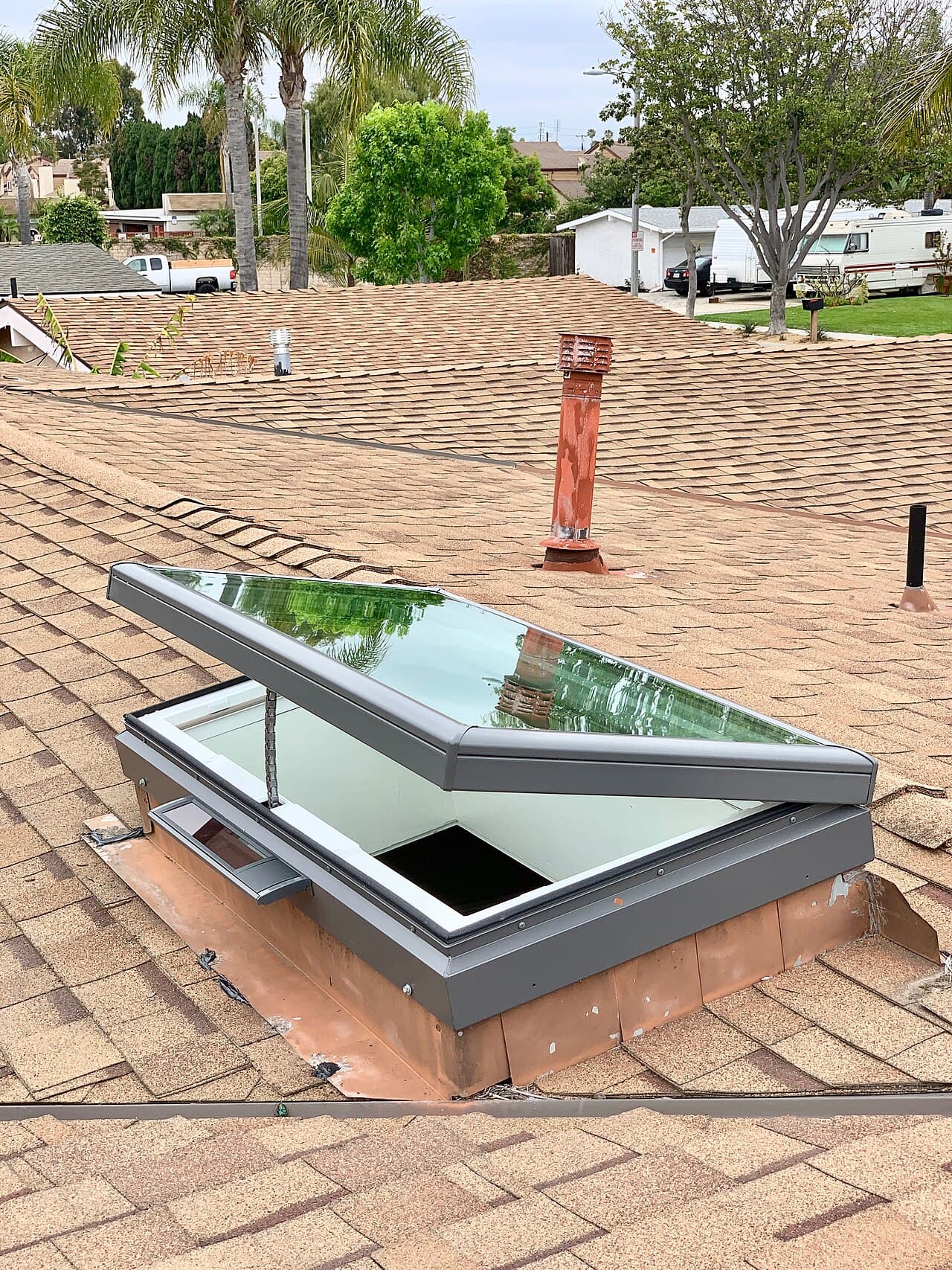
Re-flashing. This is the most common fix. Once the skylight is mounted, a flashing system is installed to protect the skylight from weather and water leaks.[1] VELUX describes its deck-mounted and curb-mounted flashing systems as adhesive underlayment and engineered flashing.[1] A repair means lifting the surrounding shingles, replacing the damaged flashing and underlayment, and shingling back in. For the flashing basics, read what roof flashing is.
Reworking the curb or surround. A curb-mounted skylight is attached to the top of a framed curb built onto the roof, which VELUX calls great for replacing older skylights and for flat or low-sloped roofs.[1] If the curb is rotted or the flashing was never installed correctly, the roofer may need to rebuild it.
Replacing a failed seal or part. Fogged or leaking glass units, worn gaskets and damaged sashes are sometimes replaced individually on newer skylights, depending on the manufacturer.
Replacing the skylight. VELUX lists mildew stains from moisture buildup, leaks or condensation around the panes among the signs that it is time to replace an old skylight.[4] VELUX says average skylights last 20 to 30 years,[4] so an old unit with a leak is often better replaced than patched. A single skylight replacement typically takes only a couple of hours, with the installer removing the existing skylight and flashing and fitting a new one.[4] If a reroof is coming, ask about replacing the skylight with the new roof.
Check warranties first
Before paying, look for coverage. VELUX says its warranty covers leaks that result from defects in materials or workmanship, and extends to the skylight's frame, flashing, seals and components.[2] It advises contacting your builder or installer first, who should inspect the skylight and verify that the installation follows its instructions.[2] If a roofer or installer worked on the skylight recently, they may owe you the repair.
Deal with the water inside
Fix the roof, but do not ignore the ceiling. The EPA says to dry water-damaged areas and items within 24 to 48 hours to prevent mold growth.[5] Wet insulation and drywall around the shaft should be dried or replaced.
When to call a licensed pro
For the repair itself, always. Working on a roof is dangerous and getting the layers right takes experience. Virginia defines roofing contracting as the installation, repair, removal or improvement of materials that form a watertight, weather resistant surface for roofs and decks.[6] DPOR says that if the work is valued at $1,000 or more, a valid Virginia contractor's licence is required for the licence category in which the contractor is to work.[7] A reroofing or replacement job often passes that line, and checking the licence takes a few minutes.
A skylight replacement that changes the framed opening can also need a permit: Virginia's building code requires a permit for installations or alterations involving any structural component.[8] Ask your local building office, and ask the contractor to state who pulls it.
Who to call and what it costs are covered in who to call for a roof leak and how much skylight repair costs in Virginia. Browse more roofing repair answers or roofing repair businesses.
When you are ready, describe the leak once and licensed local roofers send quotes or offer an inspection visit.
Common questions
- Will caulk or roofing cement stop a skylight leak?
- Only for a while, and it can hide the real source. VELUX describes its flashing systems as designed to shed water without relying on sealants that can break down over time. A roofer repairs the flashing and underlayment instead of smearing sealant over the leak.
- Is it condensation or a leak?
- Moisture on the inside of the glass on cold mornings is usually condensation, not a leak. VELUX advises ventilating 3 to 4 times daily, keeping indoor temperatures above 68°F and reducing humidity. Drips or stains after rain, or wet drywall around the shaft, point to a leak.
- Can a leaking skylight be repaired, or does it need replacing?
- Either. A failed flashing or seal on a newer unit can often be repaired. VELUX lists mildew stains from moisture buildup, leaks or condensation around the panes among the signs that it is time to replace an old skylight, and says average skylights last 20 to 30 years.
- Is the leak covered by a warranty?
- Possibly. VELUX says its warranty covers leaks that result from defects in materials or workmanship, and extends to the skylight's frame, flashing, seals and components. Check the manufacturer's warranty and your roofer's workmanship warranty before you pay for a repair.
- What should I do about the water damage inside?
- Catch drips, protect the floor and dry the area quickly. The EPA says to dry water-damaged areas and items within 24 to 48 hours to prevent mold growth. Have the ceiling and shaft checked once the leak is fixed.
Sources
- [1] Installation Type & Flashing Systems, VELUX America LLC. Checked October 26, 2026.
- [2] VELUX Skylights Warranty, VELUX America LLC. Checked October 26, 2026.
- [3] Installation Process, VELUX America LLC. Checked October 26, 2026.
- [4] Skylight FAQs, VELUX America LLC. Checked October 26, 2026.
- [5] A Brief Guide to Mold, Moisture and Your Home, U.S. Environmental Protection Agency. Checked October 26, 2026.
- [6] 18VAC50-22-30, Definitions of specialty services, Virginia Administrative Code, Board for Contractors. Checked October 26, 2026.
- [7] What You Should Know Before You Hire a Contractor, Virginia Board for Contractors, DPOR. Checked October 26, 2026.
- [8] 13VAC5-63-80, Virginia Uniform Statewide Building Code, Section 108 Application for permit, Virginia Administrative Code, Legislative Information System. Checked October 26, 2026.
Want a pro to handle it?
Describe the job once. Licensed local businesses send quotes, and you pay only when you book one.
Get a quote for Roofing